
Table of Contents
Wickham is a distinctive name with deep English roots, originally a surname that has transitioned into use as a given name. With its meaning rooted in pastoral landscapes, it evokes images of peaceful village life and natural settings. While not extremely common as a first name, it carries literary and historical significance that makes it memorable. This name offers a connection to English heritage while maintaining a unique, sophisticated sound.
Meaning of Wickham
The name Wickham has a clear and well-documented meaning derived from Old English linguistic elements. It combines ‘wic,’ which in Old English referred to a village, settlement, or dairy farm, with ‘ham,’ meaning homestead, enclosure, or meadow. This creates the composite meaning of ‘village meadow’ or ‘settlement by the dairy farm.’ The name is toponymic in nature, originally identifying people based on their geographic origin from places called Wickham. Several English villages bear this name, most notably Wickham in Hampshire, which was recorded as ‘Wicham’ in the Domesday Book of 1086. The ‘wic’ element itself has even older Germanic roots, related to the Latin ‘vicus’ meaning village.
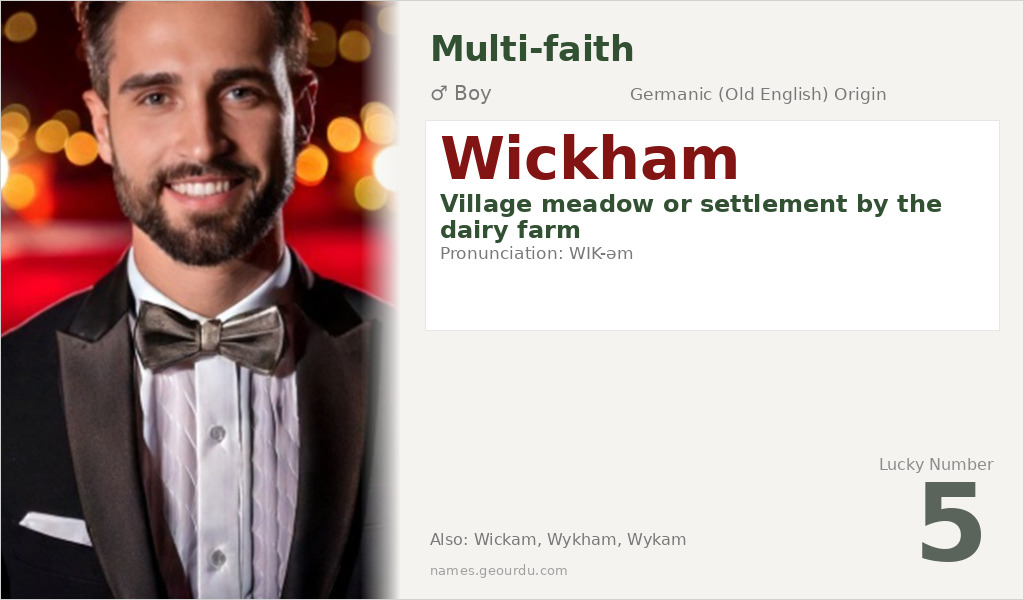
| 📛 Name | Wickham |
| 💎 Meaning | Village meadow or settlement by the dairy farm |
| 👤 Gender | Boy |
| 🕌 Religion | Multi-faith |
| 🌍 Origin | Germanic (Old English) |
| 🗣 Pronunciation | WIK-əm |
| ✍️ Urdu | وکہم |
| ✍️ Arabic | ويكهام |
| 🔢 Numerology | 5 |
| ✨ Spellings | Wickam, Wykham, Wykam |
Origin & Cultural Significance
Wickham originates from England as a locational surname that dates back to the medieval period. It was used to identify individuals who came from any of the various places named Wickham scattered across England. The name gained particular prominence through historical figures like William of Wickham (1324-1404), the influential Bishop of Winchester and founder of important educational institutions. In literature, Jane Austen immortalized the name through the character George Wickham in ‘Pride and Prejudice’ (1813). While traditionally a surname, Wickham has seen occasional use as a given name, particularly in English-speaking countries, though it remains relatively uncommon compared to its surname usage.
Personality Traits
Those named Wickham often project an image of sophistication and charm, perhaps influenced by the literary association with Jane Austen’s character. They tend to be socially adept individuals who navigate various situations with grace and adaptability. While they may possess natural leadership qualities and intellectual curiosity, they sometimes face perceptions based on the famous fictional namesake, requiring them to establish their own identity beyond literary preconceptions.
Similar Names
If you like Wickham, consider: Winston, Whitman, Wicklow, Wilham, Wick
Famous People Named Wickham
- George Wickham — Fictional character from Jane Austen's 'Pride and Prejudice', a charming but unscrupulous militia officer
- William of Wickham — 14th century English bishop and founder of Winchester College and New College, Oxford
Frequently Asked Questions About Wickham
What does Wickham mean?
Wickham means 'village meadow' or 'settlement by the dairy farm,' derived from the Old English words 'wic' (village/dairy farm) and 'ham' (homestead/meadow).
Is Wickham a boy or girl name?
Wickham is primarily used as a boy's name, though as a surname-origin name it could theoretically be used for any gender. Historically and in contemporary usage, it is overwhelmingly masculine.
What is the origin of Wickham?
Wickham originates from England as a locational surname derived from Old English. It refers to various places in England called Wickham and was used to identify people from those locations before becoming occasionally used as a given name.





