
Table of Contents
William is one of the most enduring and influential names in Western history, with roots stretching back to ancient Germanic warriors. From kings to literary giants, this name has been borne by figures who shaped nations and cultures. Its powerful meaning of ‘resolute protector’ continues to resonate with parents seeking a strong, classic name for their sons.
Meaning of William
The name William derives from the Old Germanic name ‘Willahelm’, composed of two elements: ‘wil’ meaning ‘will, desire, determination’ and ‘helm’ meaning ‘helmet, protection’. This combination creates the meaning ‘resolute protector’ or ‘determined guardian’. The name spread throughout Europe via the Normans, who brought the French form ‘Guillaume’ to England after 1066. In different languages, it evolved into variations like German ‘Wilhelm’, Italian ‘Guglielmo’, and Spanish ‘Guillermo’. The core meaning remains consistent across cultures, reflecting the protective warrior ideal valued in medieval Germanic society.
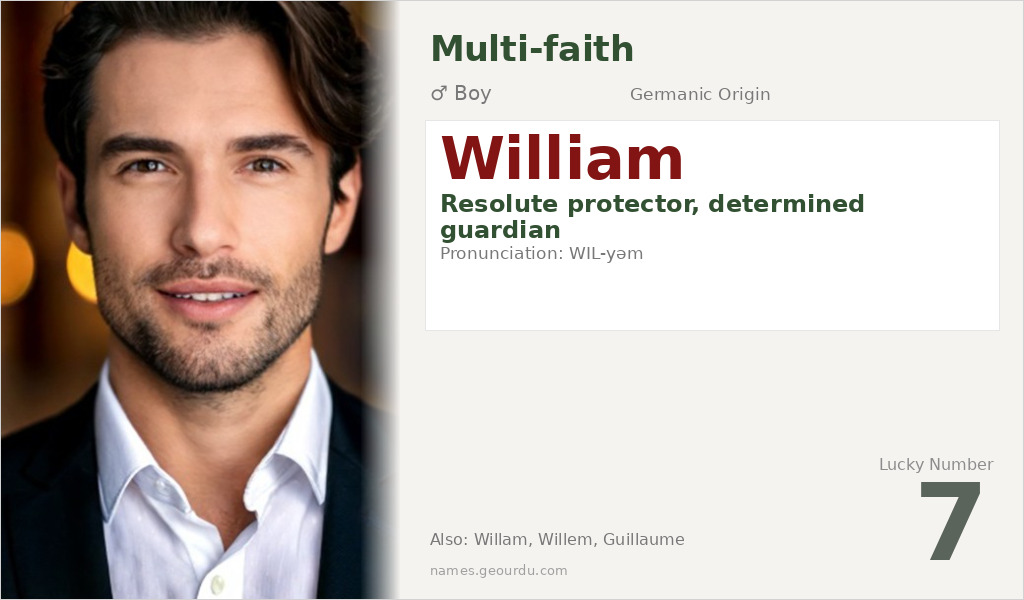
| 📛 Name | William |
| 💎 Meaning | Resolute protector, determined guardian |
| 👤 Gender | Boy |
| 🕌 Religion | Multi-faith |
| 🌍 Origin | Germanic |
| 🗣 Pronunciation | WIL-yəm |
| ✍️ Urdu | ولیم |
| ✍️ Arabic | ويليام |
| 🔢 Numerology | 7 |
| ✨ Spellings | Willam, Willem, Guillaume, Wilhelm, Guglielmo, Guillermo |
Origin & Cultural Significance
William has its origins in the Germanic tribes of early medieval Europe, particularly among the Franks and Normans. The name gained prominence with William the Conqueror, who established it as a royal name in England after 1066. Throughout the Middle Ages, it remained popular among nobility across Europe. The name’s widespread adoption in English-speaking countries was further cemented by literary figures like William Shakespeare. Today, William continues to be a top choice in many countries, maintaining its status as a classic while adapting to modern times through popular short forms like Will and Liam.
Personality Traits
The name William carries connotations of strength, reliability, and protective instincts. Those named William are often seen as natural leaders with strong determination and a sense of responsibility. The name’s historical association with kings and conquerors suggests ambition and capability, while its literary connections point to creativity and intelligence. These personality associations, while not deterministic, reflect the cultural weight this name has accumulated over centuries.
Similar Names
If you like William, consider: Wilhelm, Guillaume, Liam, Wilson, Wilfred
Famous People Named William
- William Shakespeare — English playwright and poet, widely regarded as the greatest writer in the English language
- William the Conqueror — First Norman King of England who led the Norman Conquest in 1066
Frequently Asked Questions About William
What does William mean?
William means 'resolute protector' or 'determined guardian', originating from the Germanic elements 'wil' (will, desire) and 'helm' (helmet, protection).
Is William a boy or girl name?
William is traditionally and overwhelmingly a masculine name, though feminine variations like Wilhelmina exist. In contemporary usage, it remains primarily a boy's name across all cultures where it is used.
What is the origin of William?
William originates from Old Germanic languages, specifically from the name 'Willahelm'. It entered English through Norman French after the 1066 Norman Conquest and has since spread worldwide.





