
Table of Contents
Yaakov is one of the most ancient and significant names in religious history, appearing as the patriarch Jacob in the Hebrew Bible. This Hebrew name carries deep theological and cultural weight across multiple faith traditions. From its Biblical origins to modern usage, Yaakov represents a connection to foundational religious narratives and enduring naming traditions.
Meaning of Yaakov
The name Yaakov derives from the Hebrew root עקב (ʿqb), which carries the dual meaning of ‘heel’ and ‘to follow or supplant.’ This etymology is directly tied to the Biblical story where Jacob is born grasping his twin brother Esau’s heel, and later supplants him by obtaining both his birthright and paternal blessing. The name appears in its original form as יעקב (Yaʿaqov) in the Torah, making it one of the oldest continuously used names in recorded history. Linguistically, it represents a common Hebrew naming pattern where names describe circumstances of birth or character traits. The meaning ‘he who supplants’ reflects both the literal birth story and the narrative arc of Jacob’s life in Genesis.
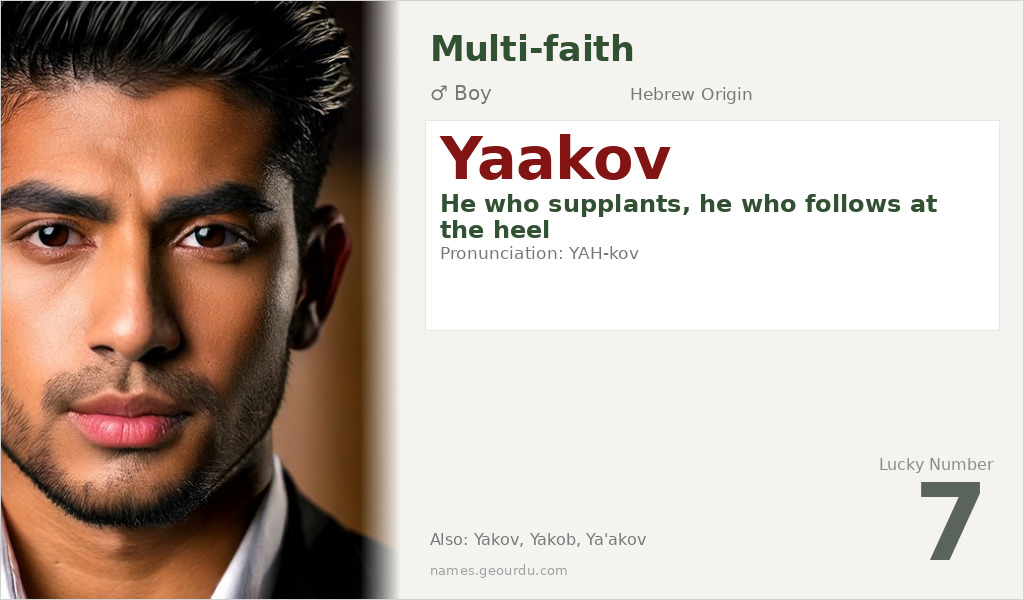
| 📛 Name | Yaakov |
| 💎 Meaning | He who supplants, he who follows at the heel |
| 👤 Gender | Boy |
| 🕌 Religion | Multi-faith |
| 🌍 Origin | Hebrew |
| 🗣 Pronunciation | YAH-kov |
| ✍️ Urdu | یعقوب |
| ✍️ Arabic | يعقوب |
| 🔢 Numerology | 7 |
| ✨ Spellings | Yakov, Yakob, Ya'akov, Jacob, Jakob, Iacob |
Origin & Cultural Significance
Yaakov originates from ancient Hebrew culture and appears in the Torah as the name of the third patriarch of the Israelites, son of Isaac and Rebecca, and father of the twelve tribes. The name has been used continuously in Jewish communities for over 3,000 years. While Christians adopted the name (typically as Jacob) through the Old Testament, and Muslims recognize Ya’qub as a prophet in the Quran, the name remains fundamentally Hebrew in origin and most closely associated with Jewish tradition. The name spread through religious texts and diaspora communities, with variations appearing in virtually every language that encountered Biblical traditions, from Greek (Iakobos) to Latin (Iacobus) to modern European forms.
Personality Traits
Those named Yaakov often embody characteristics associated with the Biblical Jacob: resilience, determination, and transformation. They tend to be strategic thinkers who pursue their goals with persistence and cleverness. The name suggests someone who can navigate complex situations and emerge transformed, much like Jacob who wrestled with an angel and became Israel. There’s often an intellectual and spiritual depth to individuals carrying this ancient name.
Similar Names
If you like Yaakov, consider: Jacob, Yitzhak, Avraham, Moshe, Yosef
Famous People Named Yaakov
- Yaakov Agam — Israeli sculptor and experimental artist known for kinetic art
- Yaakov Litzman — Israeli politician and former Minister of Health
Frequently Asked Questions About Yaakov
What does Yaakov mean?
Yaakov means 'he who supplants' or 'he who follows at the heel' in Hebrew, derived from the root עקב (ʿqb) meaning 'heel.'
Is Yaakov a boy or girl name?
Yaakov is exclusively a masculine name in its original Hebrew context and in all religious traditions that use it.
What is the origin of Yaakov?
Yaakov originates from ancient Hebrew culture and appears in the Torah as the name of the patriarch Jacob, making it one of the oldest continuously used names in religious history.





