
Table of Contents
Yamadoot is a profound name rooted in ancient Hindu mythology and Sanskrit language. Unlike common given names, it carries specific mythological significance as the designation for messengers of Yama, the god of death. This name offers a unique connection to Hindu cosmological concepts and spiritual traditions. While uncommon as a personal name today, it remains an important term in Hindu scriptures and philosophical discourse.
Meaning of Yamadoot
Yamadoot derives from classical Sanskrit, combining ‘Yama’ (यम), referring to the Hindu deity who presides over death and the afterlife, with ‘doot’ (दूत), meaning messenger or envoy. In Hindu cosmology, Yamadoots are not deities themselves but rather the attendants or emissaries of Yama who execute his commands, particularly in guiding souls after death. The term appears in foundational texts like the Mahabharata, Bhagavata Purana, and various Upanishads, where Yamadoots are described as fearsome beings who maintain cosmic justice. Linguistically, the name follows standard Sanskrit compound formation rules, creating a transparent meaning that has remained consistent for millennia.
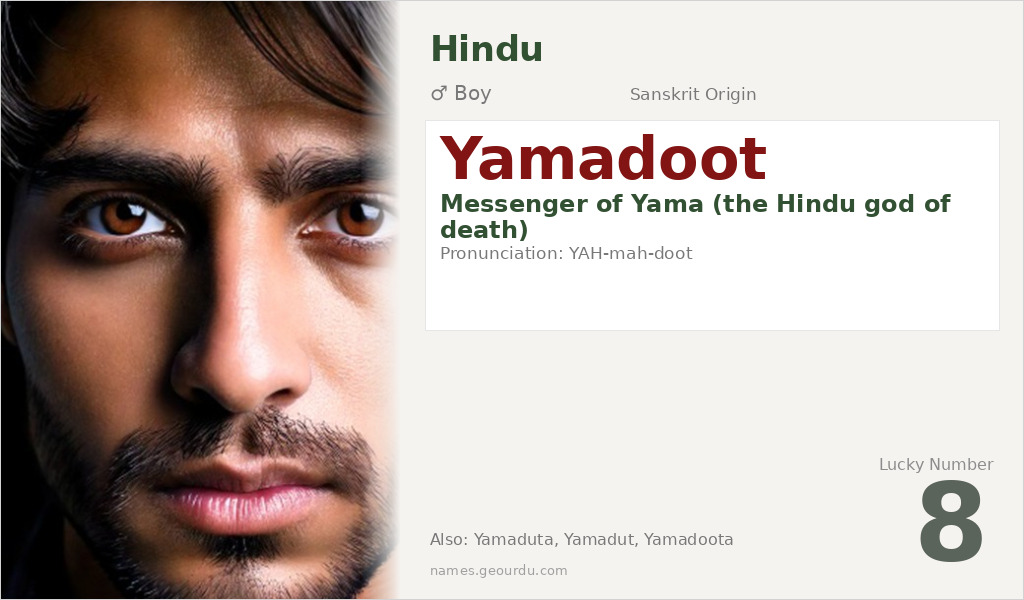
| 📛 Name | Yamadoot |
| 💎 Meaning | Messenger of Yama (the Hindu god of death) |
| 👤 Gender | Boy |
| 🕌 Religion | Hindu |
| 🌍 Origin | Sanskrit |
| 🗣 Pronunciation | YAH-mah-doot |
| ✍️ Urdu | یمدوت |
| ✍️ Arabic | يامادوت |
| 🔢 Numerology | 8 |
| ✨ Spellings | Yamaduta, Yamadut, Yamadoota |
Origin & Cultural Significance
Yamadoot originates from ancient Indian Sanskrit literature and Hindu religious texts dating back over two millennia. The concept emerges from Vedic and post-Vedic Hindu cosmology, where Yama evolved from a Vedic deity to the established lord of death in later Puranic traditions. As Yama’s role expanded in Hindu mythology, so did the need for intermediaries to carry out his duties, leading to the conceptualization of Yamadoots. The name reflects the sophisticated bureaucratic metaphor often present in Hindu cosmological descriptions, where even the afterlife has structured administration. While occasionally referenced in regional Indian languages through Sanskrit loanwords, the term remains fundamentally Sanskrit in origin and Hindu in cultural context.
Personality Traits
In Hindu naming tradition, names containing ‘Yama’ elements are typically associated with qualities of discipline, justice, and spiritual gravity. While Yamadoot is rarely used as a contemporary given name, its mythological associations suggest characteristics of duty, authority, and adherence to cosmic order. The name carries connotations of seriousness and responsibility, reflecting the weighty role of Yama’s messengers in Hindu eschatology. Parents considering this name would likely value its deep mythological roots and connection to Hindu philosophical concepts about life, death, and cosmic justice.
Similar Names
If you like Yamadoot, consider: Yamaraj, Yamuna, Doot, Devdoot, Narad
Famous People Named Yamadoot
- No notable contemporary figures found with this name – it is primarily a mythological/conceptual name in Hindu tradition
- In Hindu mythology: Various unnamed Yamadoots appear in scriptures as messengers of Yama
Frequently Asked Questions About Yamadoot
What does Yamadoot mean?
Yamadoot means 'Messenger of Yama' in Sanskrit, referring to the attendants or emissaries of Yama, the Hindu god of death.
Is Yamadoot a boy or girl name?
Yamadoot is exclusively a masculine name in Hindu tradition, as it refers to male mythological figures who serve as Yama's messengers.
What is the origin of Yamadoot?
Yamadoot originates from classical Sanskrit and Hindu mythology, appearing in ancient Indian scriptures like the Mahabharata and Puranas as a term for Yama's divine messengers.





