
Table of Contents
Yashovarman is a distinguished Sanskrit name with deep roots in Indian history and royal traditions. Meaning ‘one whose armor is fame’, this name carries connotations of honor, protection, and legacy. Historically borne by several Indian kings, Yashovarman represents the ideal of noble leadership where reputation serves as both shield and responsibility. Today, it remains a powerful choice for parents seeking a name with classical heritage and meaningful symbolism.
Meaning of Yashovarman
Yashovarman derives from two Sanskrit components: ‘Yashas’ (यशस्) meaning fame, glory, or renown, and ‘Varman’ (वर्मन्) meaning armor, protection, or shield. The compound literally translates to ‘one who has fame as armor’ or ‘protected by glory’. In Sanskrit linguistics, ‘Varman’ is a common suffix in names of the Kshatriya (warrior) class, indicating defensive qualities or protective authority. This naming pattern appears frequently in historical Indian royalty, where names like Chandragupta (‘protected by the moon’) and Samudragupta (‘protected by the ocean’) follow similar construction. The concept suggests that one’s reputation and honor serve as their ultimate protection in life.
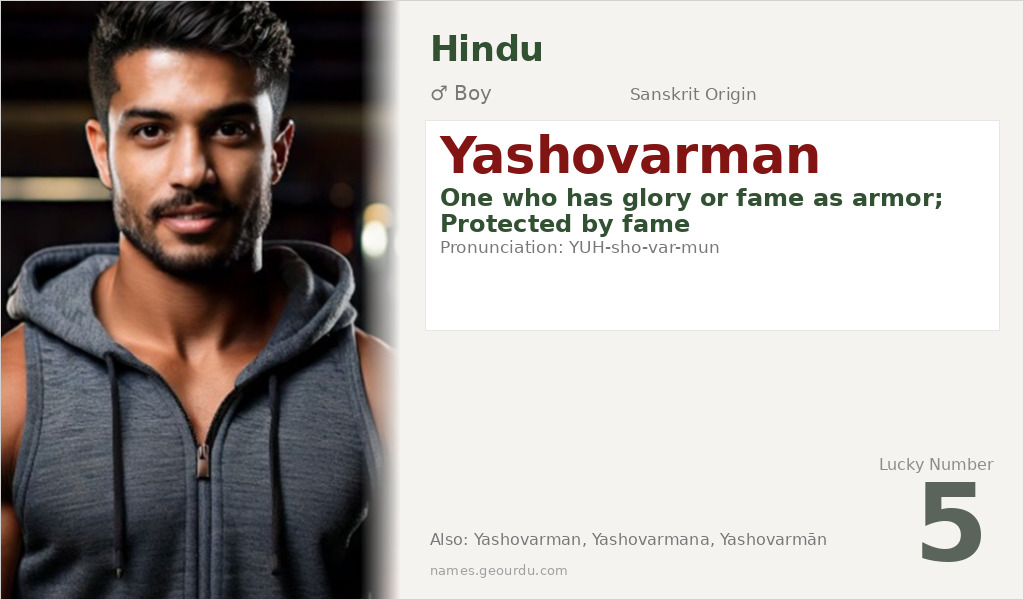
| 📛 Name | Yashovarman |
| 💎 Meaning | One who has glory or fame as armor; Protected by fame |
| 👤 Gender | Boy |
| 🕌 Religion | Hindu |
| 🌍 Origin | Sanskrit |
| 🗣 Pronunciation | YUH-sho-var-mun |
| ✍️ Urdu | یشوورمن |
| ✍️ Arabic | ياشوفارمان |
| 🔢 Numerology | 5 |
| ✨ Spellings | Yashovarman, Yashovarmana, Yashovarmān |
Origin & Cultural Significance
Yashovarman originates from classical Sanskrit, the liturgical language of Hinduism and historical Indian scholarship. The name appears in ancient Indian texts and inscriptions, most notably associated with Yashovarman of Kannauj (8th century CE), who ruled a significant kingdom in northern India. This naming tradition reflects the Kshatriya (warrior-ruler) class values where names often incorporated ‘Varman’ to denote protective qualities. The name spread through Sanskrit literature and royal lineages across the Indian subcontinent, with variations appearing in regional languages. While primarily associated with Hindu tradition due to its Sanskrit origins, the name carries cultural rather than strictly religious significance, representing ideals of noble leadership.
Personality Traits
Those named Yashovarman are often perceived as natural leaders with a strong sense of honor and responsibility. The name’s meaning suggests someone who values reputation and legacy, potentially driving them toward achievements that bring respect and recognition. Their protective nature, implied by the ‘Varman’ component, may manifest as loyalty to family and community, with a tendency to shield others from harm. These individuals often balance ambition with ethical considerations, understanding that true glory comes from righteous actions.
Similar Names
If you like Yashovarman, consider: Yashwant, Vikramaditya, Chandragupta, Samudragupta, Rajavarman
Famous People Named Yashovarman
- Yashovarman (c. 725–752 CE) — King of the Kannauj kingdom in northern India, known for his military campaigns and patronage of literature
- Yashovarman of Kashmir — 14th century ruler mentioned in Rajatarangini, the chronicle of Kashmiri kings
Frequently Asked Questions About Yashovarman
What does Yashovarman mean?
Yashovarman means 'one who has fame as armor' or 'protected by glory' in Sanskrit. It combines 'Yashas' (fame) and 'Varman' (armor/protection).
Is Yashovarman a boy or girl name?
Yashovarman is exclusively a boy's name in Sanskrit naming traditions. The '-varman' suffix is historically masculine and associated with warrior-ruler classes in Indian culture.
What is the origin of Yashovarman?
Yashovarman originates from classical Sanskrit, the ancient Indian language. It follows royal naming patterns from historical Indian kingdoms, particularly associated with the Kshatriya (warrior) class tradition.





