
Table of Contents
Yavanan is a distinctive Sanskrit name with fascinating historical roots that trace back to ancient cultural exchanges between India and the Hellenistic world. Unlike many traditional Hindu names, Yavanan carries a specific geographical and cultural meaning rather than spiritual or divine connotations. This name offers a unique connection to India’s historical interactions with foreign civilizations, particularly the Greeks who settled in northwestern regions after Alexander’s campaigns. Choosing Yavanan connects a child to this rich cross-cultural heritage.
Meaning of Yavanan
Yavanan derives from the Sanskrit word ‘Yavana’ (यवन), which originally referred to Ionian Greeks and later became a general term for foreigners from the West. The etymology traces through Old Persian ‘Yauna’, demonstrating how linguistic terms traveled along ancient trade and conquest routes. In Sanskrit literature, including works like the Mahabharata and various Puranas, Yavana/Yavanan specifically denotes Greek settlers, soldiers, and rulers in post-Alexandrian India. The name’s meaning evolved from specifically ‘Ionian Greek’ to more broadly ‘foreigner from the West’, reflecting changing historical contexts while maintaining its core association with Western peoples.
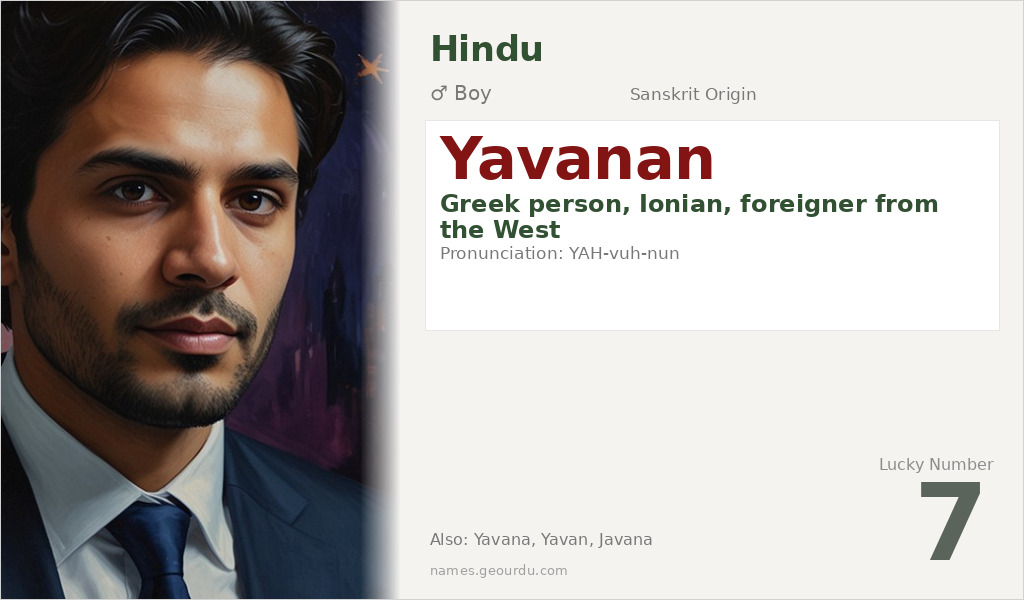
| 📛 Name | Yavanan |
| 💎 Meaning | Greek person, Ionian, foreigner from the West |
| 👤 Gender | Boy |
| 🕌 Religion | Hindu |
| 🌍 Origin | Sanskrit |
| 🗣 Pronunciation | YAH-vuh-nun |
| ✍️ Urdu | یونان |
| ✍️ Arabic | يونان |
| 🔢 Numerology | 7 |
| ✨ Spellings | Yavana, Yavan, Javana |
Origin & Cultural Significance
The name Yavanan originates from ancient Sanskrit, entering the language through Persian intermediaries during the Achaemenid Empire period. Historically, it gained prominence during the Indo-Greek period (2nd century BCE to 1st century CE) when Greek-speaking rulers governed parts of northwestern India. In Hindu tradition, the name appears in various texts describing foreign interactions, trade, and cultural exchanges. While not as common as purely indigenous Sanskrit names, Yavanan represents an important historical category in Indian civilization’s engagement with the wider world, particularly the Hellenistic sphere.
Personality Traits
Those named Yavanan often exhibit traits of cultural adaptability and intellectual curiosity, mirroring the name’s historical association with cross-cultural exchange. They may demonstrate openness to new ideas while maintaining respect for tradition, embodying the balance between indigenous and foreign influences. The name suggests someone who bridges different worlds or perspectives, potentially excelling in fields requiring cultural sensitivity or international understanding.
Similar Names
If you like Yavanan, consider: Yavan, Yavindra, Yadu, Yash, Yogesh
Famous People Named Yavanan
- Yavanan (historical) — Term used in ancient Indian texts for Greek settlers and rulers in northwestern India
- Yavanan (literary) — Appears in Sanskrit dramas and epics as characters representing foreign merchants or travelers
Frequently Asked Questions About Yavanan
What does Yavanan mean?
Yavanan means 'Greek person', 'Ionian', or 'foreigner from the West' in Sanskrit, derived from Old Persian 'Yauna' referring to Ionian Greeks.
Is Yavanan a boy or girl name?
Yavanan is traditionally a masculine name in Hindu naming conventions, though its usage is relatively uncommon in modern times.
What is the origin of Yavanan?
Yavanan originates from Sanskrit, entering the language through Persian, with historical roots in ancient India's interactions with Greek settlers and Western foreigners.





