
Table of Contents
Yehuda is one of the most historically significant names in Western civilization, carrying millennia of religious and cultural heritage. This ancient Hebrew name, meaning ‘praise’ or ‘thanksgiving,’ has been borne by biblical patriarchs, kings, poets, and scholars throughout Jewish history. While commonly known in English as Judah, the original Yehuda form maintains its authentic pronunciation and deep spiritual resonance. Today, it remains a powerful choice for parents seeking a name with profound meaning and historical depth.
Meaning of Yehuda
Yehuda derives from the Hebrew verb ‘yadah’ (יָדָה), which means ‘to praise, give thanks, or acknowledge.’ This etymology is explicitly documented in the Book of Genesis (29:35), where Leah names her fourth son Yehuda, declaring ‘This time I will praise the Lord.’ The name’s meaning of ‘praise’ or ‘thanksgiving’ reflects a direct acknowledgment of divine grace. Linguistically, Yehuda is constructed from the root Y-D-H, which appears throughout Hebrew scripture in contexts of gratitude and worship. The name’s significance extends beyond mere vocabulary to embody a fundamental religious concept in Judaism—the importance of recognizing and praising God’s blessings.
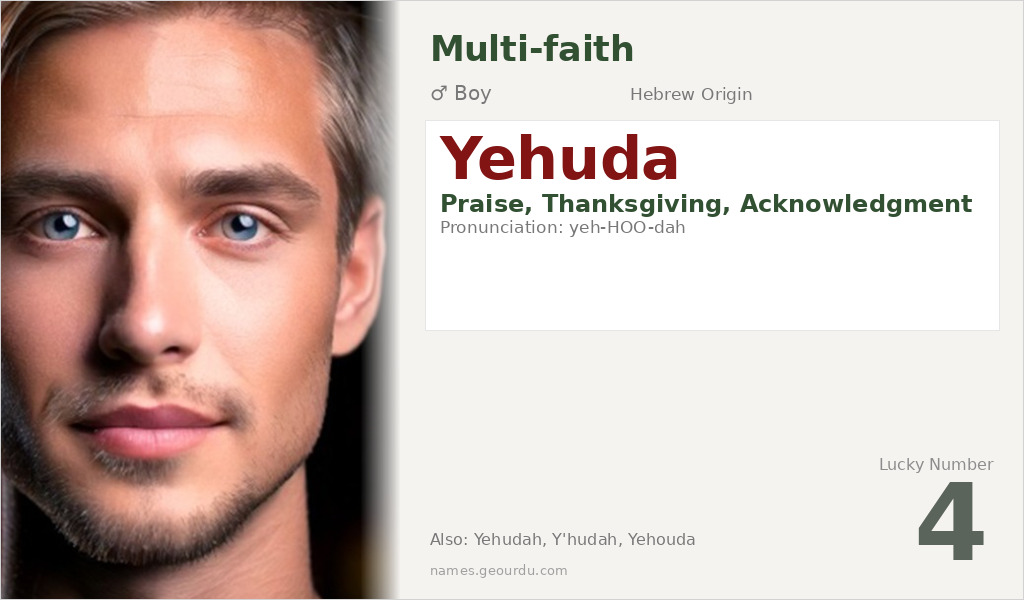
| 📛 Name | Yehuda |
| 💎 Meaning | Praise, Thanksgiving, Acknowledgment |
| 👤 Gender | Boy |
| 🕌 Religion | Multi-faith |
| 🌍 Origin | Hebrew |
| 🗣 Pronunciation | yeh-HOO-dah |
| ✍️ Urdu | یہودا |
| ✍️ Arabic | يهوذا |
| 🔢 Numerology | 4 |
| ✨ Spellings | Yehudah, Y'hudah, Yehouda |
Origin & Cultural Significance
Yehuda originates from ancient Hebrew and first appears in the Torah as the name of Judah, the fourth son of Jacob and Leah. This biblical patriarch became the ancestor of the Tribe of Judah, which eventually formed the Kingdom of Judah in the southern part of ancient Israel. The name’s historical importance cannot be overstated—it gave rise to the terms ‘Jew’ and ‘Judaism,’ as members of the Kingdom of Judah became known as Yehudim (Jews). While the name has been adopted by Christians (particularly in forms like Judah and Jude), its primary cultural and religious context remains deeply rooted in Jewish tradition, history, and identity spanning over three millennia.
Personality Traits
Those named Yehuda often embody the qualities suggested by their name’s meaning—they tend to be appreciative, expressive, and value recognition in relationships. The name’s association with leadership (through the Tribe of Judah and King David’s lineage) suggests natural authority and responsibility. Many Yehudas develop strong connections to their heritage and traditions, reflecting the name’s deep historical roots. Their personality often combines gratitude with strength, creating individuals who acknowledge blessings while demonstrating resilience.
Similar Names
If you like Yehuda, consider: Judah, Jude, Judas, Yehudit, Yehiel
Famous People Named Yehuda
- Yehuda Halevi — 12th-century Spanish Jewish physician, poet and philosopher
- Yehuda Amichai — 20th-century Israeli poet considered Israel's national poet
Frequently Asked Questions About Yehuda
What does Yehuda mean?
Yehuda means 'praise,' 'thanksgiving,' or 'acknowledgment' in Hebrew. The meaning comes from the Hebrew verb 'yadah' (to praise) and is documented in the Book of Genesis.
Is Yehuda a boy or girl name?
Yehuda is exclusively a boy's name in its original Hebrew context. The feminine equivalent is Yehudit. While some names become unisex over time, Yehuda maintains strong masculine associations in Jewish tradition.
What is the origin of Yehuda?
Yehuda originates from ancient Hebrew and first appears in the Hebrew Bible/Tanakh as the name of Judah, son of Jacob and Leah. It is fundamentally a Jewish name with over 3,000 years of continuous use in Jewish communities worldwide.





