
Table of Contents
Zacharias is a timeless name with deep biblical roots that has resonated across centuries and cultures. Derived from the Hebrew Zechariah, this name carries the profound meaning ‘Yahweh has remembered,’ reflecting divine faithfulness and covenant. While most commonly associated with Christian traditions through the New Testament figure of Zacharias, father of John the Baptist, this name also appears in Jewish scripture and Islamic tradition as Zakariya. Its enduring appeal lies in its strong theological significance and classic sound that bridges ancient heritage with modern usage.
Meaning of Zacharias
The name Zacharias originates from the Hebrew name Zechariah (זְכַרְיָה), which is composed of two Hebrew elements: ‘zakar’ (זָכַר) meaning ‘to remember’ and ‘Yah’ (יָהּ), a contraction of Yahweh, the personal name of God in the Hebrew Bible. Thus, the name literally translates to ‘Yahweh has remembered’ or ‘God has remembered.’ This meaning carries significant theological weight in Abrahamic traditions, emphasizing God’s faithfulness to His promises and people. The Greek form Zacharias (Ζαχαρίας) appears in the New Testament, while the Arabic form Zakariya (زكريا) is mentioned in the Quran as a prophet. The name’s meaning remains consistent across these linguistic variations, maintaining its core message of divine remembrance and covenant relationship.
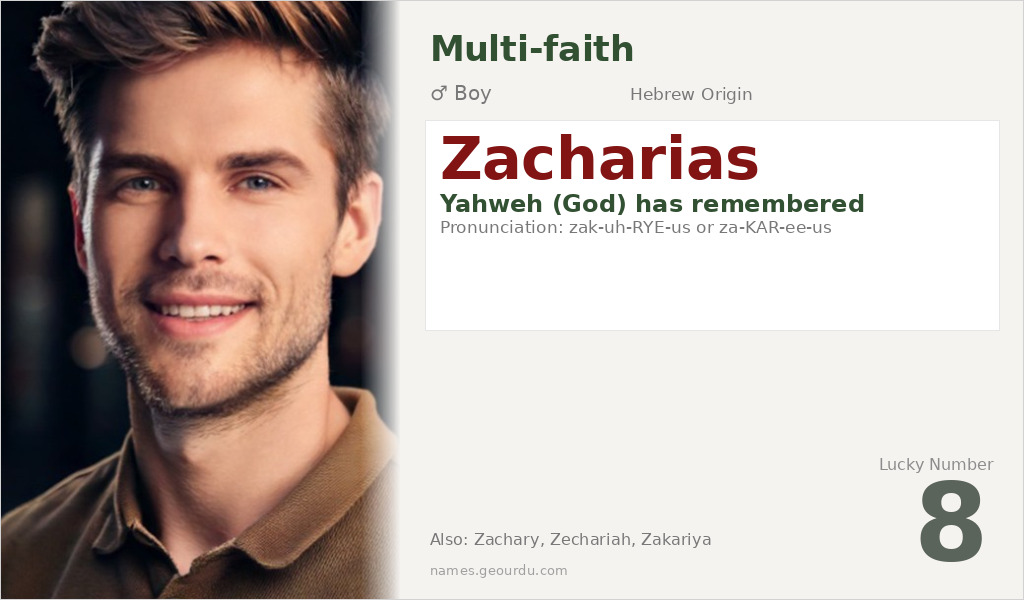
| 📛 Name | Zacharias |
| 💎 Meaning | Yahweh (God) has remembered |
| 👤 Gender | Boy |
| 🕌 Religion | Multi-faith |
| 🌍 Origin | Hebrew |
| 🗣 Pronunciation | zak-uh-RYE-us or za-KAR-ee-us |
| ✍️ Urdu | زکریا |
| ✍️ Arabic | زكريا |
| 🔢 Numerology | 8 |
| ✨ Spellings | Zachary, Zechariah, Zakariya, Zachariah, Zakary, Zakaria |
Origin & Cultural Significance
Zacharias has its origins in ancient Hebrew culture and appears prominently in the Hebrew Bible as the prophet Zechariah, author of one of the twelve minor prophetic books. The name gained particular significance in Christian tradition through Zacharias, the priest and father of John the Baptist in the Gospel of Luke. In Islamic tradition, the prophet Zakariya (the Arabic equivalent) is revered as the father of Yahya (John the Baptist) and is mentioned multiple times in the Quran. The name spread throughout Europe via Greek and Latin translations of the Bible, with variations developing in different languages. While particularly popular in Christian communities, its usage extends to Jewish and Muslim contexts as well, making it a truly multi-faith name with shared Abrahamic heritage.
Personality Traits
Those named Zacharias often embody qualities of faithfulness, wisdom, and introspection. The name’s meaning suggests someone who values memory, tradition, and spiritual connection, potentially influencing a personality that is both reflective and principled. Many Zachariases are drawn to intellectual or spiritual pursuits, with a natural inclination toward leadership roles that require moral clarity and historical perspective. Their name’s biblical heritage often contributes to a sense of purpose and connection to something greater than themselves.
Similar Names
If you like Zacharias, consider: Zachary, Zechariah, Zakariya, Isaiah, Jeremiah, Malachi
Famous People Named Zacharias
- Zacharias Janssen — Dutch spectacle-maker credited with inventing the first compound microscope in the late 16th century
- Zacharias Topelius — Finnish author and journalist known as one of Finland's most significant 19th-century writers
Frequently Asked Questions About Zacharias
What does Zacharias mean?
Zacharias means 'Yahweh has remembered' or 'God has remembered,' originating from the Hebrew name Zechariah, composed of 'zakar' (to remember) and 'Yah' (short for Yahweh).
Is Zacharias a boy or girl name?
Zacharias is exclusively a masculine name across all cultural and religious contexts where it appears, from its Hebrew origins to its usage in Christian, Jewish, and Islamic traditions.
What is the origin of Zacharias?
Zacharias originates from Hebrew, specifically from the name Zechariah in the Hebrew Bible. It entered Christian tradition through Greek translation of the New Testament and appears in Islamic tradition as Zakariya in the Quran.





