Table of Contents
Zainab is a timeless Arabic name that has graced generations with its melodic sound and beautiful meaning. Derived from the Arabic word for ‘fragrant flower’ or ‘adornment,’ this name carries both natural elegance and cultural significance. Popular across the Muslim world and beyond, Zainab connects bearers to a rich historical legacy while maintaining contemporary appeal. Its enduring popularity speaks to its universal beauty and meaningful origins.
Meaning of Zainab
The name Zainab originates from classical Arabic, specifically from the root ز-ي-ن (z-y-n), which conveys concepts of beauty, adornment, and ornamentation. Linguistically, Zainab refers to a type of fragrant flowering plant that grows in desert regions, often described as having sweet-smelling blossoms. This botanical reference gives the name its primary meaning of ‘fragrant flower.’ The name appears in pre-Islamic Arabic poetry and was well-established before the advent of Islam. Throughout Islamic history, the name gained additional cultural significance through important historical figures, though its linguistic meaning remains firmly rooted in its Arabic etymology as a descriptor of natural beauty and fragrance.
| 📛 Name | Zainab |
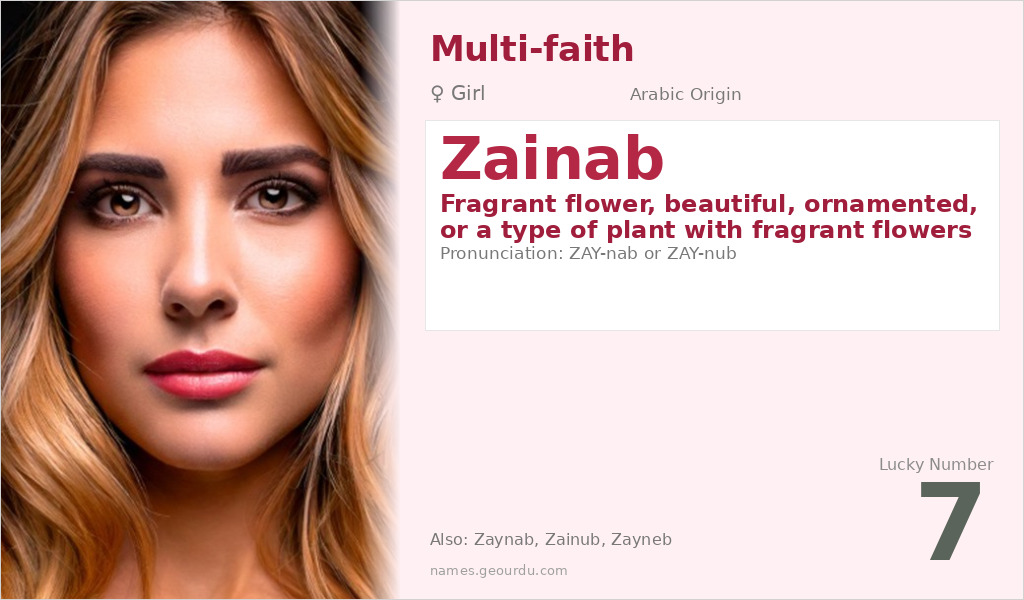
| 💎 Meaning | Fragrant flower, beautiful, ornamented, or a type of plant with fragrant flowers |
| 👤 Gender | Girl |
| 🕌 Religion | Multi-faith |
| 🌍 Origin | Arabic |
| 🗣 Pronunciation | ZAY-nab or ZAY-nub |
| ✍️ Urdu | زینب |
| ✍️ Arabic | زينب |
| 🔢 Numerology | 7 |
| ✨ Spellings | Zaynab, Zainub, Zayneb, Zeynab, Zeynep |
Origin & Cultural Significance
Zainab has deep roots in Arabic culture, dating back to pre-Islamic times when it was used in classical Arabic poetry. The name gained prominence in early Islamic history through Zainab bint Muhammad, the daughter of Prophet Muhammad, and Zainab bint Ali, his granddaughter. While particularly popular in Muslim communities worldwide, the name is also used by Arabic-speaking Christians and has spread to various cultures through Islamic influence. In Turkey, the variant ‘Zeynep’ is extremely popular, while Persian and Urdu-speaking regions use ‘Zainab’ extensively. The name’s cross-cultural appeal stems from its beautiful meaning and historical significance rather than exclusively religious associations.
Personality Traits
Those named Zainab are often associated with grace, compassion, and inner strength. The name’s connection to fragrant flowers suggests someone with natural elegance and a soothing presence. Historically, bearers of this name have been known for their resilience and devotion to family and faith. In contemporary contexts, Zainab suggests someone with traditional values balanced with modern sensibility, often displaying both emotional depth and practical wisdom.
Similar Names
If you like Zainab, consider: Zahara, Zahra, Yasmin, Layla, Aisha
Famous People Named Zainab
- Zainab bint Muhammad — Daughter of Prophet Muhammad and Khadijah, important figure in early Islamic history
- Zainab al-Ghazali — Egyptian Islamic activist and writer, founder of the Muslim Women's Association
Frequently Asked Questions About Zainab
What does Zainab mean?
Zainab means 'fragrant flower' or 'beautiful ornament' in Arabic, derived from the root ز-ي-ن (z-y-n) meaning beauty and adornment.
Is Zainab a boy or girl name?
Zainab is exclusively a feminine name in all cultures where it is used, with no masculine variants in its linguistic history.
What is the origin of Zainab?
Zainab originates from classical Arabic language and culture, with documented usage dating back to pre-Islamic Arabian poetry and early Islamic history.