
Table of Contents
Zaurashtra is a rare and intriguing name that appears to be a variant of Zarathustra, the ancient prophet of Zoroastrianism. While not commonly used, it carries deep historical and spiritual connotations. This name sparks curiosity due to its connection to one of the world’s oldest monotheistic religions. Understanding its roots requires delving into Iranian linguistics and religious history.
Meaning of Zaurashtra
The name Zaurashtra is best understood as a probable variant or corruption of ‘Zarathustra,’ the Avestan name for the prophet Zoroaster. In Avestan, ‘Zarathustra’ is traditionally broken down into ‘zarant’ (meaning ‘golden’ or ‘old’) and ‘ushtra’ (meaning ‘camel’), often interpreted as ‘owner of golden camels’ or ‘one who possesses old camels.’ However, modern scholarship sometimes debates this etymology, with alternative suggestions linking it to roots meaning ‘driving camels’ or other interpretations. The specific spelling ‘Zaurashtra’ is not documented in standard Persian, Pashto, Balochi, or other Iranian language references, indicating it may be a regional or phonetic adaptation. Its usage appears limited, and no independent meaning exists for this exact form outside its connection to Zarathustra.
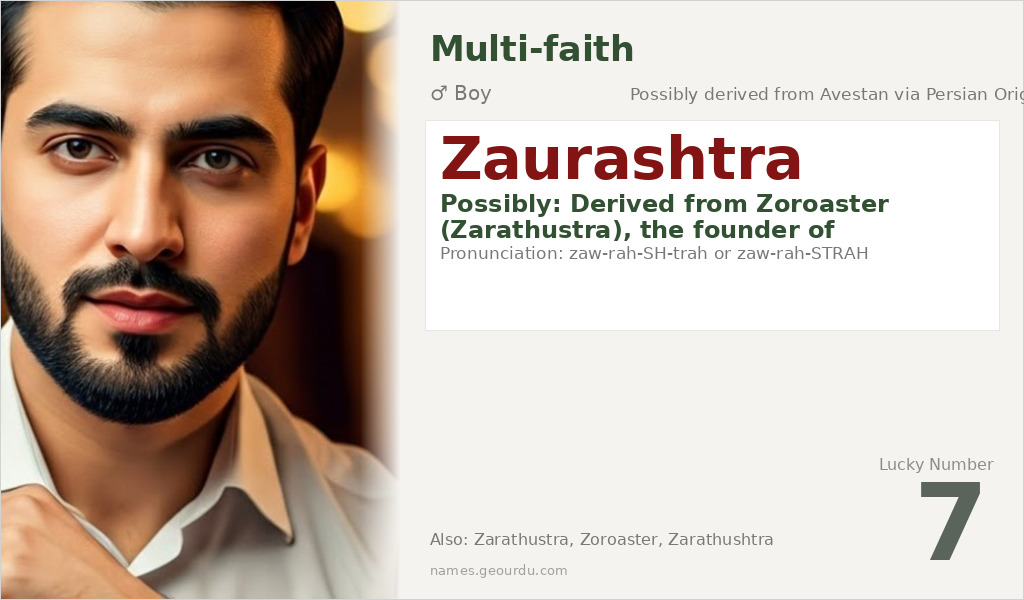
| 📛 Name | Zaurashtra |
| 💎 Meaning | Possibly: Derived from Zoroaster (Zarathustra), the founder of Zoroastrianism |
| 👤 Gender | Boy |
| 🕌 Religion | Multi-faith |
| 🌍 Origin | Possibly derived from Avestan via Persian |
| 🗣 Pronunciation | zaw-rah-SH-trah or zaw-rah-STRAH |
| ✍️ Urdu | زاراسٹرا |
| ✍️ Arabic | زاراسثرا |
| 🔢 Numerology | 7 |
| ✨ Spellings | Zarathustra, Zoroaster, Zarathushtra, Zaratushtra |
Origin & Cultural Significance
Zaurashtra traces its origins to ancient Iranian culture, specifically to Zoroastrianism, a religion founded by the prophet Zarathustra (Zoroaster) in ancient Persia (modern-day Iran). Zoroastrianism dates back to the 2nd millennium BCE and has influenced Abrahamic religions. The name Zarathustra spread through Persian empires and later into South Asia via trade and migration, where it might have been adapted into forms like Zaurashtra. In regions like India and Pakistan, Zoroastrian communities (Parsis) have preserved related names, but ‘Zaurashtra’ itself is not a standard Parsi name. Its appearance in naming contexts could stem from phonetic renderings or creative adaptations, lacking a strong traditional basis in Hindu or other religious traditions.
Personality Traits
Given its association with Zarathustra, a name like Zaurashtra might evoke traits of wisdom, spirituality, and moral leadership. Historically, Zoroaster emphasized concepts like good thoughts, good words, and good deeds, which could symbolically influence perceptions of bearers. However, as a rare name, any personality attributes are largely speculative and based on its etymological roots rather than common usage. Parents choosing this name may value its historical depth and unique sound.
Similar Names
If you like Zaurashtra, consider: Zarathustra, Zoroaster, Zarina, Zaur, Zahra
Famous People Named Zaurashtra
- Zarathustra (Zoroaster) — Ancient Iranian prophet and founder of Zoroastrianism, lived circa 1500-1000 BCE
- Friedrich Nietzsche — German philosopher who wrote 'Thus Spoke Zarathustra' (though not a person named Zaurashtra)
Frequently Asked Questions About Zaurashtra
What does Zaurashtra mean?
Zaurashtra likely derives from Zarathustra (Zoroaster), meaning 'owner of golden camels' in Avestan, but this specific spelling's meaning is unverified.
Is Zaurashtra a boy or girl name?
It is traditionally a boy's name, based on its origin from the male prophet Zarathustra.
What is the origin of Zaurashtra?
It originates from ancient Iranian culture, specifically from the name Zarathustra, the prophet of Zoroastrianism, possibly adapted in regional contexts.





