
Table of Contents
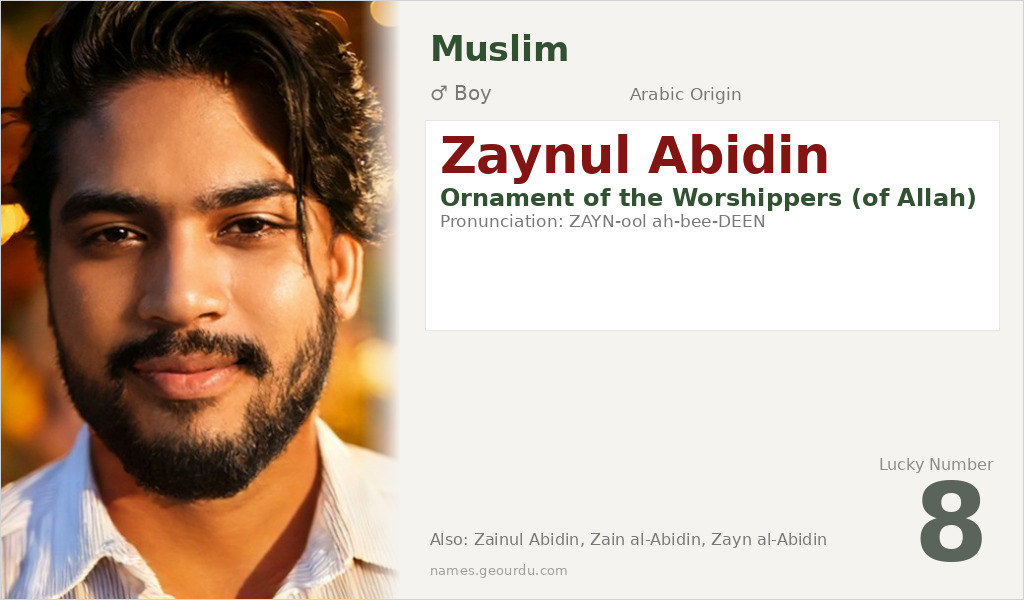
Zaynul Abidin is a profoundly meaningful Arabic name that carries significant weight in Islamic tradition. Literally translating to ‘Ornament of the Worshippers’, this name embodies spiritual devotion and religious commitment. Most famously associated with Ali ibn Husayn, the fourth Imam in Shia Islam, Zaynul Abidin represents piety, scholarship, and resilience. This guide explores the name’s rich etymology, cultural context, and enduring legacy.
Meaning of Zaynul Abidin
Zaynul Abidin is a compound Arabic name with clear linguistic components. ‘Zayn’ (زين) derives from the Arabic root Z-Y-N (ز ي ن), meaning beauty, adornment, or ornamentation. ‘Al’ (ال) is the definite article ‘the’. ‘Abidin’ (عابدين) comes from the root ‘-B-D (ع ب د), meaning to worship or serve, specifically in reference to worshipping Allah. The plural form ‘Abidin’ refers to ‘worshippers’ collectively. Thus, the complete name translates precisely to ‘Ornament of the Worshippers’. This construction follows classical Arabic naming patterns where ‘Zayn’ (ornament) is attributed to a noble group, in this case, those devoted to worship. The name appears in historical Islamic texts and continues in usage across Arabic-speaking and Muslim communities worldwide.
| 📛 Name | Zaynul Abidin |
| 💎 Meaning | Ornament of the Worshippers (of Allah) |
| 👤 Gender | Boy |
| 🕌 Religion | Muslim |
| 🌍 Origin | Arabic |
| 🗣 Pronunciation | ZAYN-ool ah-bee-DEEN |
| ✍️ Urdu | زین العابدین |
| ✍️ Arabic | زين العابدين |
| 🔢 Numerology | 8 |
| ✨ Spellings | Zainul Abidin, Zain al-Abidin, Zayn al-Abidin, Zainul Abideen |
Origin & Cultural Significance
Zaynul Abidin originates from classical Arabic and holds particular importance in Islamic history and theology. The name gained prominence through Ali ibn Husayn (659-713 CE), grandson of Prophet Muhammad, who was given the honorific title Zayn al-Abidin for his exceptional devotion and piety. In Twelver Shia Islam, he is recognized as the fourth Imam, while Sunni tradition reveres him as a respected scholar and descendant of the Prophet. The name spread through the Muslim world via religious scholarship, poetry, and cultural exchange, maintaining its Arabic linguistic roots without significant adaptation in Persian, Urdu, or other Islamic languages. Unlike some names that evolve across regions, Zaynul Abidin has remained remarkably consistent in form and meaning across centuries of use.
Personality Traits
Those named Zaynul Abidin are often associated with qualities of devotion, introspection, and steadfastness. The name’s meaning suggests someone who enhances or beautifies the community of believers through their actions and character. Historically, namesakes like Imam Zayn al-Abidin exemplified patience, scholarship, and spiritual depth—traits that continue to influence perceptions of this name today. While individual personalities vary, the name carries expectations of religious commitment and moral integrity.
Similar Names
If you like Zaynul Abidin, consider: Zayn, Zain, Abidin, Abdullah, Mohammed, Ali, Hassan, Hussein
Famous People Named Zaynul Abidin
- Ali ibn Husayn Zayn al-Abidin — Fourth Imam in Twelver Shia Islam, known for his piety and scholarly works including Al-Sahifa al-Sajjadiyya
- Zainul Abedin — Renowned Bangladeshi painter (1914-1976), considered the founding father of Bangladeshi modern art
Frequently Asked Questions About Zaynul Abidin
What does Zaynul Abidin mean?
Zaynul Abidin means 'Ornament of the Worshippers' in Arabic. It combines 'Zayn' (ornament) with 'Abidin' (worshippers), specifically referring to devotees of Allah.
Is Zaynul Abidin a boy or girl name?
Zaynul Abidin is exclusively a boy's name in Arabic and Islamic naming traditions. There is no feminine equivalent in common usage.
What is the origin of Zaynul Abidin?
Zaynul Abidin originates from classical Arabic and holds special significance in Islamic history, particularly through Ali ibn Husayn, the fourth Imam in Shia tradition who bore this title.





