
Table of Contents
Zulqurnayn is a profoundly significant Arabic name with direct Quranic origins that carries centuries of Islamic heritage. Unlike many modern names, this appellation appears explicitly in the Holy Quran, giving it special religious importance for Muslim families. The name evokes images of leadership, righteousness, and historical journeys that have inspired generations. Choosing Zulqurnayn connects a child to one of the most discussed figures in Islamic scripture.
Meaning of Zulqurnayn
Zulqurnayn derives from classical Arabic, combining ‘Dhū’ (ذو), meaning ‘possessor of’ or ‘owner of’, with ‘al-Qarnayn’ (القرنين), meaning ‘the two horns’. This is not a literal reference to physical horns but carries rich symbolic meaning in Islamic tradition. Scholars have interpreted the ‘two horns’ as representing dual aspects of leadership, such as power over East and West, wisdom in both spiritual and worldly matters, or authority across two eras. The name appears in Surah Al-Kahf (18:83-101) where Dhul-Qarnayn is described as a righteous ruler who traveled to the ends of the earth, built a protective barrier against Gog and Magog, and established justice. This Quranic narrative gives the name layers of meaning beyond its literal translation.
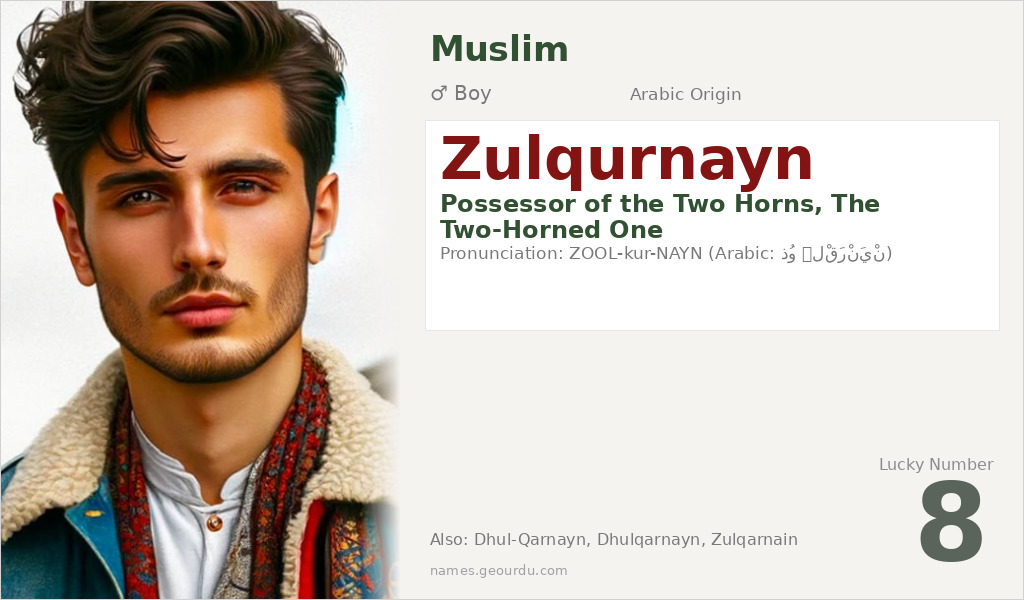
| 📛 Name | Zulqurnayn |
| 💎 Meaning | Possessor of the Two Horns, The Two-Horned One |
| 👤 Gender | Boy |
| 🕌 Religion | Muslim |
| 🌍 Origin | Arabic |
| 🗣 Pronunciation | ZOOL-kur-NAYN (Arabic: ذُو ٱلْقَرْنَيْن) |
| ✍️ Urdu | ذوالقرنین |
| ✍️ Arabic | ذُو ٱلْقَرْنَيْن |
| 🔢 Numerology | 8 |
| ✨ Spellings | Dhul-Qarnayn, Dhulqarnayn, Zulqarnain, Dhu al-Qarnayn, Zul-Qarnayn |
Origin & Cultural Significance
The name Zulqurnayn originates directly from the Quranic Arabic text and has been used primarily in Muslim communities for centuries. Its most famous bearer is the figure mentioned in Surah Al-Kahf, whose identity has been debated by Islamic scholars—with some identifying him as Alexander the Great (Iskandar) and others as Cyrus the Great or another ancient righteous ruler. The name spread throughout the Islamic world from the Arabian Peninsula to South Asia, Southeast Asia, and beyond through Quranic education and Islamic scholarship. In South Asian Muslim communities, particularly in Pakistan and India, the name gained popularity as parents sought meaningful Quranic names for their children. Unlike many Arabic names that pre-date Islam, Zulqurnayn is distinctly Islamic in its origin and significance.
Personality Traits
Those named Zulqurnayn are often associated with leadership qualities, determination, and a sense of destiny. The Quranic narrative suggests characteristics of justice, protection of the weak, and visionary thinking. In cultural contexts, the name may inspire expectations of strength, wisdom, and the ability to navigate complex challenges. The historical and religious weight of the name can influence how bearers perceive themselves and are perceived by others in Muslim communities.
Similar Names
If you like Zulqurnayn, consider: Sulaiman, Iskandar, Yusuf, Harun, Qasim
Famous People Named Zulqurnayn
- Dhul-Qarnayn — The figure mentioned in the Quran (Surah Al-Kahf), often identified by Islamic scholars with historical figures like Alexander the Great or Cyrus the Great, though interpretations vary
- Zulqarnain Haider — Pakistani cricketer who played for the national team as a wicket-keeper batsman
Frequently Asked Questions About Zulqurnayn
What does Zulqurnayn mean?
Zulqurnayn means 'Possessor of the Two Horns' in Arabic. This refers to the Quranic figure in Surah Al-Kahf, with the 'two horns' symbolizing dual aspects of leadership or power, not literal horns.
Is Zulqurnayn a boy or girl name?
Zulqurnayn is exclusively a boy's name in Islamic tradition, as it refers to a male historical/Quranic figure and follows Arabic masculine grammatical structure with 'Dhū' (possessor).
What is the origin of Zulqurnayn?
Zulqurnayn originates from Quranic Arabic and Islamic tradition. It appears in the Holy Quran (Surah Al-Kahf) and has been used primarily in Muslim communities worldwide, particularly in Arabic-speaking regions and South Asia.





