Table of Contents
Batoul is a beautiful Arabic name with deep spiritual resonance, particularly in Islamic tradition where it describes a woman of exceptional purity and devotion. Most famously associated with Maryam (Mary), mother of Prophet Isa (Jesus), this name carries centuries of religious and cultural significance. Beyond its religious context, Batoul represents ideals of moral integrity and spiritual dedication that appeal to parents across various cultures. Let’s explore the rich etymology, historical usage, and contemporary relevance of this meaningful name.
Meaning of Batoul
The name Batoul originates from classical Arabic, derived from the triliteral root B-T-L (ب-ط-ل) which fundamentally means ‘to cut off’ or ‘to sever.’ This root gives rise to the specific meaning of a woman who has cut herself off from worldly pleasures and distractions to devote herself entirely to worship and spiritual pursuits. In Islamic theology, the term gained particular prominence through its application to Maryam (Mary), who is described in Hadith literature as ‘Al-Batoul’ because she was protected from worldly desires and dedicated to God’s service. The meaning extends beyond physical virginity to encompass spiritual purity, asceticism, and moral excellence. This linguistic connection makes Batoul a name loaded with religious symbolism and ethical ideals.
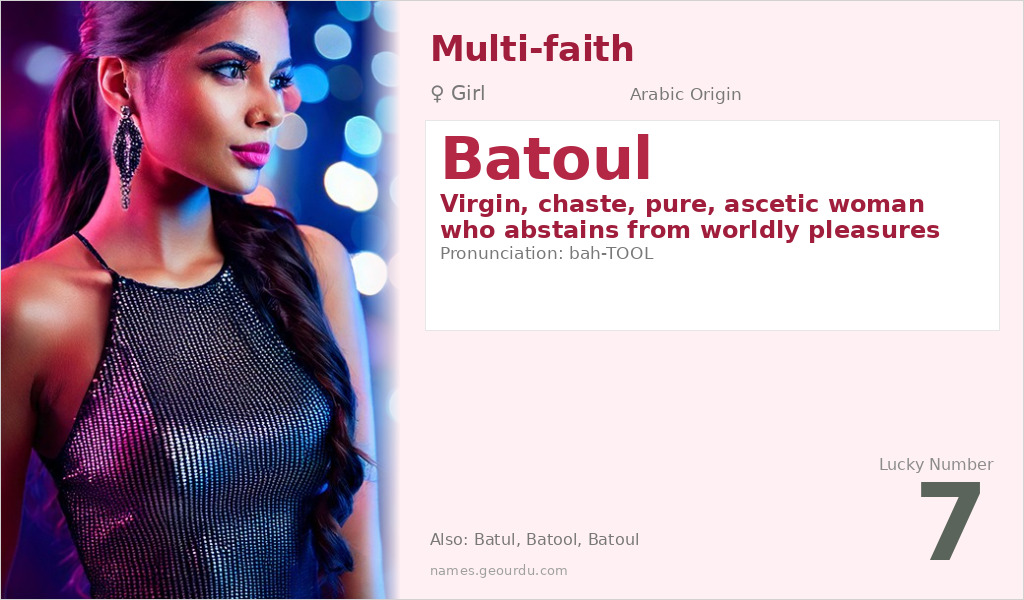
| 📛 Name | Batoul |
| 💎 Meaning | Virgin, chaste, pure, ascetic woman who abstains from worldly pleasures |
| 👤 Gender | Girl |
| 🕌 Religion | Multi-faith |
| 🌍 Origin | Arabic |
| 🗣 Pronunciation | bah-TOOL |
| ✍️ Urdu | بتول |
| ✍️ Arabic | بطول |
| 🔢 Numerology | 7 |
| ✨ Spellings | Batul, Batool, Batoul, Battoul |
Origin & Cultural Significance
Batoul has its origins in pre-Islamic Arabic language but gained significant religious importance with the advent of Islam. The name appears in Islamic texts describing Maryam, mother of Prophet Isa (Jesus), establishing it as an honorific title for women of exceptional spiritual stature. While predominantly used in Muslim communities across Arabic-speaking regions, Iran, Pakistan, and South Asia, the name also appears in Christian Arab communities due to its association with Mary. The name spread through Islamic expansion and literary traditions, maintaining its religious connotations while becoming a popular given name. Today, variations exist across different regions with slight phonetic adaptations but consistent core meaning.
Personality Traits
Those named Batoul are often associated with qualities of introspection, spiritual depth, and moral consistency. The name’s etymology suggests someone who values substance over superficiality, with a natural inclination toward meaningful pursuits and relationships. In cultural contexts, Batoul might be expected to embody the virtues of patience, devotion, and ethical strength that the name historically represents. These associations, while not deterministic, reflect the aspirational qualities that parents often hope to instill through this meaningful name choice.
Similar Names
If you like Batoul, consider: Maryam, Fatima, Zahra, Aisha, Khadija
Famous People Named Batoul
- Batoul Hosseini — Iranian actress known for roles in Persian cinema and television
- Batoul Mahmoud — Syrian poet and writer recognized for contemporary Arabic literature
Frequently Asked Questions About Batoul
What does Batoul mean?
Batoul means 'virgin, chaste, pure' in Arabic, specifically referring to a woman who abstains from worldly pleasures and dedicates herself to spiritual devotion. The term is most famously used for Maryam (Mary), mother of Prophet Isa (Jesus), in Islamic tradition.
Is Batoul a boy or girl name?
Batoul is exclusively a feminine name in all cultural contexts where it is used. It describes female spiritual qualities and is historically associated with women, particularly Maryam in religious texts.
What is the origin of Batoul?
Batoul originates from classical Arabic, derived from the root B-T-L meaning 'to cut off.' It gained religious significance in Islam as an honorific for Maryam and spread through Islamic cultural diffusion to various regions including the Middle East, South Asia, and beyond.