Table of Contents
Nada is a beautiful, multicultural name with rich meanings across different languages and cultures. While commonly associated with the Arabic word for ‘dew,’ it also carries the powerful meaning of ‘hope’ in Slavic traditions. This name has traveled across continents, maintaining its elegance and significance in diverse communities. Whether chosen for its natural imagery or its optimistic connotations, Nada remains a timeless choice for parents worldwide.
Meaning of Nada
The name Nada has distinct, well-documented meanings in two major linguistic families. In Arabic, Nada (ندى) directly translates to ‘dew’ or ‘morning dew,’ evoking images of freshness, purity, and the gentle beginning of a new day. This meaning comes from the Arabic root N-D-Y, which relates to moisture and tenderness. In Slavic languages including Serbian, Croatian, and Russian, Nada (Нада) means ‘hope,’ derived from the Proto-Slavic root ‘naděja.’ This meaning conveys optimism, expectation, and faith in the future. While Spanish and Portuguese use ‘nada’ to mean ‘nothing,’ this is not typically used as a personal name in those cultures, making the Arabic and Slavic meanings the primary considerations for naming purposes.
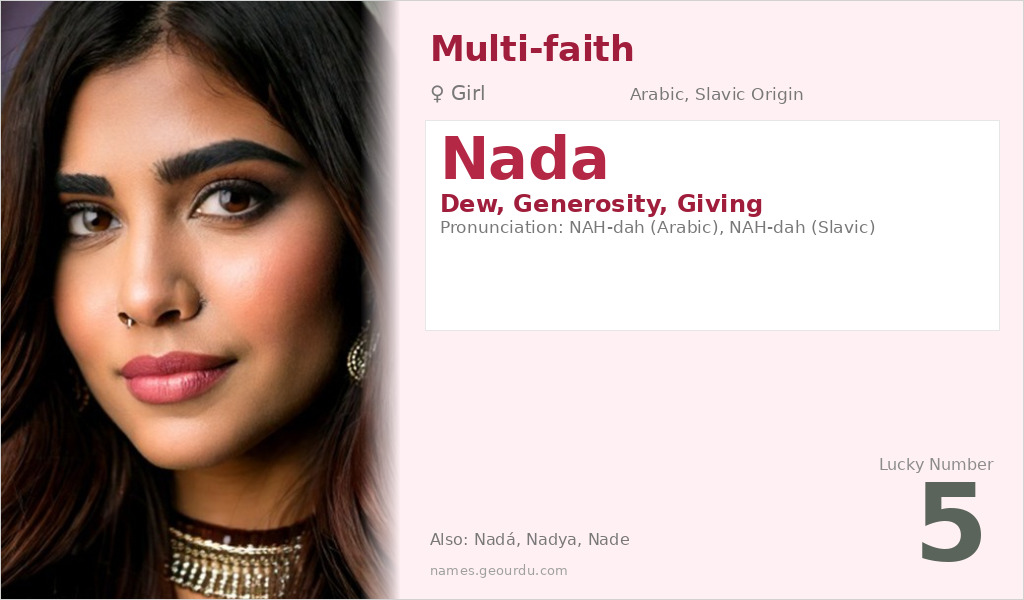
| 📛 Name | Nada |
| 💎 Meaning | Dew, Generosity, Giving |
| 👤 Gender | Girl |
| 🕌 Religion | Multi-faith |
| 🌍 Origin | Arabic, Slavic |
| 🗣 Pronunciation | NAH-dah (Arabic), NAH-dah (Slavic) |
| ✍️ Urdu | ندا |
| ✍️ Arabic | ندى |
| 🔢 Numerology | 5 |
| ✨ Spellings | Nadá, Nadya, Nade, Nadah |
Origin & Cultural Significance
Nada originates from two distinct cultural and linguistic traditions. In the Arab world, the name has been used for centuries, valued for its connection to nature and its gentle, feminine qualities. It appears in classical Arabic poetry and literature, often symbolizing purity and renewal. In Slavic countries, particularly in the Balkans and Eastern Europe, Nada emerged as a given name derived from the common word for ‘hope,’ reflecting cultural values of resilience and optimism. The name gained popularity in the 19th and 20th centuries across Yugoslavia and neighboring regions. Today, Nada is truly multicultural, found in Muslim, Christian, and secular communities worldwide, with each culture embracing either the Arabic or Slavic meaning according to their linguistic heritage.
Personality Traits
People named Nada often embody the qualities suggested by their name’s meanings. Those connected to the Arabic ‘dew’ meaning tend to be refreshing, pure-hearted, and nurturing—bringing a sense of renewal to their surroundings. Those linked to the Slavic ‘hope’ meaning typically demonstrate optimism, resilience, and an encouraging spirit that inspires others. Both interpretations suggest someone who is gentle yet strong, with a natural ability to uplift those around them. The name carries an inherent elegance that often translates to graceful personal presence.
Similar Names
If you like Nada, consider: Nadia, Nadine, Nadira, Nadja, Nadezhda
Famous People Named Nada
- Nada Al-Ahdal — Yemeni child rights activist known for her viral video against child marriage
- Nada — Lebanese singer and actress popular in the Arab world during the 1970s-1990s
Frequently Asked Questions About Nada
What does Nada mean?
Nada has two primary meanings: In Arabic, it means 'dew' or 'morning dew.' In Slavic languages (Serbian, Croatian, Russian, etc.), it means 'hope.'
Is Nada a boy or girl name?
Nada is exclusively a girl's name in both Arabic and Slavic naming traditions. There are no documented uses as a masculine name.
What is the origin of Nada?
Nada has dual origins: from Arabic (meaning 'dew') and from Slavic languages (meaning 'hope'). It is used in Muslim, Christian, and secular contexts across multiple cultures.