
Table of Contents
Fir’aun is one of the most recognizable names from religious history, yet it’s rarely chosen for children today. This Arabic term, meaning ‘Pharaoh,’ carries profound significance in Islamic tradition as the title of the ruler who opposed Prophet Moses. Understanding this name requires exploring its journey from ancient Egyptian palaces to Quranic revelation. While technically a boy’s name, its usage is almost exclusively historical and theological rather than practical.
Meaning of Fir'aun
Fir’aun (فِرْعَوْن) has a precise and well-documented meaning: it is the Arabic word for ‘Pharaoh,’ the title of ancient Egyptian rulers. Etymologically, it traces back to the Egyptian term ‘pr-ꜥꜣ,’ meaning ‘Great House’ or ‘Royal Palace,’ which originally referred to the palace itself before becoming a title for the monarch. This term entered Semitic languages through Hebrew as ‘Par’oh’ (פַּרְעֹה) and was subsequently adopted into Arabic. In Islamic context, Fir’aun specifically refers to the Pharaoh mentioned in the Quran who enslaved the Israelites and opposed Moses, making it a name loaded with religious and historical significance rather than positive personal attributes.
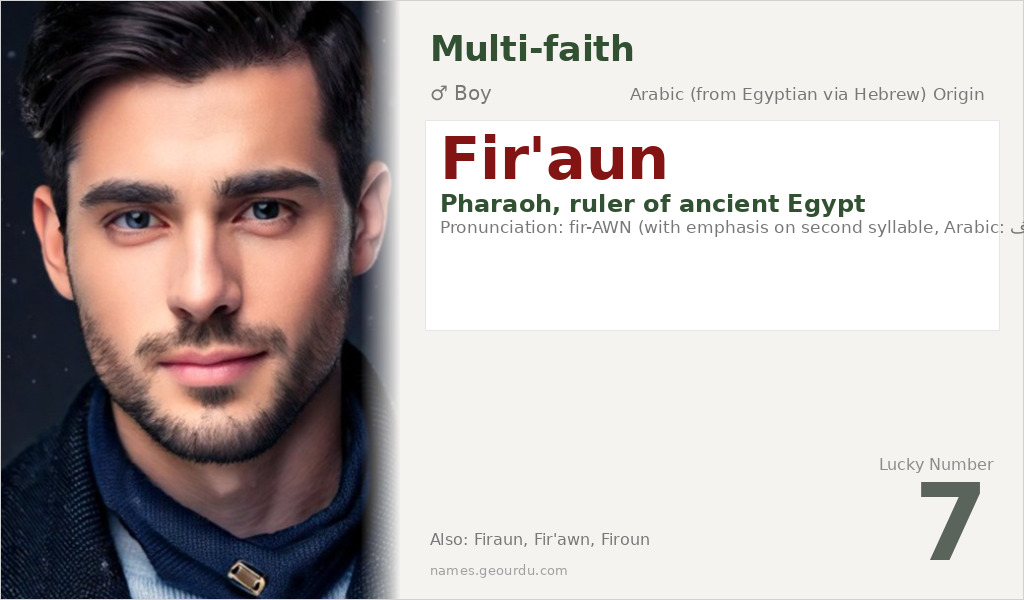
| 📛 Name | Fir'aun |
| 💎 Meaning | Pharaoh, ruler of ancient Egypt |
| 👤 Gender | Boy |
| 🕌 Religion | Multi-faith |
| 🌍 Origin | Arabic (from Egyptian via Hebrew) |
| 🗣 Pronunciation | fir-AWN (with emphasis on second syllable, Arabic: فِرْعَوْن) |
| ✍️ Urdu | فرعون |
| ✍️ Arabic | فِرْعَوْن |
| 🔢 Numerology | 7 |
| ✨ Spellings | Firaun, Fir'awn, Firoun, Pharaoh (English equivalent) |
Origin & Cultural Significance
The origin of Fir’aun is multilayered: it originates from ancient Egyptian ‘pr-ꜥꜣ,’ was transmitted through Hebrew as ‘Par’oh,’ and was fully incorporated into Arabic vocabulary, particularly through Quranic usage. Culturally, this name holds immense importance in Abrahamic traditions as the archetypal oppressive ruler. In Islamic naming traditions, Fir’aun is almost never given to children due to its negative connotations—the Quranic Pharaoh represents tyranny, arrogance, and rejection of divine guidance. While the name exists linguistically in Arabic, its practical use is limited to historical, literary, or theological contexts rather than as a personal name.
Personality Traits
As Fir’aun refers specifically to a historical religious figure rather than being used as a contemporary personal name, assigning personality traits would be inappropriate. In Islamic narrative, the character of Fir’aun embodies negative qualities: arrogance, tyranny, stubbornness, and rejection of prophetic guidance. The Quran presents him as a warning against pride and disobedience to God. Therefore, this name carries strong cautionary connotations rather than aspirational qualities for a child.
Similar Names
If you like Fir'aun, consider: Malik (king/ruler), Sultan (ruler/authority), Qaisar (Caesar), Kisra (Persian king), Shah (king)
Famous People Named Fir'aun
- None as a personal name — In Islamic tradition, Fir'aun refers specifically to the Pharaoh who opposed Prophet Moses, mentioned in the Quran and considered a symbol of tyranny and disbelief
Frequently Asked Questions About Fir'aun
What does Fir'aun mean?
Fir'aun means 'Pharaoh' in Arabic. It specifically refers to the ancient Egyptian rulers and, in Islamic context, to the Pharaoh who opposed Prophet Moses as mentioned in the Quran.
Is Fir'aun a boy or girl name?
Fir'aun is grammatically masculine in Arabic and refers to male rulers, so it would be considered a boy's name. However, it is virtually never used as a personal name for children in Muslim communities due to its negative religious associations.
What is the origin of Fir'aun?
Fir'aun originates from ancient Egyptian 'pr-ꜥꜣ' (Great House/Royal Palace), which entered Hebrew as 'Par'oh' and was adopted into Arabic. It's primarily known through its Quranic usage referring to the Egyptian ruler during Moses' time.





