
Table of Contents
Fasah is a distinctive Arabic name with deep linguistic roots that celebrates the art of communication. Derived from the Arabic concept of ‘fasahah’ (eloquence), this name carries centuries of cultural significance in the Arab world and beyond. For parents seeking a name that embodies clarity, intelligence, and expressive ability, Fasah offers both traditional resonance and contemporary appeal. Its connection to linguistic purity makes it particularly meaningful in cultures that value articulate expression.
Meaning of Fasah
Fasah originates from the Arabic triliteral root ف-ص-ح (f-ṣ-ḥ), which forms the basis for words related to eloquence, clarity, and purity of expression. In classical Arabic, ‘fasahah’ (فصاحة) specifically denotes the quality of eloquent, correct, and clear speech—a highly valued attribute in Arabic literary tradition. The name Fasah itself means ‘eloquent one’ or ‘clear speaker,’ referring to someone who expresses themselves with precision and fluency. This linguistic heritage connects the name to the rich tradition of Arabic rhetoric and poetry, where eloquence was considered both an art form and a mark of intelligence. The concept appears in Islamic scholarship as well, with references to the ‘fasih’ (eloquent) speech of prophets and scholars.
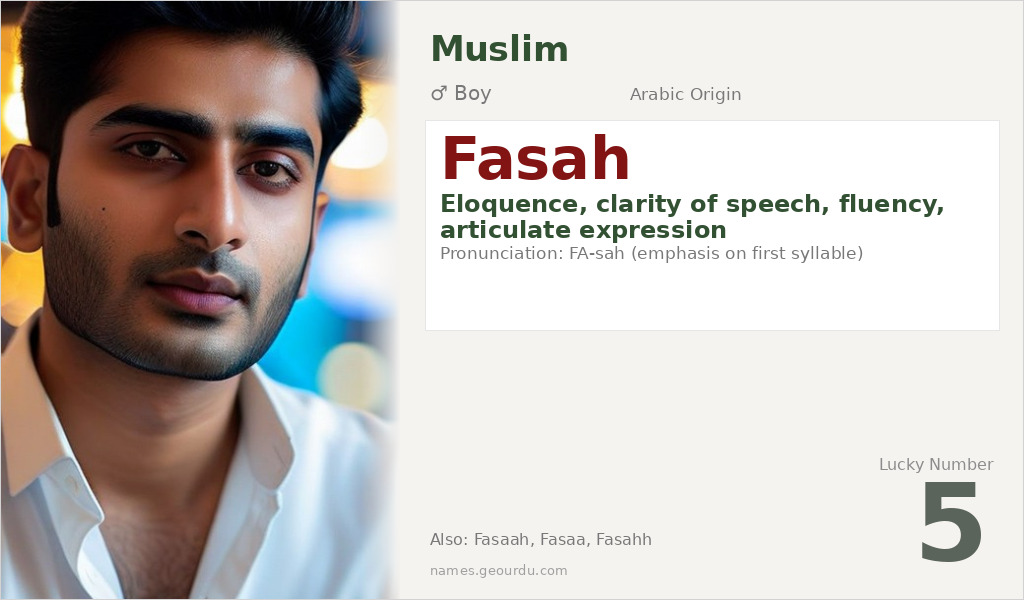
| 📛 Name | Fasah |
| 💎 Meaning | Eloquence, clarity of speech, fluency, articulate expression |
| 👤 Gender | Boy |
| 🕌 Religion | Muslim |
| 🌍 Origin | Arabic |
| 🗣 Pronunciation | FA-sah (emphasis on first syllable) |
| ✍️ Urdu | فصاح |
| ✍️ Arabic | فصاح |
| 🔢 Numerology | 5 |
| ✨ Spellings | Fasaah, Fasaa, Fasahh, Fasa |
Origin & Cultural Significance
Fasah has its origins in classical Arabic language and culture, emerging from the linguistic traditions of the Arabian Peninsula. The name reflects the high value placed on eloquent speech in pre-Islamic and Islamic Arab societies, where oral poetry and rhetoric were central to cultural expression. As Arabic spread through Islamic expansion, the name traveled to regions including Persia, South Asia, and parts of Africa, though it remained most common in Arabic-speaking communities. In contemporary usage, Fasah is primarily found among Muslim families, particularly those with Arabic linguistic heritage or appreciation for traditional Arabic names. While not among the most common names, it maintains cultural significance for its connection to the esteemed quality of eloquence.
Personality Traits
Those named Fasah are often associated with communicative gifts and intellectual clarity. They tend to be articulate individuals who express themselves with precision and thoughtfulness. This name suggests someone who values language as a tool for connection and understanding, potentially excelling in fields like writing, teaching, law, or diplomacy. The linguistic roots of the name imply a personality that combines intelligence with expressive ability.
Similar Names
If you like Fasah, consider: Faseeh, Fasih, Bayan, Lisan, Qalam
Famous People Named Fasah
- Fasah Ahmed — Pakistani poet and writer known for his Urdu poetry
- Fasahuddin — Historical Islamic scholar mentioned in classical texts for his eloquence
Frequently Asked Questions About Fasah
What does Fasah mean?
Fasah means 'eloquence,' 'clarity of speech,' or 'fluency' in Arabic. It comes from the root ف-ص-ح (f-ṣ-ḥ) related to articulate expression.
Is Fasah a boy or girl name?
Fasah is traditionally a masculine name in Arabic naming conventions. It follows the pattern of Arabic masculine nouns ending with the 'ah' sound.
What is the origin of Fasah?
Fasah originates from classical Arabic language and culture. It derives from the Arabic linguistic concept of 'fasahah' (eloquence) and has been used in Arabic-speaking regions for centuries.





