
Table of Contents
Majnoun is a name that echoes through centuries of Arabic and Persian poetry, symbolizing the ultimate romantic archetype: the madly passionate lover. Derived from the Arabic word for ‘madman,’ it is immortalized in the tale of Majnoun Layla, a story of obsessive love that has inspired countless works of art and literature. While not a conventional given name in modern times, it holds profound cultural significance across the Islamic world. This article delves into the true meaning, origin, and literary legacy of Majnoun.
Meaning of Majnoun
Majnoun (مجنون) is an Arabic term meaning ‘madman’ or ‘insane person,’ originating from the root ‘j-n-n’ (ج-ن-ن), which conveys concepts of madness, possession, and hiddenness. In classical Arabic usage, it specifically refers to one who is love-crazed or mentally unsettled, most famously embodied by Qays ibn al-Mulawwah, the poet known as Majnoun Layla. The name gained literary prominence through epic poems like Nizami’s ‘Layla and Majnun,’ where it symbolizes transcendent, irrational love. Linguistically, it is a passive participle form, indicating a state of being affected by madness, and is used across Arabic, Persian, Urdu, and Turkish in literary contexts.
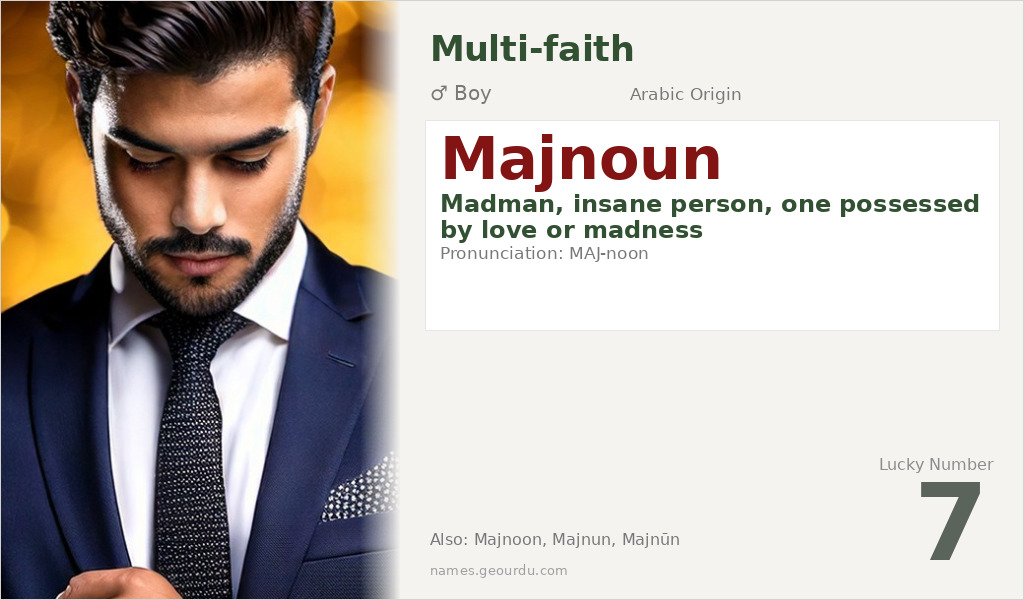
| 📛 Name | Majnoun |
| 💎 Meaning | Madman, insane person, one possessed by love or madness |
| 👤 Gender | Boy |
| 🕌 Religion | Multi-faith |
| 🌍 Origin | Arabic |
| 🗣 Pronunciation | MAJ-noon |
| ✍️ Urdu | مجنون |
| ✍️ Arabic | مجنون |
| 🔢 Numerology | 7 |
| ✨ Spellings | Majnoon, Majnun, Majnūn |
Origin & Cultural Significance
Majnoun originates from pre-Islamic and early Islamic Arabic culture, with its most famous bearer, Qays ibn al-Mulawwah, living in the 7th century in the Arabian Peninsula. The story of his unrequited love for Layla became a cornerstone of Arabic literature, later spreading to Persian, Turkish, and South Asian traditions through adaptations by poets like Nizami Ganjavi and Amir Khusrow. While the term is Arabic, its cultural impact is pan-Islamic, appearing in Sufi poetry as a metaphor for divine love and in folk tales across the Middle East and Central Asia. It is not traditionally used as a personal name in Muslim communities but remains a powerful cultural and literary reference.
Personality Traits
In literary tradition, Majnoun represents a personality defined by extreme passion, creativity, and defiance of societal conventions. Those inspired by this archetype are often seen as deeply emotional, artistic, and driven by ideals that border on obsession. They may exhibit a tendency toward introspection and a willingness to sacrifice everything for love or belief, reflecting the Sufi interpretation of madness as a state of spiritual ecstasy. This portrayal emphasizes traits like loyalty, intensity, and a break from rationality in pursuit of higher meaning.
Similar Names
If you like Majnoun, consider: Qays, Layla, Farhad, Shirin, Wamiq
Famous People Named Majnoun
- Majnoun Layla (Qays ibn al-Mulawwah) — 7th-century Arabic poet famous for his obsessive love for Layla, central figure in Arabic and Persian literature
- Nizami Ganjavi — 12th-century Persian poet who wrote 'Layla and Majnun,' popularizing the story in Islamic culture
Frequently Asked Questions About Majnoun
What does Majnoun mean?
Majnoun means 'madman' or 'insane person' in Arabic, derived from the root 'j-n-n.' It is famously associated with the poet Qays ibn al-Mulawwah, known as Majnoun Layla, symbolizing obsessive love in literature.
Is Majnoun a boy or girl name?
Majnoun is historically and linguistically masculine, as it refers to male figures in literature like Majnoun Layla. It is not commonly used as a given name for either gender in modern times.
What is the origin of Majnoun?
Majnoun originates from Arabic language and culture, with roots in 7th-century Arabian poetry. It gained widespread cultural significance through Islamic literary traditions across the Middle East and South Asia.





