
Table of Contents
Khyber is a powerful and historically rich name that carries the weight of geography and history within its syllables. Originating from the Pashto language, this name directly references one of the world’s most famous mountain passes—the Khyber Pass connecting Afghanistan and Pakistan. More than just a geographical term, Khyber has evolved into a meaningful given name symbolizing strength, resilience, and strategic importance. Its usage spans across South Asian communities, particularly among Pashtun and Pakistani families who value its deep regional roots.
Meaning of Khyber
The name Khyber derives from the Pashto word ‘خېبر’ (Kheibar), which literally translates to ‘mountain pass’ or ‘strategic passage.’ This etymology is directly connected to the famous Khyber Pass, a 53-kilometer passage through the Hindu Kush mountains that has served as a crucial trade and military route for millennia. Linguistically, the name reflects the geographical reality of the region where Pashto is spoken, emphasizing the importance of mountain passes in connecting different areas. In cultural context, the name carries connotations of strength, endurance, and the ability to bridge divides—qualities embodied by the physical pass itself. While sometimes associated with the Arabic ‘Khaibar’ (a historical oasis in Arabia), the Pashto origin is more directly relevant to the name’s contemporary usage.
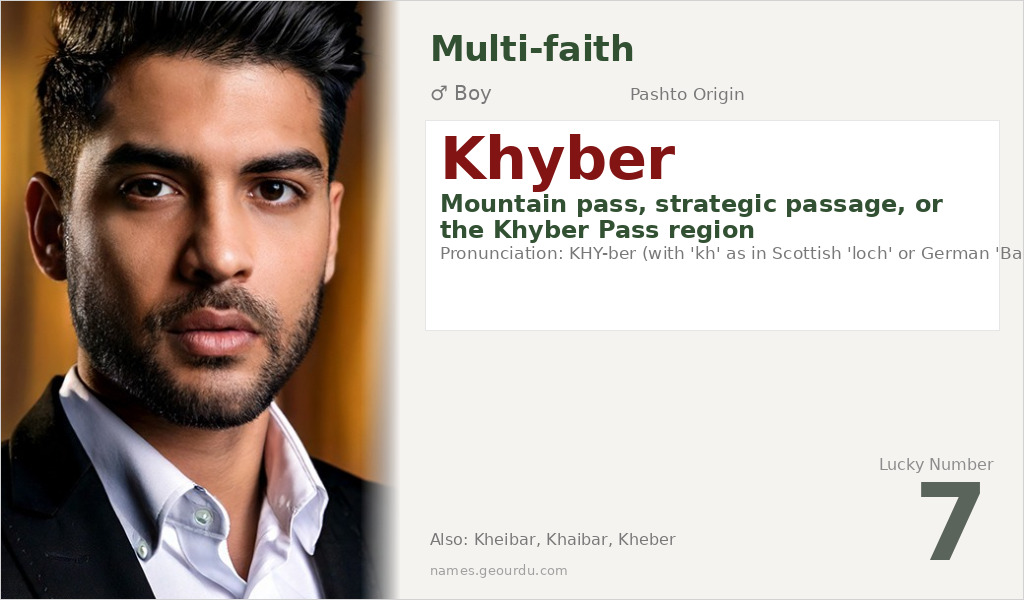
| 📛 Name | Khyber |
| 💎 Meaning | Mountain pass, strategic passage, or the Khyber Pass region |
| 👤 Gender | Boy |
| 🕌 Religion | Multi-faith |
| 🌍 Origin | Pashto |
| 🗣 Pronunciation | KHY-ber (with 'kh' as in Scottish 'loch' or German 'Bach') |
| ✍️ Urdu | خیبر |
| ✍️ Arabic | خيبر |
| 🔢 Numerology | 7 |
| ✨ Spellings | Kheibar, Khaibar, Kheber, Khaybar |
Origin & Cultural Significance
Khyber originates from the Pashto language, spoken primarily in Afghanistan and northwestern Pakistan. The name gained prominence through its association with the Khyber Pass, which has been mentioned in historical records dating back to Alexander the Great’s invasion in 326 BCE. Throughout history, this strategic passage has been controlled by various empires including the Mughals, Sikhs, and British, each leaving their cultural imprint on the region. As a given name, Khyber became popular among Pashtun communities and spread to other South Asian cultures, particularly in Pakistan’s Khyber Pakhtunkhwa province. While commonly used by Muslim families, the name’s geographical origins make it appropriate for multi-faith usage in the region.
Personality Traits
Those named Khyber are often associated with qualities of resilience, strategic thinking, and natural leadership. Like the mountain pass that inspired the name, they may possess the ability to connect different people or ideas, serving as bridges in social or professional contexts. The name suggests someone who can navigate challenging situations with determination and foresight, embodying the historical significance of the Khyber Pass as a route that has withstood centuries of change. These individuals may be perceived as strong-willed yet adaptable, capable of maintaining their course while adjusting to changing circumstances.
Similar Names
If you like Khyber, consider: Kabul, Hindukush, Sulaiman, Zamindawar, Tirah
Famous People Named Khyber
- Khyber Shinwari — Pakistani Pashto poet and writer from the Khyber region
- Khyber Pakhtunkhwa — The northwestern province of Pakistan named after the Khyber Pass
Frequently Asked Questions About Khyber
What does Khyber mean?
Khyber means 'mountain pass' or 'strategic passage' in Pashto, specifically referring to the famous Khyber Pass between Afghanistan and Pakistan.
Is Khyber a boy or girl name?
Khyber is primarily a boy's name, though its geographical origins make it theoretically unisex. In practice, it is overwhelmingly used for boys in Pashtun and South Asian communities.
What is the origin of Khyber?
Khyber originates from the Pashto language and is directly connected to the Khyber Pass region. While sometimes confused with the Arabic place name Khaibar, the Pashto etymology is most relevant for the given name.





