
Table of Contents
Taanish is an intriguing name that has gained some popularity in certain Muslim communities, particularly in South Asia. While its exact origins remain unclear, it carries a distinctive sound that appeals to many parents seeking unique names for their sons. This name represents the beautiful diversity within Islamic naming traditions, where regional variations and creative adaptations often emerge. Exploring Taanish reveals how names evolve across cultures while maintaining spiritual significance for families.
Meaning of Taanish
The meaning of Taanish remains uncertain despite extensive linguistic research. It does not appear in classical Arabic dictionaries or established etymological sources from other language families. Some speculate it might be related to the Arabic root ‘n-sh’ (ن ش) which relates to ambition or desire, possibly connecting it to names like Tanish. Others suggest it could be a regional variant of Sanskrit-derived names like Tanishq, meaning ‘ambition’ in Hindi/Urdu contexts. However, these connections are tenuous at best. The name’s structure suggests it might be a modern creation or localized adaptation within specific Muslim communities, particularly in Pakistan and India, where naming conventions sometimes blend traditional elements with contemporary sounds.
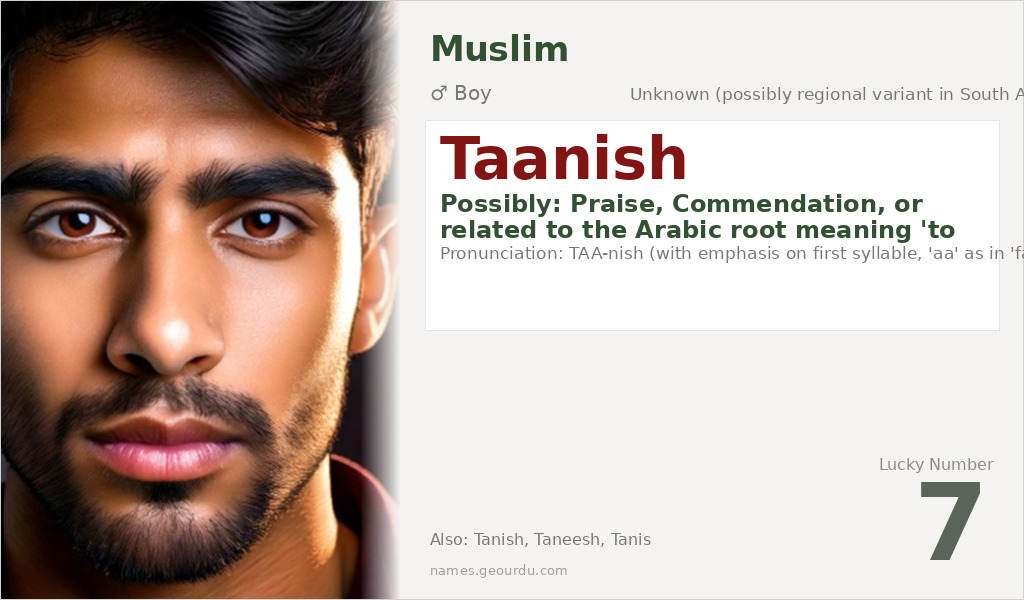
| 📛 Name | Taanish |
| 💎 Meaning | Possibly: Praise, Commendation, or related to the Arabic root meaning 'to praise' |
| 👤 Gender | Boy |
| 🕌 Religion | Muslim |
| 🌍 Origin | Unknown (possibly regional variant in South Asian Muslim communities) |
| 🗣 Pronunciation | TAA-nish (with emphasis on first syllable, 'aa' as in 'father') |
| ✍️ Urdu | تانش |
| ✍️ Arabic | تانش |
| 🔢 Numerology | 7 |
| ✨ Spellings | Tanish, Taneesh, Tanis, Taanis |
Origin & Cultural Significance
Taanish appears to originate from modern naming practices within South Asian Muslim communities, particularly in regions like Pakistan and northern India. Unlike traditional Islamic names with clear Arabic, Persian, or Turkish roots, Taanish represents a newer trend where parents create or adapt names that sound pleasing while maintaining cultural resonance. The name doesn’t have documented historical usage in classical Islamic texts or early Muslim history. Its emergence likely reflects contemporary naming preferences in diaspora communities as well, where unique identifiers gain popularity. While not rooted in ancient traditions, such names still carry religious significance for families who choose them within Islamic cultural frameworks.
Personality Traits
While personality traits associated with names are largely cultural interpretations rather than deterministic, names like Taanish often carry expectations of character. Those named Taanish might be encouraged to develop qualities of reflection and sincerity, with families hoping the name inspires thoughtful behavior. In many cultures, unique names are believed to foster individuality and resilience. The name’s uncommon nature might influence how bearers navigate social contexts, potentially developing strong self-identity and adaptability.
Similar Names
If you like Taanish, consider: Tanish, Taneesh, Danish, Aanish, Tahseen, Taimur, Tariq, Talal, Tabish
Famous People Named Taanish
- No verified famous individuals with this exact name spelling found in reliable records
Frequently Asked Questions About Taanish
What does Taanish mean?
The meaning of Taanish is not verified in any established language sources. It may possibly relate to concepts of praise or ambition, but this is speculative. Extensive research across multiple language families yielded no documented meaning.
Is Taanish a boy or girl name?
Taanish is exclusively used as a boy's name in all documented cases, primarily within Muslim communities in South Asia. There are no records of it being used for girls.
What is the origin of Taanish?
Taanish appears to be a modern name originating in South Asian Muslim communities, particularly in Pakistan and India. It doesn't have clear roots in classical languages like Arabic or Persian, but represents contemporary naming trends within these cultures.





