
Table of Contents
Sanghamitra is a name steeped in ancient Buddhist history and spiritual significance. Unlike common modern names, it carries the weight of a remarkable historical figure who helped shape religious history. This Sanskrit name beautifully combines community and friendship in its very essence, making it a meaningful choice with deep cultural roots.
Meaning of Sanghamitra
Sanghamitra derives from classical Sanskrit, combining ‘Sangha’ (संघ), referring specifically to the Buddhist monastic community, and ‘Mitra’ (मित्र), meaning friend or ally. The compound thus translates precisely to ‘Friend of the Sangha’ or ‘Ally of the Buddhist Order’. This isn’t a generic term for friendship between groups, but a specific reference to the Buddhist monastic community established by Gautama Buddha. The ‘Sangha’ represents one of the Three Jewels in Buddhism (Buddha, Dharma, Sangha), making this name deeply embedded in Buddhist theology. Historically, it gained prominence through Princess Sanghamitra, daughter of Emperor Ashoka, who became a Buddhist nun and played a pivotal role in spreading Buddhism beyond India.
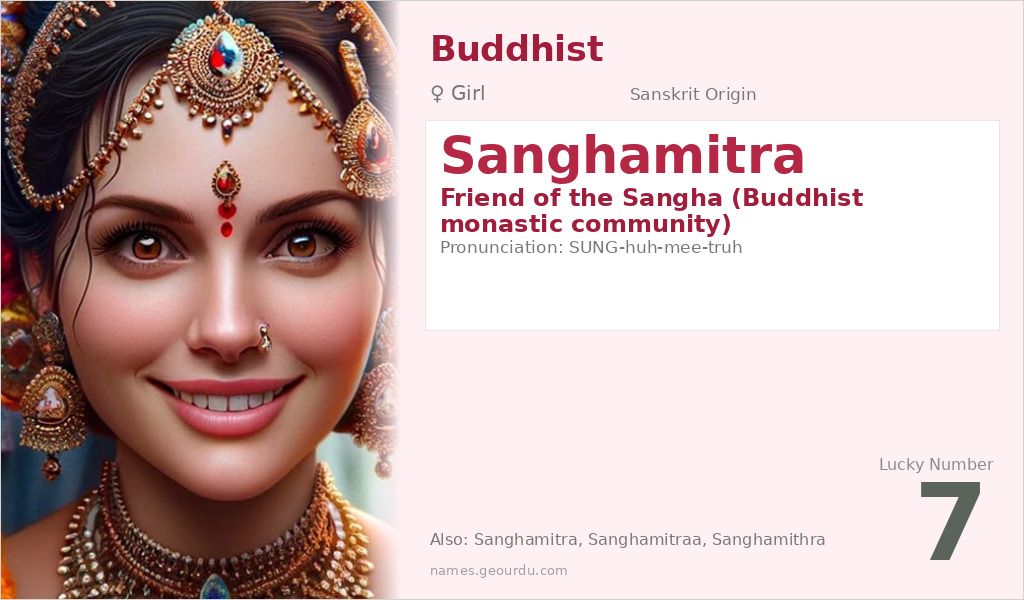
| 📛 Name | Sanghamitra |
| 💎 Meaning | Friend of the Sangha (Buddhist monastic community) |
| 👤 Gender | Girl |
| 🕌 Religion | Buddhist |
| 🌍 Origin | Sanskrit |
| 🗣 Pronunciation | SUNG-huh-mee-truh |
| ✍️ Urdu | سنگھمترا |
| ✍️ Arabic | سانغاميترا |
| 🔢 Numerology | 7 |
| ✨ Spellings | Sanghamitra, Sanghamitraa, Sanghamithra |
Origin & Cultural Significance
The name Sanghamitra originates from ancient India during the Mauryan Empire period (3rd century BCE). It emerged within Buddhist circles rather than Hindu traditions, despite both religions sharing Sanskrit linguistic roots. The name’s historical significance is tied directly to Sanghamitra, daughter of Emperor Ashoka, who along with her brother Mahinda, was instrumental in establishing Buddhism in Sri Lanka. She traveled there carrying a sapling from the original Bodhi tree under which Buddha attained enlightenment. This historical context makes the name particularly significant in Sri Lankan and Theravada Buddhist communities. While the name uses Sanskrit components, its cultural and religious association is firmly Buddhist rather than Hindu.
Personality Traits
Those named Sanghamitra often embody qualities of spiritual leadership and community service. The name suggests someone who values harmony, possesses diplomatic skills, and naturally assumes roles that bridge different perspectives. There’s an inherent sense of responsibility toward collective well-being, reflecting the name’s meaning of being a friend to the community. These individuals typically exhibit patience, wisdom, and a calm demeanor that helps unite people.
Similar Names
If you like Sanghamitra, consider: Ashoka, Mahindra, Bodhidharma, Ananda, Upali
Famous People Named Sanghamitra
- Sanghamitra — Daughter of Emperor Ashoka, Buddhist nun who carried a sapling of the Bodhi tree to Sri Lanka in the 3rd century BCE
- Sanghamitra Bandyopadhyay — Indian computational biologist and professor
Frequently Asked Questions About Sanghamitra
What does Sanghamitra mean?
Sanghamitra means 'Friend of the Sangha' in Sanskrit, specifically referring to the Buddhist monastic community. The name combines 'Sangha' (Buddhist order) and 'Mitra' (friend).
Is Sanghamitra a boy or girl name?
Sanghamitra is traditionally a girl's name, most famously borne by Princess Sanghamitra, daughter of Emperor Ashoka, who was a Buddhist nun. While Sanskrit names can sometimes be unisex, historical usage strongly associates it with females.
What is the origin of Sanghamitra?
Sanghamitra originates from Sanskrit in ancient India (3rd century BCE) and is deeply connected to Buddhist history. It gained prominence through Princess Sanghamitra who helped spread Buddhism to Sri Lanka, making it significant in Buddhist rather than Hindu traditions.





