
Table of Contents
Bhairava is a powerful Sanskrit name with deep roots in Hindu mythology and spirituality. As the fierce manifestation of Lord Shiva, this name carries connotations of divine protection and the destruction of fear. Traditionally given to boys, Bhairava represents strength, guardianship, and spiritual power. The name continues to be popular in Hindu communities across India and the diaspora.
Meaning of Bhairava
Bhairava derives from the Sanskrit word ‘भैरव’ (Bhairava), which comes from the root ‘भी’ (bhī) meaning ‘fear’ or ‘terror.’ The suffix ‘-rava’ intensifies this meaning, creating a term that translates to ‘The Terrible One’ or ‘The Frightful.’ In Hindu theological context, this terrifying aspect is not negative but represents the divine power that destroys ignorance, fear, and obstacles. The name specifically refers to Bhairava, a fierce form of Shiva who serves as the guardian of sacred spaces and protector of devotees. This paradoxical nature—being terrifying yet protective—makes the name spiritually significant in Hindu traditions.
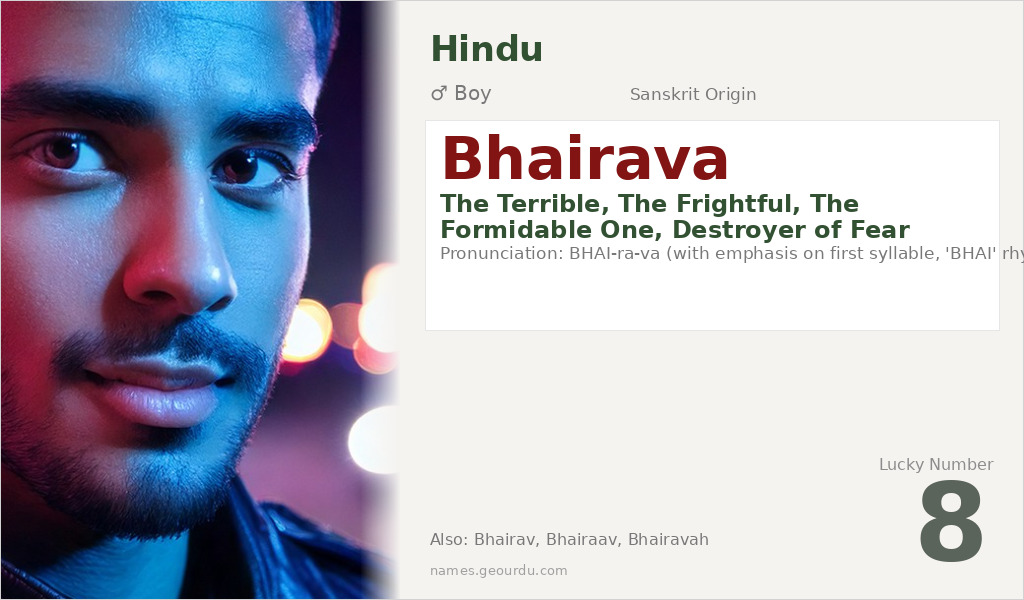
| 📛 Name | Bhairava |
| 💎 Meaning | The Terrible, The Frightful, The Formidable One, Destroyer of Fear |
| 👤 Gender | Boy |
| 🕌 Religion | Hindu |
| 🌍 Origin | Sanskrit |
| 🗣 Pronunciation | BHAI-ra-va (with emphasis on first syllable, 'BHAI' rhymes with 'high') |
| ✍️ Urdu | بھیرو |
| ✍️ Arabic | بهايرافا |
| 🔢 Numerology | 8 |
| ✨ Spellings | Bhairav, Bhairaav, Bhairavah |
Origin & Cultural Significance
Bhairava originates from ancient Sanskrit texts and Hindu mythology, where Bhairava appears as one of the most important manifestations of Lord Shiva. According to Puranic literature, Bhairava was created by Shiva to cut off one of Brahma’s heads and subsequently became the guardian of the eight directions. The name is particularly significant in Shaivism and Tantric traditions, where Bhairava is worshipped as the supreme reality. Culturally, the name is most common in India, Nepal, and among Hindu communities worldwide, with special importance in regions with strong Shiva worship traditions like Tamil Nadu, Kashmir, and Maharashtra.
Personality Traits
Those named Bhairava are often associated with strong, protective personalities. They tend to be determined individuals who face challenges with courage and resilience. In social settings, they may naturally assume leadership roles and are often seen as guardians or protectors by friends and family. Their name’s mythological connection suggests a personality that combines fierce determination with a protective nature.
Similar Names
If you like Bhairava, consider: Shiva, Rudra, Kala, Mahakala, Veerabhadra
Famous People Named Bhairava
- Bhairava (Hindu deity) — Fierce manifestation of Lord Shiva, guardian of sacred spaces in Hindu mythology
- Bhairava (musical raga) — Important morning raga in Indian classical music tradition
Frequently Asked Questions About Bhairava
What does Bhairava mean?
Bhairava means 'The Terrible,' 'The Frightful,' or 'Destroyer of Fear' in Sanskrit. It refers to the fierce manifestation of Lord Shiva in Hindu mythology.
Is Bhairava a boy or girl name?
Bhairava is exclusively a boy's name in Hindu naming traditions, derived from the masculine deity Bhairava, a form of Lord Shiva.
What is the origin of Bhairava?
Bhairava originates from Sanskrit and Hindu mythology. It comes from ancient Indian religious texts where Bhairava appears as a fierce form of Shiva, with linguistic roots in the Sanskrit word for 'fear' or 'terror.'





