
Table of Contents
Eswara is a powerful and spiritually significant name with deep roots in Hindu tradition and Sanskrit language. Primarily used for boys, this name carries the weight of divine authority and supreme lordship. Derived from ancient Indian scriptures, Eswara represents the ultimate controller and is closely associated with Lord Shiva. Parents choosing this name often seek to imbue their child with qualities of leadership, spiritual depth, and protective strength.
Meaning of Eswara
Eswara originates from the Sanskrit term ‘ईश्वर’ (īśvara), which fundamentally means ‘lord’, ‘master’, or ‘supreme ruler’. The word breaks down into the root ‘īś’ (to own, rule, command) combined with the suffix ‘-vara’ denoting excellence. In Hindu philosophical systems, particularly in Vedanta and Shaivism, Īśvara represents the personal aspect of the divine, the supreme controller of the universe who governs with compassion and justice. This concept appears prominently in texts like the Yoga Sutras of Patanjali and various Upanishads. The name specifically connects to Lord Shiva, who is often addressed as ‘Maheshwara’ (Great Lord) in devotional contexts, making Eswara a theologically rich name choice.
| 📛 Name | Eswara |
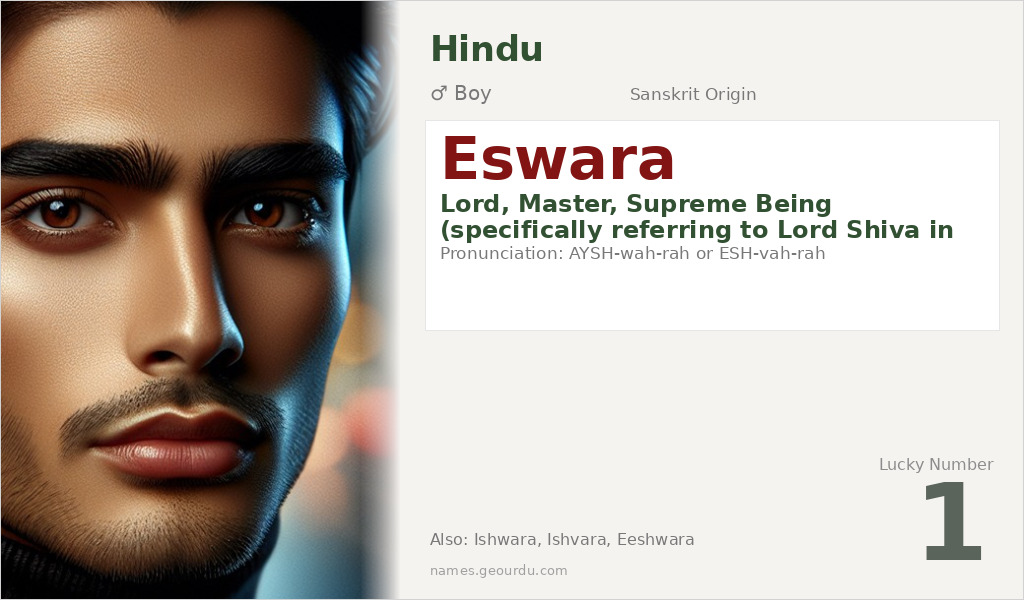
| 💎 Meaning | Lord, Master, Supreme Being (specifically referring to Lord Shiva in Hindu context) |
| 👤 Gender | Boy |
| 🕌 Religion | Hindu |
| 🌍 Origin | Sanskrit |
| 🗣 Pronunciation | AYSH-wah-rah or ESH-vah-rah |
| ✍️ Urdu | ایشور |
| ✍️ Arabic | إيشوارا |
| 🔢 Numerology | 1 |
| ✨ Spellings | Ishwara, Ishvara, Eeshwara, Eeshvara, Iswara |
Origin & Cultural Significance
The name Eswara has its origins in ancient India, emerging from Sanskrit, the classical language of Hindu scriptures. It appears in Vedic literature dating back over 3,000 years, where ‘īśvara’ described both earthly rulers and cosmic deities. Over centuries, the term became specifically associated with Shiva in Shaivite traditions across South Asia. The name spread through Hindu communities in India, Nepal, Sri Lanka, and the diaspora, maintaining its religious significance. While primarily used in Hindu contexts, the philosophical concept of Īśvara has influenced other Indian religions and spiritual movements. Regional variations in spelling (like Ishwara or Iswara) reflect linguistic adaptations in different Indian languages including Telugu, Kannada, and Tamil.
Personality Traits
Those named Eswara are often seen as natural authorities with strong leadership qualities and spiritual depth. They tend to approach life with determination and a sense of higher purpose, sometimes displaying protective instincts toward family and community. While they can be assertive and independent, they typically balance this with philosophical reflection and ethical consideration. Their name’s association with divine lordship may inspire them to take responsibility seriously and strive for excellence in their endeavors.
Similar Names
If you like Eswara, consider: Ishaan, Shiva, Mahesh, Rudra, Harish
Famous People Named Eswara
- Eswara Reddy — Indian cricketer who played for Andhra Pradesh
- Eswara Rao — Indian film director known for Telugu cinema
Frequently Asked Questions About Eswara
What does Eswara mean?
Eswara means 'Lord', 'Master', or 'Supreme Being' in Sanskrit, specifically referring to Lord Shiva in Hindu tradition.
Is Eswara a boy or girl name?
Eswara is traditionally a masculine name used for boys in Hindu communities, derived from the masculine Sanskrit noun 'īśvara'.
What is the origin of Eswara?
Eswara originates from Sanskrit, the ancient Indian language of Hindu scriptures, and has been used for millennia in Hindu religious and philosophical contexts.





