
Table of Contents
Isis is one of the most powerful and enduring names from ancient mythology, carrying the weight of millennia of religious devotion. Originally the name of the Egyptian goddess of magic, motherhood, and fertility, this name has transcended its origins to become recognized worldwide. While its modern usage has faced challenges due to contemporary associations, the historical significance of Isis remains profound and culturally rich.
Meaning of Isis
The name Isis derives directly from ancient Egyptian language, specifically from ‘Aset’ or ‘Iset’, which translates to ‘throne’ or ‘seat of power’. This etymology reflects the goddess’s role as the personification of the royal throne, essential to pharaonic legitimacy in Egyptian cosmology. In Egyptian mythology, Isis was the daughter of Geb (earth) and Nut (sky), sister-wife of Osiris, and mother of Horus. The name was adopted into Greek as ‘Isis’ during the Hellenistic period when Egyptian religion spread throughout the Mediterranean world, maintaining its core meaning while adapting to new cultural contexts.
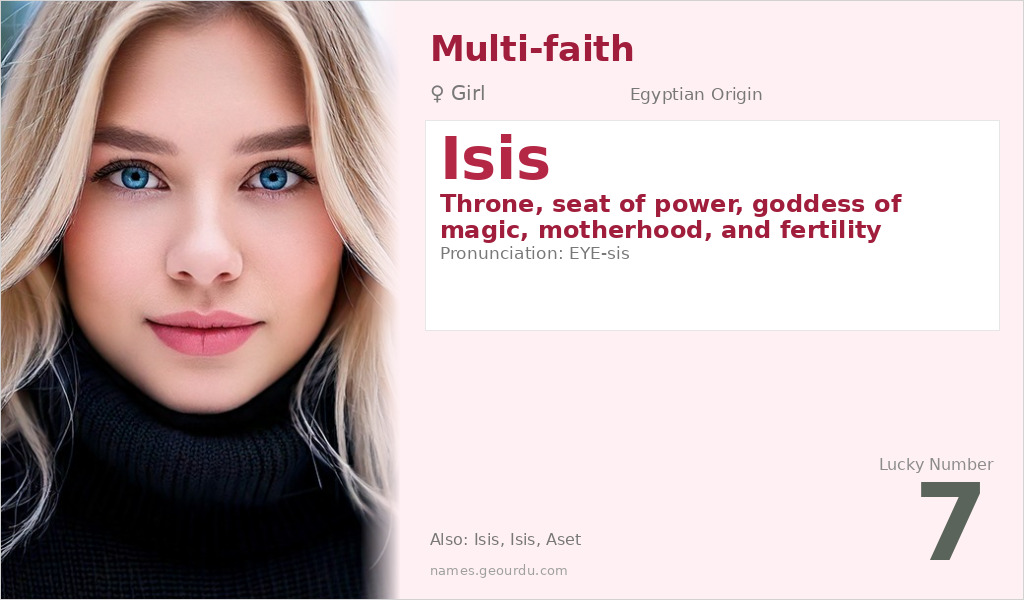
| 📛 Name | Isis |
| 💎 Meaning | Throne, seat of power, goddess of magic, motherhood, and fertility |
| 👤 Gender | Girl |
| 🕌 Religion | Multi-faith |
| 🌍 Origin | Egyptian |
| 🗣 Pronunciation | EYE-sis |
| ✍️ Urdu | آئیسس |
| ✍️ Arabic | إيزيس |
| 🔢 Numerology | 7 |
| ✨ Spellings | Isis, Isis, Aset, Iset, Eset |
Origin & Cultural Significance
Isis originates from ancient Egyptian religion, dating back to at least the Old Kingdom (c. 2686–2181 BCE). The worship of Isis eventually spread beyond Egypt through trade and conquest, becoming one of the most popular mystery religions in the Greco-Roman world. Temples to Isis were established throughout the Roman Empire, from Britain to the Black Sea. While the name has been used sporadically in Western countries, particularly during Egyptomania periods, it has no established history in Hindu, Islamic, or other South Asian naming traditions. The goddess Isis was syncretized with various deities in different cultures but remained distinctly Egyptian in origin.
Personality Traits
Those named Isis often embody the protective, nurturing qualities associated with the Egyptian goddess. They may demonstrate strong maternal instincts, wisdom in practical matters, and a natural inclination toward healing and caregiving. The name’s historical connection to magic and mysticism can also suggest intuitive abilities and spiritual depth in individuals who bear it.
Similar Names
If you like Isis, consider: Iris, Iris, Isadora, Isolde, Ishtar
Famous People Named Isis
- Isis (Egyptian goddess) — Ancient Egyptian deity, wife of Osiris and mother of Horus, worshipped throughout the Mediterranean world
- Isis King — American model and LGBTQ+ activist, first openly transgender contestant on America's Next Top Model
Frequently Asked Questions About Isis
What does Isis mean?
Isis means 'throne' or 'seat of power' in ancient Egyptian, referring to the Egyptian goddess of magic, motherhood, and fertility.
Is Isis a boy or girl name?
Isis is traditionally a feminine name, named after the Egyptian goddess Isis. There is no historical evidence of it being used as a masculine name.
What is the origin of Isis?
Isis originates from ancient Egyptian religion and language, specifically from the Egyptian word 'Aset' meaning 'throne'. It was the name of one of the most important Egyptian deities.





