
Table of Contents
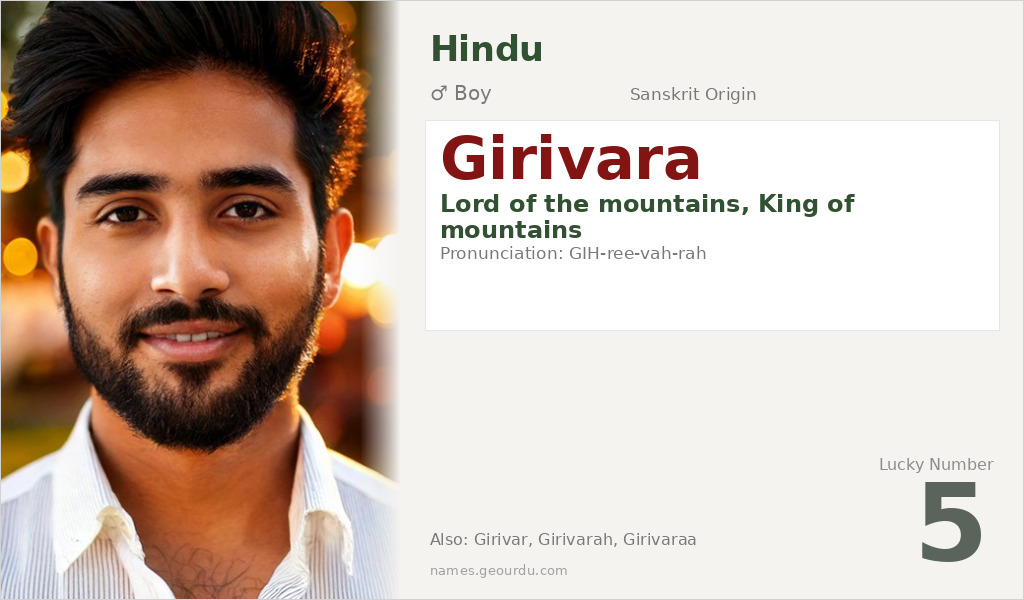
Girivara is a powerful Sanskrit name with deep roots in Hindu tradition and mythology. Meaning ‘Lord of the mountains’ or ‘King of mountains’, this name carries connotations of strength, stability, and spiritual significance. Often associated with Lord Shiva and mountainous deities, Girivara represents both physical grandeur and divine protection. For parents seeking a name with classical heritage and profound meaning, Girivara offers a connection to ancient Indian culture and values.
Meaning of Girivara
Girivara derives from the Sanskrit language, combining two distinct elements that create its profound meaning. The first component ‘giri’ (गिरि) unequivocally means ‘mountain’ or ‘hill’, appearing in numerous Sanskrit texts and compound words. The second element ‘vara’ (वर) carries multiple nuanced meanings including ‘best’, ‘excellent’, ‘choicest’, ‘lord’, or ‘superior one’. When combined, Girivara literally translates to ‘best of mountains’ or ‘lord of mountains’, suggesting supremacy among mountainous entities. This construction follows standard Sanskrit compounding rules where ‘vara’ acts as an attributive noun indicating excellence or lordship. The name appears in Hindu scriptures as an epithet for deities, particularly Shiva who is intimately connected with Mount Kailash, the abode of the gods.
| 📛 Name | Girivara |
| 💎 Meaning | Lord of the mountains, King of mountains |
| 👤 Gender | Boy |
| 🕌 Religion | Hindu |
| 🌍 Origin | Sanskrit |
| 🗣 Pronunciation | GIH-ree-vah-rah |
| ✍️ Urdu | گیری ورا |
| ✍️ Arabic | غيريفارا |
| 🔢 Numerology | 5 |
| ✨ Spellings | Girivar, Girivarah, Girivaraa |
Origin & Cultural Significance
Girivara originates from classical Sanskrit, the ancient liturgical language of Hinduism, Buddhism, and Jainism. As a compound Sanskrit name, it reflects the sophisticated word-formation traditions of ancient Indian linguistics. The name has particular significance in Hindu culture where mountains are revered as sacred spaces and abodes of deities. In Hindu mythology, several gods and sages are associated with mountains—Shiva with Mount Kailash, Vishnu with Mount Meru, and Parvati (whose name means ‘daughter of the mountain’). Girivara continues to be used primarily in Hindu communities across India, Nepal, and the diaspora, maintaining its religious and cultural associations while adapting to contemporary naming practices.
Personality Traits
Those named Girivara are often associated with mountain-like qualities: stability, endurance, and protective strength. They tend to approach life with grounded practicality and resilience in facing challenges. Their connection to the name’s meaning may manifest as a strong sense of responsibility toward family and community, much like mountains sheltering what lies within their slopes. These individuals often exhibit natural leadership combined with spiritual depth, creating balanced personalities who value both material achievement and inner growth.
Similar Names
If you like Girivara, consider: Girish, Girindra, Giridhar, Parvateshwar, Shailendra
Famous People Named Girivara
- Girivara — A character in Hindu mythology and scriptures, often used as an epithet for Lord Shiva
- Girivara — Occasionally used as a given name in Hindu communities, particularly in India and Nepal
Frequently Asked Questions About Girivara
What does Girivara mean?
Girivara means 'Lord of the mountains' or 'King of mountains' in Sanskrit, combining 'giri' (mountain) and 'vara' (lord/best).
Is Girivara a boy or girl name?
Girivara is exclusively a boy's name in Hindu naming tradition, reflecting masculine attributes associated with mountains and lordship.
What is the origin of Girivara?
Girivara originates from Sanskrit, the classical language of ancient India, with specific roots in Hindu religious and cultural traditions.





