
Table of Contents
Gajendranath is a powerful and meaningful Sanskrit name that carries deep cultural and mythological significance in Hindu tradition. Meaning ‘Lord of elephants’ or ‘Master of the king of elephants’, this name evokes images of strength, wisdom, and divine protection. With roots in ancient Indian epics and scriptures, Gajendranath represents both earthly authority and spiritual devotion. This distinctive name continues to be chosen by parents seeking a name with historical depth and noble connotations.
Meaning of Gajendranath
Gajendranath derives from the classical Sanskrit language, combining two significant elements: ‘Gajendra’ and ‘nath’. The first component, ‘Gajendra’, itself is a compound of ‘gaja’ (elephant) and ‘indra’ (king, lord, or ruler), referring specifically to the ‘king of elephants’. In Hindu mythology, Gajendra is the elephant king who was rescued by Lord Vishnu in the famous Gajendra Moksha story from the Bhagavata Purana. The second element, ‘nath’, means ‘lord’, ‘master’, ‘protector’, or ‘ruler’. Thus, the complete name Gajendranath translates to ‘Lord of Gajendra’ or more broadly ‘Master of the king of elephants’. This name symbolizes not just physical strength and royal authority, but also spiritual surrender and divine grace, as exemplified in the Gajendra Moksha narrative where the elephant king achieves liberation through devotion to Vishnu.
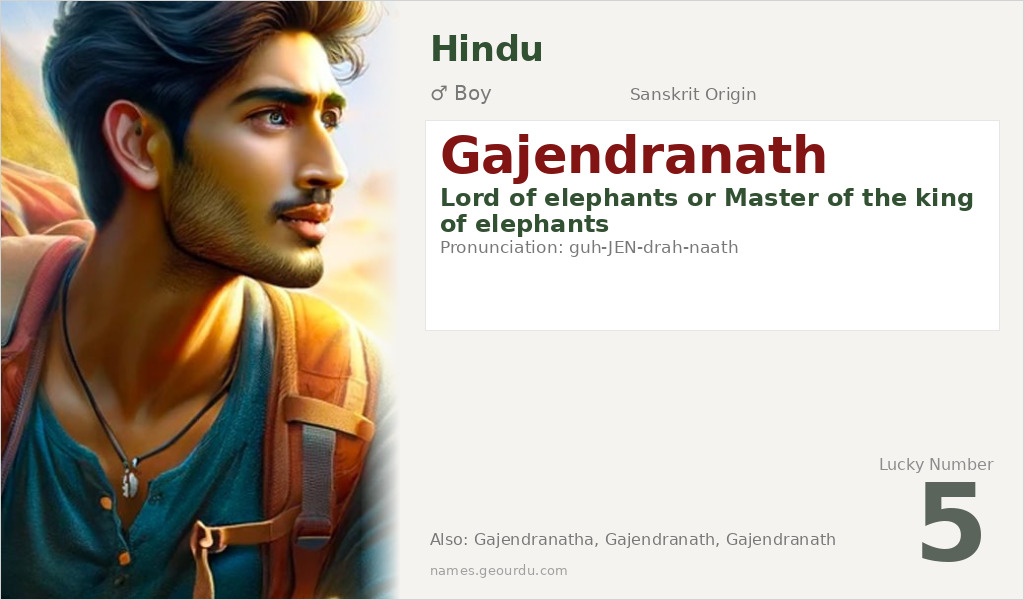
| 📛 Name | Gajendranath |
| 💎 Meaning | Lord of elephants or Master of the king of elephants |
| 👤 Gender | Boy |
| 🕌 Religion | Hindu |
| 🌍 Origin | Sanskrit |
| 🗣 Pronunciation | guh-JEN-drah-naath |
| ✍️ Urdu | گجندر ناتھ |
| ✍️ Arabic | غاجيندرانات |
| 🔢 Numerology | 5 |
| ✨ Spellings | Gajendranatha, Gajendranath, Gajendranath |
Origin & Cultural Significance
Gajendranath originates from ancient Sanskrit, the classical language of Hindu scriptures, philosophy, and literature in India. The name finds its most significant reference in the Gajendra Moksha story from the Bhagavata Purana (8th century CE), where Gajendra represents the individual soul crying out for divine help and being saved by Lord Vishnu. This mythological connection gives the name profound religious significance in Vaishnavism, particularly among followers of Vishnu. Historically, the name has been used in various regions of India, especially in Bengali, Marathi, and South Indian communities. While primarily a Hindu name, its Sanskrit roots mean it’s understood across different Indian linguistic communities. The name reflects the cultural importance of elephants in Indian tradition—as symbols of royalty, wisdom, and strength in both secular and religious contexts.
Personality Traits
Those named Gajendranath are often associated with qualities of leadership, protection, and steadfastness. Like the elephant—revered in Indian culture for its memory, intelligence, and strength—individuals with this name may exhibit reliability, wisdom, and a protective nature toward family and community. They often carry themselves with dignity and command respect naturally. The mythological association with Gajendra’s devotion suggests potential spiritual depth and the ability to overcome challenges through faith and perseverance.
Similar Names
If you like Gajendranath, consider: Gajendra, Gajanana, Gajadhar, Gajanan, Gajapati
Famous People Named Gajendranath
- Gajendranath Tagore — Indian painter and cartoonist from the Tagore family, pioneer of modern Indian art
- Gajendranath Sarkar — Bengali writer and journalist associated with the Kallol literary movement
Frequently Asked Questions About Gajendranath
What does Gajendranath mean?
Gajendranath means 'Lord of elephants' or 'Master of the king of elephants' in Sanskrit. It combines 'Gajendra' (king of elephants) and 'nath' (lord/master).
Is Gajendranath a boy or girl name?
Gajendranath is exclusively a masculine name in Hindu naming tradition. The '-nath' suffix is typically masculine in Sanskrit names.
What is the origin of Gajendranath?
Gajendranath originates from Sanskrit, the classical language of ancient India. It has strong roots in Hindu mythology, particularly the Gajendra Moksha story from the Bhagavata Purana.





