
Table of Contents
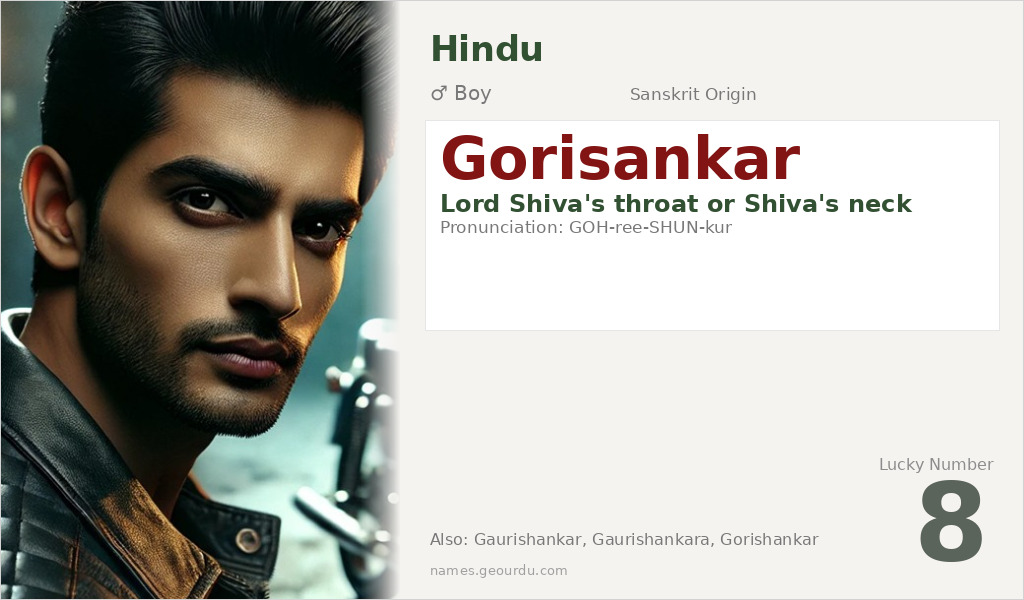
Gorisankar is a profound Sanskrit name steeped in Hindu mythology and devotion. Meaning ‘Shiva’s throat’ or ‘Shiva’s neck’, it commemorates one of the most significant episodes in Shiva’s mythology—his consumption of the cosmic poison Halahala. This name carries deep spiritual symbolism and is traditionally given to boys in Hindu families, particularly those with Shaivite traditions. Its compound structure reveals layers of meaning that connect directly to core Hindu narratives.
Meaning of Gorisankar
Gorisankar derives from classical Sanskrit, combining ‘Gori’ (गोरी) and ‘Shankar’ (शंकर). ‘Gori’ typically means ‘fair’ or ‘white’, but in this context specifically refers to Shiva’s throat which turned blue-black after he consumed the poison during Samudra Manthan (the churning of the ocean). ‘Shankar’ means ‘auspicious’ or ‘beneficent’ and is one of Shiva’s primary epithets. Thus, Gorisankar literally translates to ‘Shiva’s throat’ or ‘the auspicious one’s throat’. This name is directly connected to Shiva’s manifestation as Neelakantha (the blue-throated one), symbolizing his role as protector who takes suffering upon himself for universal welfare. The name appears in various Hindu texts and regional traditions across South Asia.
| 📛 Name | Gorisankar |
| 💎 Meaning | Lord Shiva's throat or Shiva's neck |
| 👤 Gender | Boy |
| 🕌 Religion | Hindu |
| 🌍 Origin | Sanskrit |
| 🗣 Pronunciation | GOH-ree-SHUN-kur |
| ✍️ Urdu | گوری شنکر |
| ✍️ Arabic | غوري شانكار |
| 🔢 Numerology | 8 |
| ✨ Spellings | Gaurishankar, Gaurishankara, Gorishankar, Gaurishankar |
Origin & Cultural Significance
Gorisankar originates from Sanskrit, the classical language of Hindu scriptures and philosophy. It emerged as a devotional name within Shaivism, the tradition centered on worship of Shiva. The name gained particular prominence in regions with strong Shiva worship traditions, including parts of India, Nepal, and among Hindu diaspora communities. Historically, it appears in religious literature and has been used by several notable figures in mathematics, music, and religious scholarship. While primarily a Hindu name, its linguistic roots in Sanskrit give it cultural resonance across South Asia, though it remains specifically associated with Shiva’s mythology and devotees.
Personality Traits
Those named Gorisankar are often associated with qualities of resilience, protection, and spiritual depth. Like Shiva who contained poison in his throat to save creation, they may exhibit the ability to handle difficult situations with calm determination. They tend to be thoughtful, with a strong sense of duty and compassion. Their personality often reflects the dual nature of Shiva—both fierce protector and benevolent ascetic.
Similar Names
If you like Gorisankar, consider: Neelakantha, Shankar, Shiva, Gaurish, Gaurinath, Shankara, Mahesh, Rudra, Bholenath
Famous People Named Gorisankar
- Gaurishankar Rajhans — 19th century Indian mathematician and astronomer from Nepal
- Gaurishankar Mishra — Indian classical vocalist of the Banaras gharana
Frequently Asked Questions About Gorisankar
What does Gorisankar mean?
Gorisankar means 'Lord Shiva's throat' or 'Shiva's neck' in Sanskrit, specifically referencing the mythological episode where Shiva consumed poison during the churning of the ocean.
Is Gorisankar a boy or girl name?
Gorisankar is exclusively a boy's name in Hindu naming tradition, derived from masculine Sanskrit components and associated with the male deity Shiva.
What is the origin of Gorisankar?
Gorisankar originates from Sanskrit, the classical language of Hindu scriptures. It is a compound name combining 'Gori' (referring to Shiva's throat) and 'Shankar' (an epithet of Shiva), with deep roots in Hindu mythology and Shaivite tradition.





