Table of Contents
Narasimhan is a powerful Hindu boy name with deep mythological roots in Sanskrit tradition. Derived from the fourth avatar of Lord Vishnu, this name carries centuries of cultural and religious significance. Parents choosing Narasimhan often seek to imbue their child with qualities of protection, courage, and divine grace. The name remains popular in South Indian communities while gaining recognition globally.
Meaning of Narasimhan
Narasimhan originates from the Sanskrit compound ‘nara-simha’, where ‘nara’ (नर) means ‘man’ or ‘human being’ and ‘simha’ (सिंह) means ‘lion’. This directly translates to ‘man-lion’ or ‘half-man half-lion’, specifically referencing Narasimha, the fourth avatar of the Hindu god Vishnu. In Hindu mythology, Vishnu assumed this form to defeat the demon king Hiranyakashipu while circumventing the boon that made him immune to attack by man or beast. The ‘-an’ suffix is a common Dravidian linguistic element that adds an honorific or possessive quality, making Narasimhan mean ‘of Narasimha’ or ‘belonging to Narasimha’. This name thus represents divine protection, the triumph of good over evil, and the intersection of human intelligence with animal strength.
| 📛 Name | Narasimhan |
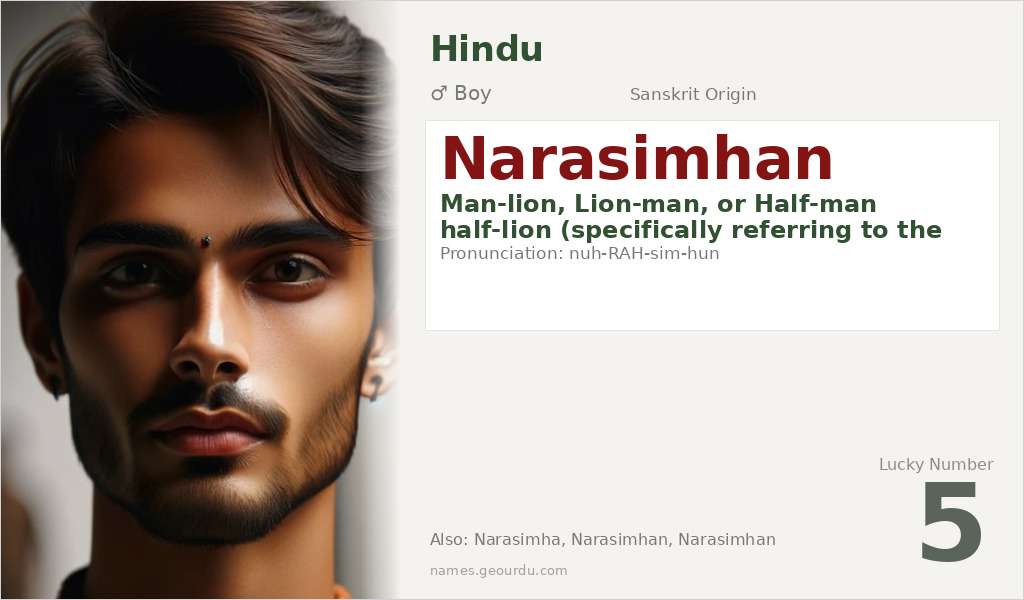
| 💎 Meaning | Man-lion, Lion-man, or Half-man half-lion (specifically referring to the fourth avatar of Vishnu) |
| 👤 Gender | Boy |
| 🕌 Religion | Hindu |
| 🌍 Origin | Sanskrit |
| 🗣 Pronunciation | nuh-RAH-sim-hun |
| ✍️ Urdu | نرسمہن |
| ✍️ Arabic | ناراسيمهان |
| 🔢 Numerology | 5 |
| ✨ Spellings | Narasimha, Narasimhan, Narasimhan, Narasimhan |
Origin & Cultural Significance
Narasimhan has its origins in ancient Sanskrit texts, particularly the Puranas which detail the avataras of Vishnu. The name is deeply embedded in Hindu tradition, with the Narasimha avatar first appearing in texts like the Bhagavata Purana and Vishnu Purana. Culturally, the name is especially prevalent in South Indian states like Tamil Nadu, Karnataka, and Andhra Pradesh, where Dravidian linguistic influences added the ‘-an’ suffix. Historically, the name has been used for centuries to honor the protective qualities of the Narasimha avatar, with many temples across India dedicated to this form of Vishnu. The name maintains religious significance while also functioning as a common given name in Hindu communities worldwide.
Personality Traits
Those named Narasimhan are often associated with protective and courageous qualities, mirroring the mythological avatar from which the name derives. They tend to be principled individuals who stand firmly for justice and righteousness, even in challenging circumstances. The name suggests a personality that combines human wisdom and compassion with the strength and determination of a lion when defending what is right.
Similar Names
If you like Narasimhan, consider: Narasimha, Simha, Narayan, Vishnu, Prahlad
Famous People Named Narasimhan
- Narasimhan Ram — Indian journalist and former editor-in-chief of The Hindu newspaper
- Narasimhan Seshan — former Chief Election Commissioner of India known for electoral reforms
Frequently Asked Questions About Narasimhan
What does Narasimhan mean?
Narasimhan means 'man-lion' or 'half-man half-lion' in Sanskrit, specifically referring to the fourth avatar of the Hindu god Vishnu who appeared in this form to protect his devotee Prahlada.
Is Narasimhan a boy or girl name?
Narasimhan is exclusively a boy's name in Hindu naming tradition, as it refers to a masculine divine avatar and follows masculine grammatical forms in Sanskrit.
What is the origin of Narasimhan?
Narasimhan originates from Sanskrit, with 'nara' meaning 'man' and 'simha' meaning 'lion'. The name specifically comes from Hindu mythology describing Vishnu's Narasimha avatar, with cultural adoption particularly in South Indian communities where Dravidian linguistic elements added the '-an' suffix.