
Table of Contents
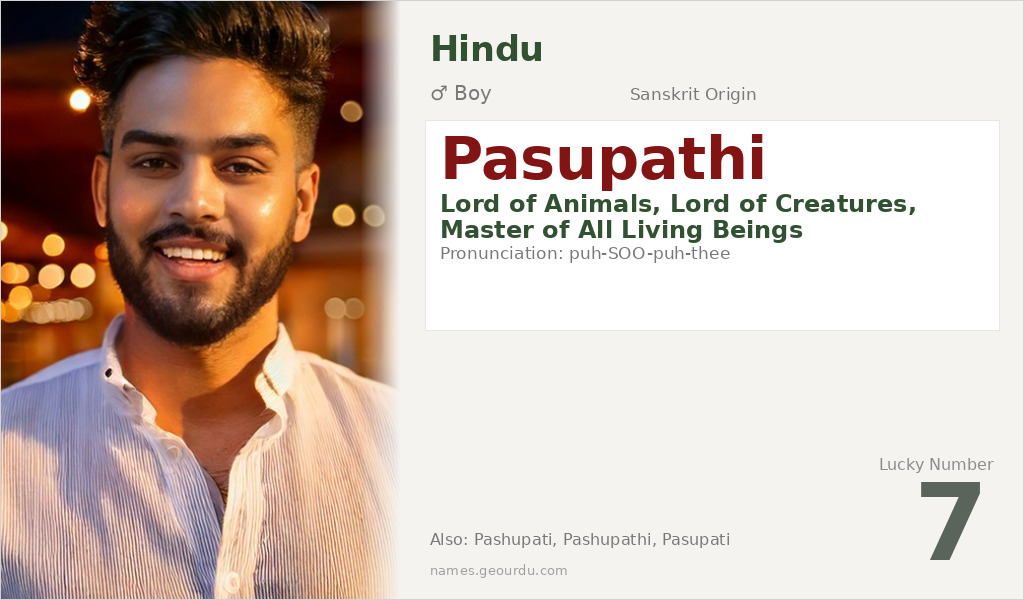
Pasupathi is a profound Sanskrit name with deep roots in Hindu spirituality and mythology. As one of the primary names of Lord Shiva, it carries the powerful meaning ‘Lord of Animals’ or ‘Master of All Living Beings’. This name has been revered for millennia in Indian culture and continues to be chosen by parents seeking a name with spiritual depth and historical significance. Understanding Pasupathi requires exploring its Vedic origins and its central place in Shaivite tradition.
Meaning of Pasupathi
Pasupathi is a compound Sanskrit name formed from two distinct elements: ‘Pashu’ (पशु) and ‘Pati’ (पति). ‘Pashu’ broadly means ‘animal, creature, or any living being’, extending beyond just domesticated animals to encompass all sentient life. ‘Pati’ translates to ‘lord, master, husband, or protector’, indicating authority and guardianship. Together, they create the meaning ‘Lord of Animals’ or ‘Master of All Creatures’. In Hindu theology, this refers to Shiva’s role as the divine protector and shepherd of all souls. The name appears in the Rigveda (circa 1500-1200 BCE) and is particularly significant in the Pasupata tradition, one of the oldest schools of Shaivism. Linguistically, it demonstrates the classical Sanskrit practice of creating meaningful compounds that convey complex theological concepts.
| 📛 Name | Pasupathi |
| 💎 Meaning | Lord of Animals, Lord of Creatures, Master of All Living Beings |
| 👤 Gender | Boy |
| 🕌 Religion | Hindu |
| 🌍 Origin | Sanskrit |
| 🗣 Pronunciation | puh-SOO-puh-thee |
| ✍️ Urdu | پشوپتی |
| ✍️ Arabic | باشوباتي |
| 🔢 Numerology | 7 |
| ✨ Spellings | Pashupati, Pashupathi, Pasupati |
Origin & Cultural Significance
Pasupathi originates from ancient Sanskrit texts and Vedic traditions of the Indian subcontinent. Its earliest documented appearance is in the Rigveda, where Rudra (an early form of Shiva) is described as Pasupati. The name gained particular prominence through the Pasupata sect, which emerged around the 2nd century CE and worshipped Shiva exclusively as Pasupati. Archaeological evidence includes the famous Pasupati seal from the Indus Valley Civilization (circa 2500-1900 BCE), though its interpretation remains debated by scholars. Culturally, the name is predominantly used in Hindu communities across India, Nepal, and the diaspora, especially among Shaivites. It represents not just a name but a theological concept of divine guardianship over all creation, making it more than merely a personal identifier but a connection to ancient spiritual traditions.
Personality Traits
While personality traits associated with names are cultural rather than scientific, Pasupathi carries connotations of protection, wisdom, and spiritual leadership. Those bearing this name are often expected to exhibit qualities of guardianship and responsibility, mirroring Shiva’s role as protector of all beings. There may be associations with strength combined with compassion, and a natural inclination toward spiritual or philosophical pursuits. In many Hindu families, such names are chosen with the hope that the child will embody the divine qualities the name represents.
Similar Names
If you like Pasupathi, consider: Shiva, Mahadeva, Rudra, Nataraja, Bholenath
Famous People Named Pasupathi
- Pashupati Shumsher Rana — Nepalese politician and former Minister of Foreign Affairs
- Pashupati Nath Sukul — Indian freedom fighter and politician from Bihar
Frequently Asked Questions About Pasupathi
What does Pasupathi mean?
Pasupathi means 'Lord of Animals' or 'Master of All Living Beings' in Sanskrit. It is a compound of 'Pashu' (animal/creature) and 'Pati' (lord/master), and is one of the primary names of Lord Shiva in Hindu tradition.
Is Pasupathi a boy or girl name?
Pasupathi is exclusively a boy's name in Hindu naming tradition. As an epithet of Lord Shiva, it carries masculine grammatical and cultural associations in Sanskrit and related languages.
What is the origin of Pasupathi?
Pasupathi originates from Sanskrit, the ancient language of India. It appears in Vedic texts dating back over 3,000 years and is central to Shaivism, where Shiva is worshipped as Pasupati, the protector of all living beings.





