
Table of Contents
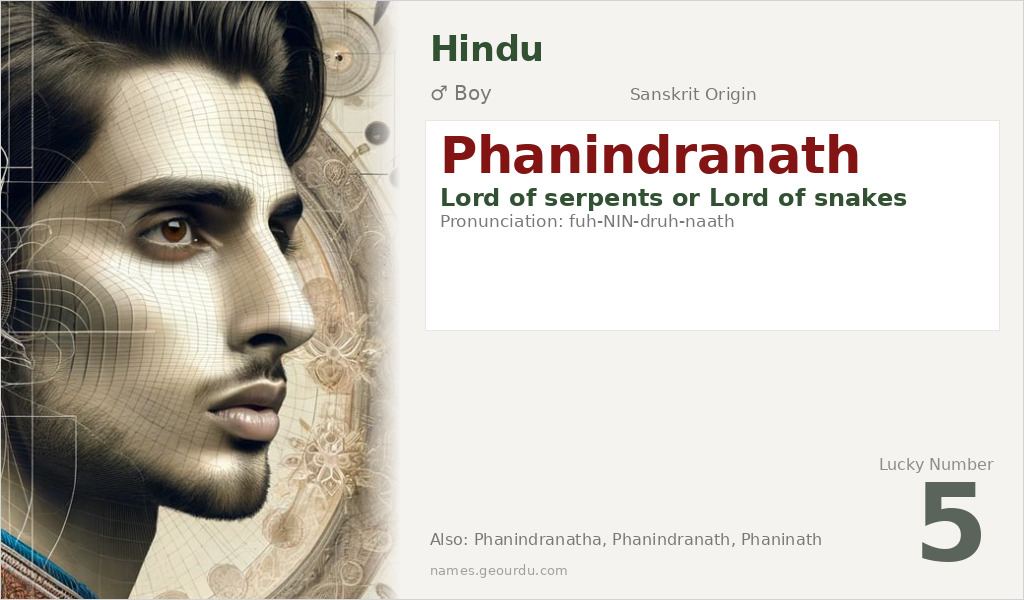
Phanindranath is a powerful Sanskrit name with deep roots in Hindu mythology and tradition. Meaning ‘Lord of serpents’ or ‘Master of snakes’, this name carries both spiritual significance and cultural heritage. Often chosen for boys in Hindu families, it connects the bearer to ancient Indian symbolism where serpents represent wisdom, protection, and cosmic energy. Discover the rich etymology and cultural context behind this distinctive name.
Meaning of Phanindranath
Phanindranath derives from two Sanskrit components: ‘Phanin’ meaning ‘serpent’ or specifically ‘hooded snake’ (from ‘phana’ meaning hood), and ‘Nath’ meaning ‘lord’, ‘master’, or ‘protector’. The complete name therefore translates literally to ‘Lord of serpents’. This is not merely a descriptive term but carries mythological weight in Hinduism, where serpents (nagas) are considered powerful beings with connections to the underworld, wisdom, and protection. The name appears in various Hindu texts as an epithet for deities, particularly Shiva who is often depicted with serpents around his neck, and Vishnu who rests upon the cosmic serpent Sheshnag. The linguistic construction follows classical Sanskrit compound formation rules, creating a meaningful and sonorous name.
| 📛 Name | Phanindranath |
| 💎 Meaning | Lord of serpents or Lord of snakes |
| 👤 Gender | Boy |
| 🕌 Religion | Hindu |
| 🌍 Origin | Sanskrit |
| 🗣 Pronunciation | fuh-NIN-druh-naath |
| ✍️ Urdu | پھنندر ناتھ |
| ✍️ Arabic | فانيندراناث |
| 🔢 Numerology | 5 |
| ✨ Spellings | Phanindranatha, Phanindranath, Phaninath |
Origin & Cultural Significance
Phanindranath originates from classical Sanskrit, the ancient liturgical language of Hinduism. As a compound name, it reflects the sophisticated naming traditions of Hindu culture where names often combine meaningful elements to create layered significance. The name is particularly prevalent in Bengali, Odia, and other eastern Indian communities, though it appears across the Indian subcontinent. Historically, names containing ‘nath’ (lord) were often given to denote devotion to particular deities or to invoke protective qualities. The serpent element connects to pre-Vedic snake worship traditions that were incorporated into Hinduism, where nagas (serpent deities) are revered as guardians of treasures, waters, and the underworld.
Personality Traits
Those named Phanindranath are often perceived as having a dual nature—calm and composed on the surface like a resting serpent, yet potentially powerful and transformative when called to action. They may exhibit natural protective instincts toward family and community, along with a contemplative wisdom that others seek. The serpent symbolism suggests someone who understands both the earthly and spiritual realms, capable of navigating complex situations with grace and discernment.
Similar Names
If you like Phanindranath, consider: Vasuki, Sheshnath, Nagendra, Nagabhushan, Nagadatta
Famous People Named Phanindranath
- Phanindranath Bose — Early 20th century Indian nationalist and revolutionary
- Phanindranath Chakrabarti — Bengali writer and journalist
Frequently Asked Questions About Phanindranath
What does Phanindranath mean?
Phanindranath means 'Lord of serpents' or 'Master of snakes' in Sanskrit. It combines 'Phanin' (serpent) and 'Nath' (lord).
Is Phanindranath a boy or girl name?
Phanindranath is exclusively a masculine name in Hindu naming traditions, given to boys.
What is the origin of Phanindranath?
The name originates from Sanskrit, the classical language of ancient India, and is used primarily in Hindu communities across the Indian subcontinent.





