
Table of Contents
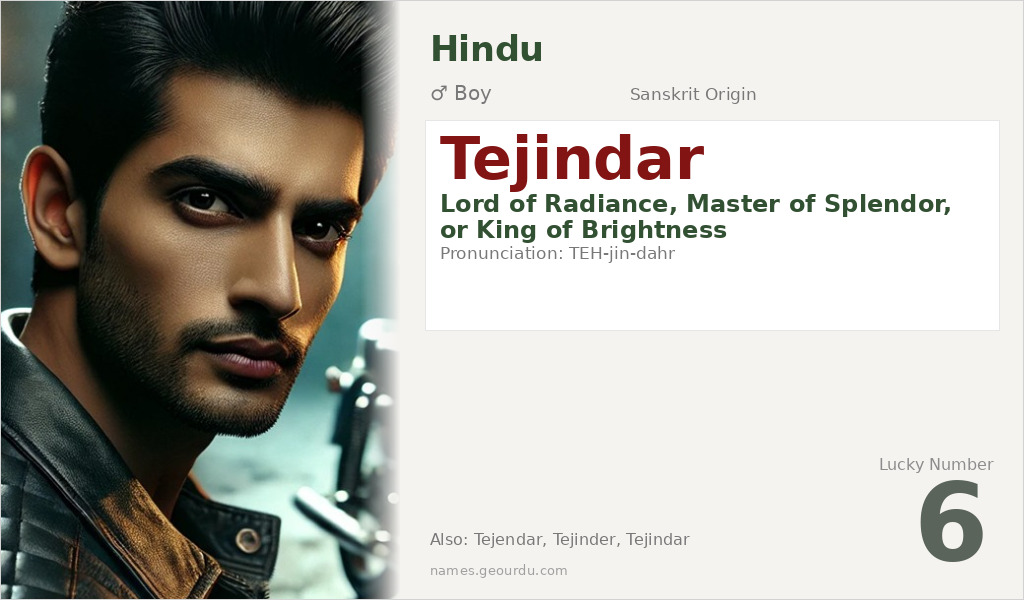
Tejindar is a powerful and meaningful name of Sanskrit origin that carries the essence of brilliance and leadership. Primarily used for boys in Hindu communities, particularly in Punjab and North India, this name combines two significant elements: ‘Tej’ meaning radiance and ‘Indar’ meaning lord. Parents who choose this name often hope to bestow qualities of splendor, strength, and divine protection upon their child. With its rich linguistic roots and cultural resonance, Tejindar remains a distinctive choice that connects modern naming with ancient tradition.
Meaning of Tejindar
Tejindar derives from the Sanskrit language, where it is a compound of two meaningful components. The first part, ‘Tej’ (तेज), signifies radiance, splendor, brilliance, light, or power—a concept deeply embedded in Hindu philosophy representing both physical and spiritual illumination. The second part, ‘Indar’ (इन्द्र), originally refers to Indra, the king of gods in Hindu mythology, but in compound names it functions as a suffix meaning ‘lord,’ ‘master,’ or ‘king.’ When combined, Tejindar literally translates to ‘Lord of Radiance,’ ‘Master of Splendor,’ or ‘King of Brightness.’ This name exemplifies the common Sanskrit naming practice of creating meaningful compounds that convey aspirational qualities, with ‘Tej’ appearing in numerous Indian names like Tejpal, Tejvir, and Tejbir.
| 📛 Name | Tejindar |
| 💎 Meaning | Lord of Radiance, Master of Splendor, or King of Brightness |
| 👤 Gender | Boy |
| 🕌 Religion | Hindu |
| 🌍 Origin | Sanskrit |
| 🗣 Pronunciation | TEH-jin-dahr |
| ✍️ Urdu | تیجندر |
| ✍️ Arabic | تيجيندار |
| 🔢 Numerology | 6 |
| ✨ Spellings | Tejendar, Tejinder, Tejindar |
Origin & Cultural Significance
Tejindar originates from Sanskrit, the classical language of India that has influenced naming traditions across South Asia for millennia. While the name has Sanskrit roots, it is particularly prevalent in Punjabi and North Indian Hindu communities, where compound names ending with ‘indar’ are culturally significant. These names often reflect values of strength, leadership, and divine connection, with ‘indar’ serving as an honorific suffix. The name’s usage spans regions with Hindu populations, including India, Nepal, and diaspora communities worldwide. Historically, such names were chosen to invoke protective qualities and aspirational traits, with Tejindar specifically suggesting someone who embodies or commands brilliance and power.
Personality Traits
According to naming traditions and cultural associations, individuals named Tejindar are believed to possess a luminous and commanding presence. They often exhibit natural leadership qualities, confidence, and a radiant personality that inspires others. The name’s meaning suggests someone who brings light to situations, whether through intelligence, charisma, or moral clarity. These individuals may be drawn to roles where they can shine and guide others, with an inherent sense of responsibility and a desire to achieve meaningful impact.
Similar Names
If you like Tejindar, consider: Tejpal, Tejvir, Tejbir, Tejwant, Tejdeep, Indarjit, Harinder, Kulwinder, Gurinder, Maninder
Famous People Named Tejindar
- Tejinder Singh — Indian cricketer who played for Delhi in domestic cricket
- Tejinder Pal Singh — Punjabi poet and writer known for his contributions to Sikh literature
Frequently Asked Questions About Tejindar
What does Tejindar mean?
Tejindar means 'Lord of Radiance' or 'Master of Splendor' in Sanskrit, combining 'Tej' (radiance) and 'Indar' (lord).
Is Tejindar a boy or girl name?
Tejindar is exclusively a boy's name in Hindu naming traditions, particularly in Punjabi and North Indian communities.
What is the origin of Tejindar?
Tejindar originates from Sanskrit, the classical language of India, and is used primarily in Hindu communities across South Asia.





