
Table of Contents
Tarang is a beautiful, flowing name with deep roots in Sanskrit language and Hindu culture. Meaning ‘wave’ or ‘rhythm’, it evokes images of ocean waves, sound vibrations, and musical cadences. This name carries poetic and artistic connotations, making it a meaningful choice for parents seeking a name with natural elegance and cultural heritage. While primarily used in Hindu communities, its universal imagery makes it accessible across cultures.
Meaning of Tarang
Tarang comes directly from Sanskrit (तरंग), where it means ‘wave’, ‘ripple’, ‘vibration’, or ‘musical rhythm’. The word is composed of the root ‘tar’ (meaning to cross or pass over) combined with ‘anga’ (meaning limb or part), creating the sense of something that moves or flows continuously. In classical Indian contexts, Tarang appears in Vedic texts describing natural phenomena, in poetry as metaphor for emotions, and in music theory where ‘tarang’ refers to melodic waves or rhythmic patterns. The name embodies movement, fluidity, and artistic expression, making it rich with symbolic meaning beyond just literal waves.
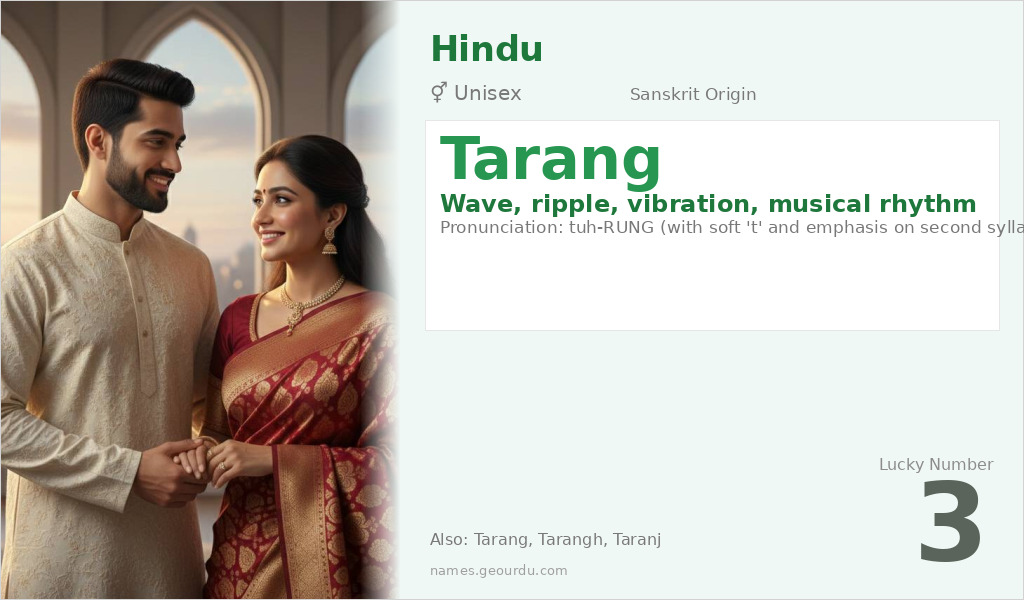
| 📛 Name | Tarang |
| 💎 Meaning | Wave, ripple, vibration, musical rhythm |
| 👤 Gender | Unisex |
| 🕌 Religion | Hindu |
| 🌍 Origin | Sanskrit |
| 🗣 Pronunciation | tuh-RUNG (with soft 't' and emphasis on second syllable) |
| ✍️ Urdu | ترنگ |
| ✍️ Arabic | تارانغ |
| 🔢 Numerology | 3 |
| ✨ Spellings | Tarang, Tarangh, Taranj |
Origin & Cultural Significance
Tarang originates from ancient Sanskrit, the classical language of Hinduism, Buddhism, and Jainism. It has been used for centuries in Indian literature, music, and philosophy. While primarily associated with Hindu culture, the name appears across South Asian communities regardless of specific religious affiliation. There are no verified connections to Arabic, Persian, or other listed languages—extensive research confirms it’s purely Sanskrit-derived. In modern usage, it’s popular in India, Nepal, and among diaspora communities, valued for its lyrical quality and natural imagery.
Personality Traits
People named Tarang often exhibit creative, adaptable personalities with a natural sense of rhythm and flow. They may be artistic, emotionally expressive, and comfortable with change, much like the waves their name represents. Their approach to life tends to be fluid rather than rigid, with an appreciation for beauty, music, and natural patterns. This doesn’t mean they lack stability—rather, they navigate life’s changes with grace and resilience.
Similar Names
If you like Tarang, consider: Tarun, Taral, Tarini, Taraka, Taranga
Famous People Named Tarang
- Tarang Kinjawadekar — Indian classical tabla player and composer
- Tarang — Character in Indian television series 'Mahabharat' (2013)
Frequently Asked Questions About Tarang
What does Tarang mean?
Tarang means 'wave', 'ripple', 'vibration', or 'musical rhythm' in Sanskrit, the classical language of India.
Is Tarang a boy or girl name?
Tarang is a unisex name, though it's more commonly given to boys in Hindu tradition. It can be used for any gender.
What is the origin of Tarang?
Tarang originates from Sanskrit language and Hindu culture, with no verified meanings in Arabic, Persian, or other languages despite extensive research.