
Table of Contents
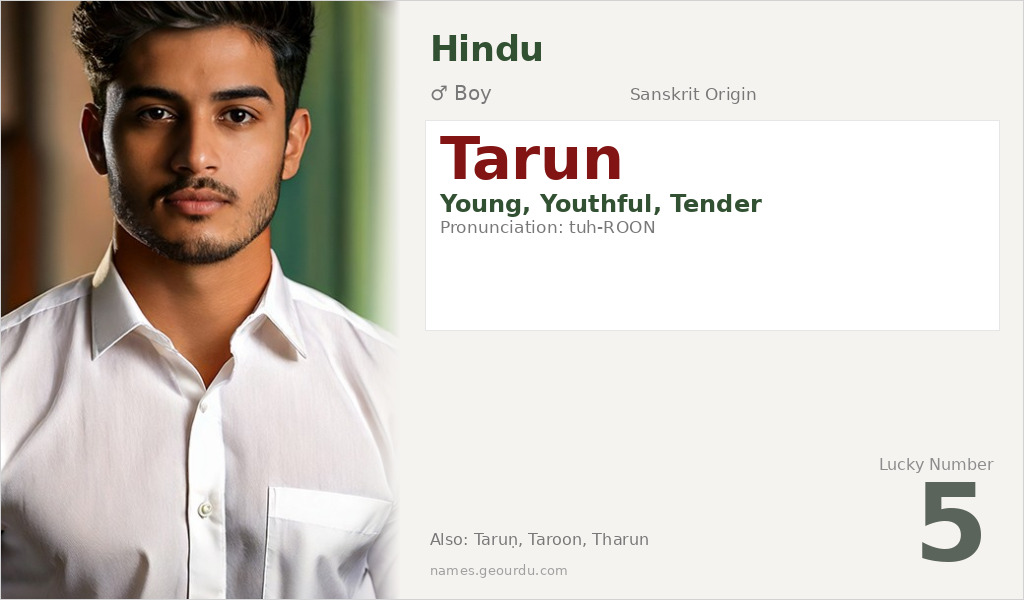
Tarun is a classic Indian name with deep roots in Sanskrit tradition. Meaning ‘young’ or ‘youthful’, it captures the essence of vitality and new beginnings. Popular across India and among Hindu communities worldwide, this name carries both cultural significance and timeless appeal. Let’s explore the rich linguistic heritage and contemporary relevance of the name Tarun.
Meaning of Tarun
The name Tarun originates from the Sanskrit word ‘taruna’ (तरुण), which unequivocally means ‘young’, ‘youthful’, or ‘tender’. Sanskrit, as one of the oldest Indo-European languages, provides the definitive etymology for this name. In Vedic and classical Sanskrit literature, ‘taruna’ describes someone in the early stage of life, often associated with freshness, vigor, and potential. The name has maintained this core meaning through centuries of usage in Hindu culture, appearing in epics like the Mahabharata where it describes young warriors and heroes. Unlike some names that evolve semantically, Tarun has remained remarkably consistent in its meaning across different Indian languages and regions.
| 📛 Name | Tarun |
| 💎 Meaning | Young, Youthful, Tender |
| 👤 Gender | Boy |
| 🕌 Religion | Hindu |
| 🌍 Origin | Sanskrit |
| 🗣 Pronunciation | tuh-ROON |
| ✍️ Urdu | ترن |
| ✍️ Arabic | تارون |
| 🔢 Numerology | 5 |
| ✨ Spellings | Taruṇ, Taroon, Tharun |
Origin & Cultural Significance
Tarun has its origins firmly in ancient Sanskrit, the liturgical language of Hinduism. It emerged as a given name within Hindu communities across the Indian subcontinent, particularly in regions where Sanskrit influence was strong. The name appears in various Hindu texts and has been used by multiple communities in India, Nepal, and the diaspora. While primarily associated with Hinduism, the name’s linguistic roots in Sanskrit give it cultural significance beyond strictly religious boundaries. In contemporary usage, it remains popular among Hindu families while also being adopted by some non-Hindu Indians who appreciate its melodic sound and positive meaning.
Personality Traits
People named Tarun are often described as having youthful energy and a positive outlook on life. They tend to approach challenges with enthusiasm and adaptability, qualities that align with the name’s meaning of ‘young’ and ‘fresh’. Their natural curiosity drives them to explore new ideas and experiences, making them lifelong learners. While personality traits vary by individual, the name Tarun carries connotations of vitality, optimism, and growth.
Similar Names
If you like Tarun, consider: Yuvan, Kumar, Balak, Yuvaan, Navin
Famous People Named Tarun
- Tarun Tahiliani — Indian fashion designer known for bridal wear
- Tarun Gogoi — Former Chief Minister of Assam, India
Frequently Asked Questions About Tarun
What does Tarun mean?
Tarun means 'young', 'youthful', or 'tender'. It comes from the Sanskrit word 'taruna' (तरुण), which has been used for centuries in Indian literature and Hindu texts.
Is Tarun a boy or girl name?
Tarun is exclusively a boy's name in Hindu naming tradition. While some Sanskrit words have gender-neutral applications, 'tarun' as a personal name is traditionally masculine in all recorded usage.
What is the origin of Tarun?
Tarun originates from Sanskrit, one of the oldest languages of the Indian subcontinent. It has been used as a given name within Hindu communities for centuries, with documented appearances in classical Hindu texts and epics.





