
Table of Contents
Yaksh is a distinctive Sanskrit name with deep roots in Indian mythology and spirituality. Unlike common modern names, it carries the weight of ancient traditions where Yakshas were revered as nature spirits and divine attendants. This name connects the bearer to a rich cultural heritage of protective celestial beings who guard natural treasures. Choosing Yaksh for a child links them to centuries of spiritual storytelling.
Meaning of Yaksh
The name Yaksh derives directly from the Sanskrit word ‘Yaksha’ (यक्ष), which refers to a class of semi-divine beings in Indian religions. Etymologically, it comes from the Sanskrit root ‘yaj’ (यज्) meaning ‘to worship, honor, or sacrifice,’ reflecting their divine status. In Hindu, Buddhist, and Jain texts, Yakshas are nature spirits who serve as guardians of natural places and treasures, often associated with Kubera, the god of wealth. The term appears in ancient literature including the Rigveda (where Yakshas are mentioned in ritual contexts) and the Mahabharata (as protectors of forests). Unlike gods (devas), Yakshas occupy an intermediate position between humans and deities, making the name signify ‘celestial attendant’ or ‘nature guardian’ rather than a direct divine representative.
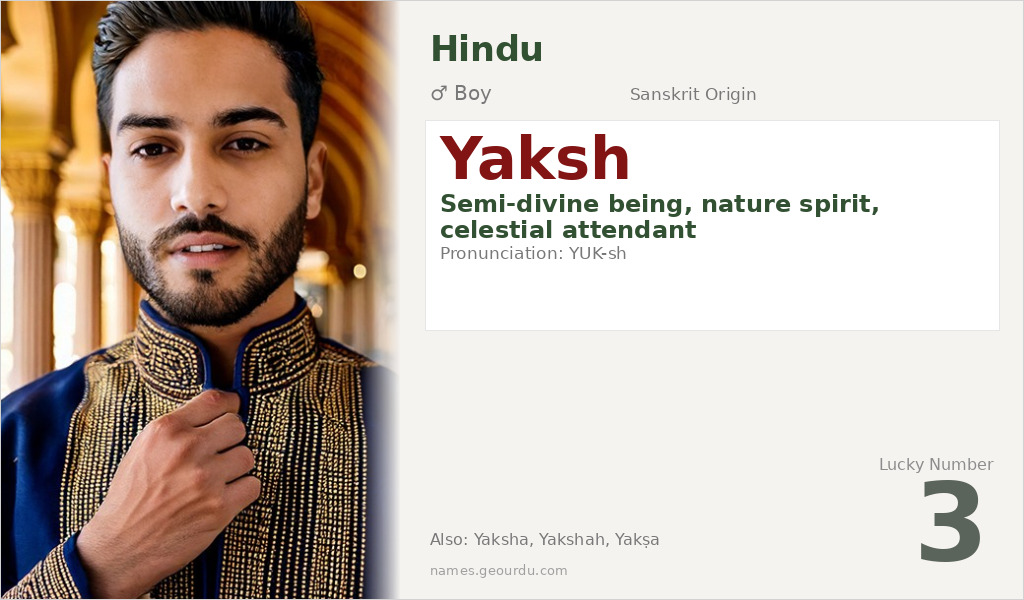
| 📛 Name | Yaksh |
| 💎 Meaning | Semi-divine being, nature spirit, celestial attendant |
| 👤 Gender | Boy |
| 🕌 Religion | Hindu |
| 🌍 Origin | Sanskrit |
| 🗣 Pronunciation | YUK-sh |
| ✍️ Urdu | یکش |
| ✍️ Arabic | يَكْش |
| 🔢 Numerology | 3 |
| ✨ Spellings | Yaksha, Yakshah, Yakṣa |
Origin & Cultural Significance
Yaksh originates from classical Sanskrit, the liturgical language of Hinduism, with documented usage for millennia. The concept of Yakshas appears across Indian religions—in Hinduism as attendants to Kubera, in Buddhism as protective deities mentioned in Jataka tales, and in Jainism as supernatural beings. Culturally, Yakshas were worshipped in ancient India as guardians of villages, forests, and water sources, with archaeological evidence from sites like Mathura showing Yaksha statues from the 2nd century BCE. The name reflects India’s animistic traditions where natural elements were personified as divine spirits. While primarily Hindu in contemporary usage, the name’s mythological roots span multiple faiths that originated in the Indian subcontinent.
Personality Traits
Those named Yaksh often exhibit traits reminiscent of their mythological namesakes—protective, nature-connected, and spiritually inclined. They may demonstrate creativity and expressiveness, much like the artistic depictions of Yakshas in Indian art. Their personality tends to balance earthly practicality with higher spiritual awareness, reflecting the semi-divine status of Yakshas who bridge human and divine realms. This name suggests someone who values guardianship, whether of people, ideas, or natural environments.
Similar Names
If you like Yaksh, consider: Yaksha, Yakshi, Yakshini, Yaksharaj, Yakshadhipa
Famous People Named Yaksh
- Yaksh — Indian actor known for Telugu films
- Yaksh Patel — emerging Indian cricketer
Frequently Asked Questions About Yaksh
What does Yaksh mean?
Yaksh means 'semi-divine being' or 'nature spirit' in Sanskrit, specifically referring to celestial attendants in Hindu, Buddhist, and Jain mythology who guard natural treasures.
Is Yaksh a boy or girl name?
Yaksh is primarily a boy's name in Hindu naming traditions, though the feminine form 'Yakshi' or 'Yakshini' exists for girls.
What is the origin of Yaksh?
Yaksh originates from Sanskrit, the ancient Indian language, with roots in Hindu mythology where Yakshas appear as nature spirits and attendants to deities like Kubera.





