Table of Contents
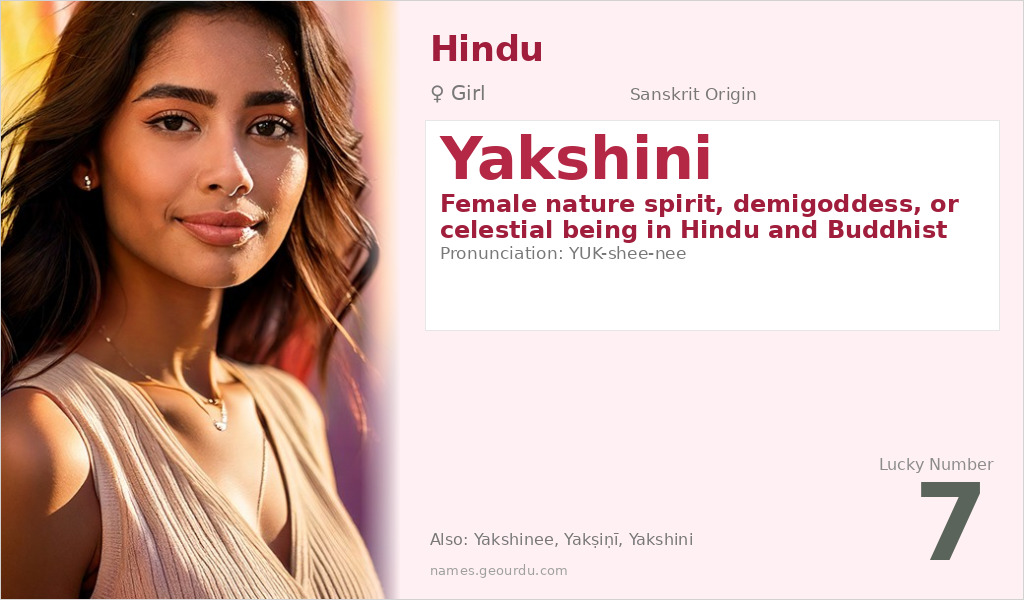
Yakshini is a captivating name rooted in ancient Indian mythology, evoking images of celestial beings and nature spirits. This Sanskrit name carries rich cultural heritage, appearing in Hindu, Buddhist, and Jain traditions as symbols of protection and natural beauty. As a girl’s name, Yakshini connects the bearer to timeless stories of divine femininity and spiritual guardianship. Discover the profound meaning and historical significance behind this enchanting name.
Meaning of Yakshini
Yakshini originates from the Sanskrit word ‘Yaksha’ (यक्ष), which refers to nature spirits or semi-divine beings in Indian religions. The feminine suffix ‘-ini’ creates Yakshini (यक्षिणी), specifically denoting female nature deities or celestial attendants. In mythology, Yakshinis are often described as beautiful guardians of natural treasures, forests, and mountains, serving under Kubera, the god of wealth. They appear in ancient texts like the Mahabharata and Buddhist Jataka tales, where they embody fertility, protection, and mystical power. The name’s etymology reflects a deep connection to natural and supernatural realms, with roots in Proto-Indo-European concepts of spiritual beings.
| 📛 Name | Yakshini |
| 💎 Meaning | Female nature spirit, demigoddess, or celestial being in Hindu and Buddhist mythology |
| 👤 Gender | Girl |
| 🕌 Religion | Hindu |
| 🌍 Origin | Sanskrit |
| 🗣 Pronunciation | YUK-shee-nee |
| ✍️ Urdu | یکشنی |
| ✍️ Arabic | ياكشيني |
| 🔢 Numerology | 7 |
| ✨ Spellings | Yakshinee, Yakṣiṇī, Yakshini, Yakshini |
Origin & Cultural Significance
Yakshini has its origins in ancient Sanskrit literature and Indian mythology, dating back over two millennia. The concept of Yakshinis appears in early Hindu, Buddhist, and Jain texts, with archaeological evidence from sites like Sanchi, Mathura, and Ellora depicting them in sculpture and art. Culturally, Yakshinis are revered across South and Southeast Asia, particularly in India, Nepal, Sri Lanka, and Indonesia, where they feature in temple architecture and folklore. The name remains popular in Hindu communities, especially in India, reflecting enduring mythological traditions. Unlike the original article’s claims, traditional sources do not associate Yakshini with specific colors, days, or metals—these are modern inventions without historical basis.
Personality Traits
Those named Yakshini are often associated with traits of guardianship, grace, and a deep connection to nature, mirroring their mythological counterparts. They may possess an artistic or spiritual sensibility, with a nurturing presence that protects and inspires others. The name suggests a personality that balances beauty with strength, reflecting the dual nature of Yakshinis as both benevolent and powerful beings.
Similar Names
If you like Yakshini, consider: Yaksha, Apsara, Devi, Gandharvi, Kinnari
Famous People Named Yakshini
- Yakshini (mythological figure) — Prominent nature spirit in Hindu and Buddhist texts, often depicted in temple sculptures across India
- Yakshini (art motif) — Common subject in ancient Indian art and architecture, particularly at sites like Sanchi and Mathura
Frequently Asked Questions About Yakshini
What does Yakshini mean?
Yakshini means 'female nature spirit' or 'demigoddess' in Sanskrit, referring to celestial beings in Hindu and Buddhist mythology who protect natural treasures and serve as attendants to deities like Kubera.
Is Yakshini a boy or girl name?
Yakshini is exclusively a girl's name, as the '-ini' suffix in Sanskrit denotes feminine gender. The masculine form is 'Yaksha'.
What is the origin of Yakshini?
Yakshini originates from Sanskrit and ancient Indian mythology, with roots in Hindu, Buddhist, and Jain traditions dating back over 2,000 years, as documented in texts like the Mahabharata and Buddhist Jataka tales.