
Table of Contents
Magdalena is a timeless name with profound biblical roots, famously borne by Mary Magdalene, one of Jesus Christ’s most devoted followers. This elegant name has traveled through centuries and cultures, maintaining its spiritual significance while adapting to various languages. From its Hebrew origins to its widespread use in Christian communities worldwide, Magdalena represents faith, strength, and historical continuity. Discover the rich tapestry of meaning and tradition woven into this beautiful name.
Meaning of Magdalena
Magdalena originates from the Hebrew place name ‘Magdala’ (מִגְדָּל), which means ‘tower’ or ‘elevated, great, magnificent’. The name specifically denotes ‘woman from Magdala’, referring to Mary Magdalene’s origin from the fishing village on the Sea of Galilee. Through Greek (Μαγδαληνή) and Latin (Magdalena) transmission, the name entered Christian tradition as a reference to this important biblical figure. The ‘-ena’ suffix represents a common feminine form in these classical languages. Thus, Magdalena carries both geographical and descriptive meaning—not just identifying someone from Magdala, but also suggesting the qualities of strength and elevation associated with a tower.
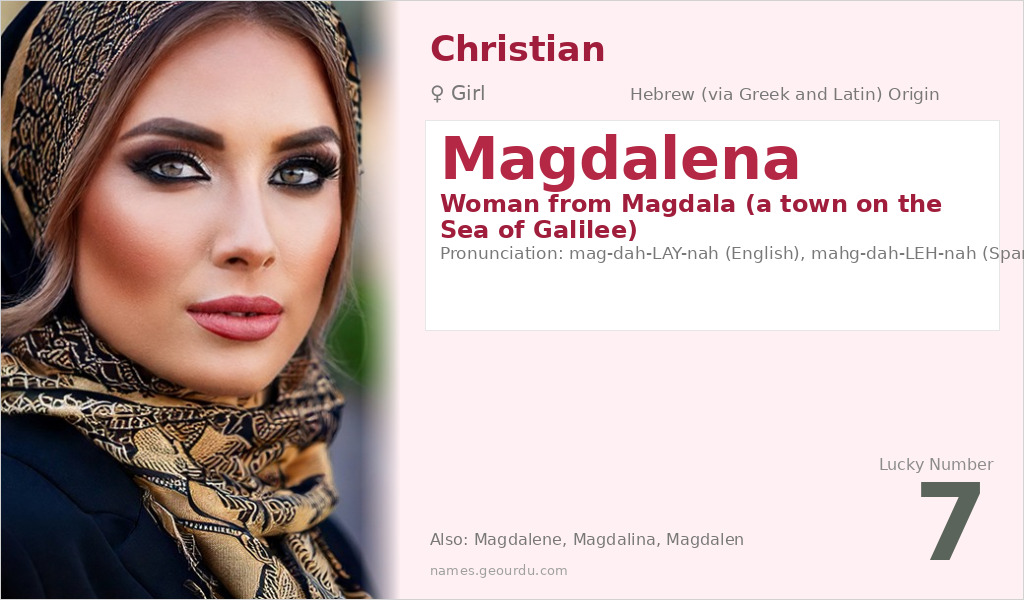
| 📛 Name | Magdalena |
| 💎 Meaning | Woman from Magdala (a town on the Sea of Galilee) |
| 👤 Gender | Girl |
| 🕌 Religion | Christian |
| 🌍 Origin | Hebrew (via Greek and Latin) |
| 🗣 Pronunciation | mag-dah-LAY-nah (English), mahg-dah-LEH-nah (Spanish/Polish) |
| ✍️ Urdu | میگڈالینا |
| ✍️ Arabic | مجدلين |
| 🔢 Numerology | 7 |
| ✨ Spellings | Magdalene, Magdalina, Magdalen, Magdaléna, Magdalina |
Origin & Cultural Significance
Magdalena’s origin traces directly to first-century Judea and the village of Magdala (modern-day Migdal), home to Mary Magdalene. The name gained prominence through the New Testament Gospels, where Mary Magdalene appears as a key disciple of Jesus. During the Middle Ages, devotion to Mary Magdalene spread throughout Europe, making Magdalena a popular name in Catholic and Orthodox Christian communities. The name has particularly strong traditions in Spanish-speaking countries, Poland, Germany, and Scandinavia, often with local variations in spelling and pronunciation. Unlike many names that evolved through multiple cultures, Magdalena maintains a direct line from its biblical source to modern usage.
Personality Traits
Those named Magdalena often carry associations of spiritual depth, compassion, and resilience inspired by the biblical Mary Magdalene. The name’s meaning (‘tower’) suggests qualities of strength, protection, and stability. Historically, Magdalena has been associated with redemption and devotion, giving it emotional and religious significance. While personality traits vary by individual, the name’s heritage lends it an air of grace, faith, and historical continuity.
Similar Names
If you like Magdalena, consider: Madeleine, Madeline, Magda, Maddalena, Magali
Famous People Named Magdalena
- Mary Magdalene — Biblical figure, follower of Jesus Christ
- Magdalena Abakanowicz — Polish sculptor and fiber artist
- Magdalena Neuner — German former biathlete, two-time Olympic champion
- Magdalena Frackowiak — Polish fashion model and actress
Frequently Asked Questions About Magdalena
What does Magdalena mean?
Magdalena means 'woman from Magdala', with Magdala being a Hebrew place name meaning 'tower' or 'elevated'. The name specifically refers to Mary Magdalene's origin from the village of Magdala on the Sea of Galilee.
Is Magdalena a boy or girl name?
Magdalena is exclusively a feminine name. It has been used for girls throughout Christian history, originating as the name for Mary Magdalene in the New Testament.
What is the origin of Magdalena?
Magdalena originates from Hebrew via Greek and Latin. It comes from the place name Magdala (meaning 'tower') and specifically refers to Mary Magdalene, making it fundamentally a Christian name with biblical roots.





