
Table of Contents
Lisanne is an elegant, modern compound name that beautifully blends traditional elements with contemporary appeal. With roots stretching back to ancient Hebrew names and European naming traditions, this name carries layers of meaning that resonate across cultures. Whether you’re drawn to its spiritual significance or its melodic sound, Lisanne offers a distinctive choice that stands out while honoring classic naming conventions.
Meaning of Lisanne
The name Lisanne derives from two established name elements with deep historical roots. The ‘Lis’ component primarily originates from Elisabeth, which comes from the Hebrew name Elisheva (אֱלִישֶׁבַע) meaning ‘God is my oath’—combining ‘El’ (God) and ‘sheva’ (oath). Alternatively, ‘Lis’ may connect to the Germanic ‘lisa’ meaning ‘noble’ or serve as a diminutive of names like Elizabeth. The ‘anne’ element traces back to the Hebrew name Channah (חַנָּה) meaning ‘grace’ or ‘favor,’ which entered European languages through the Latin ‘Anna.’ When combined, Lisanne can be interpreted as ‘God is my oath and grace,’ or more poetically as ‘graceful lily’ through association with the flower symbolism. This compound construction follows a common European naming pattern similar to names like Rosanne or Marianne.
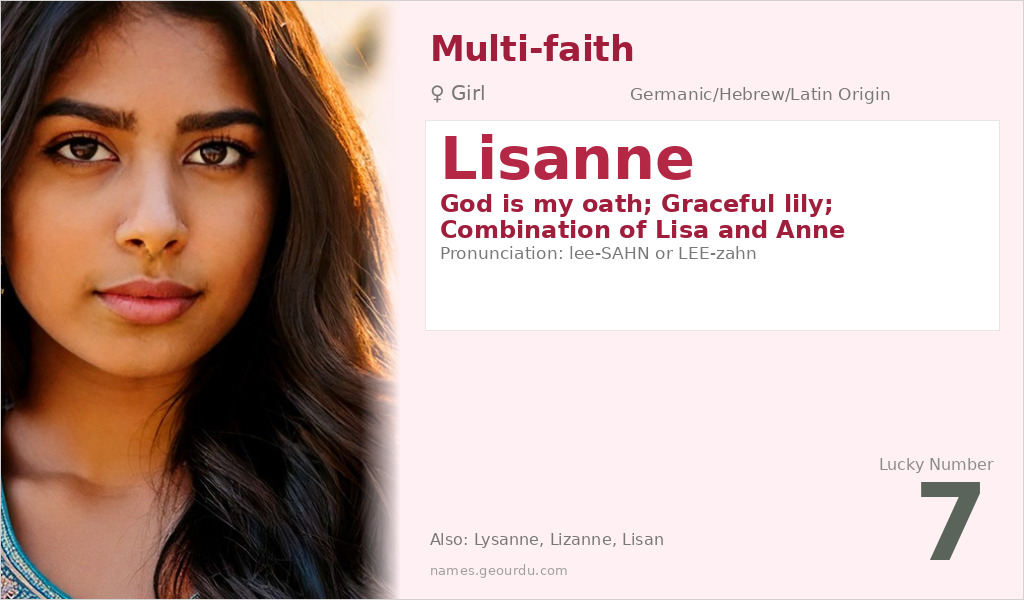
| 📛 Name | Lisanne |
| 💎 Meaning | God is my oath; Graceful lily; Combination of Lisa and Anne |
| 👤 Gender | Girl |
| 🕌 Religion | Multi-faith |
| 🌍 Origin | Germanic/Hebrew/Latin |
| 🗣 Pronunciation | lee-SAHN or LEE-zahn |
| ✍️ Urdu | لیسان |
| ✍️ Arabic | ليسان |
| 🔢 Numerology | 7 |
| ✨ Spellings | Lysanne, Lizanne, Lisan, Lysann |
Origin & Cultural Significance
Lisanne emerged as a modern European given name in the 20th century, particularly popular in Dutch, German, and Scandinavian countries. While its components have ancient origins—Elisabeth appears in the Hebrew Bible, and Anne has biblical and saintly associations—the specific combination Lisanne represents a contemporary innovation. The name gained traction in post-World War II Europe as parents sought names that sounded both traditional and fresh. Unlike names with single-language origins, Lisanne’s hybrid nature reflects the interconnectedness of European naming traditions, drawing from Hebrew through Christian adoption, Germanic linguistic patterns, and Latin influences. It’s particularly common in the Netherlands, where compound names have been fashionable since the mid-20th century.
Personality Traits
Those named Lisanne often embody the dual qualities suggested by their name’s components: the steadfastness of ‘God is my oath’ and the elegance of ‘grace.’ They tend to be thoughtful individuals who value both tradition and personal expression. With the analytical energy associated with the number 7 in numerology, Lisannes frequently exhibit intellectual curiosity and spiritual depth. Their compound name suggests someone who can balance different aspects of their personality—perhaps both practical and idealistic, both traditional and innovative.
Similar Names
If you like Lisanne, consider: Elisabeth, Annabelle, Lillian, Susanne, Rosanne
Famous People Named Lisanne
- Lisanne de Roever — Dutch field hockey goalkeeper, Olympic medalist
- Lisanne Falk — American actress known for 'Heathers' (1989 film)
Frequently Asked Questions About Lisanne
What does Lisanne mean?
Lisanne primarily means 'God is my oath' from its Elisabeth root, combined with 'grace' from Anne. It can also be interpreted as 'graceful lily' through floral association.
Is Lisanne a boy or girl name?
Lisanne is exclusively a feminine name across all cultures where it's used, following the feminine endings of both its component names (Elisabeth and Anne).
What is the origin of Lisanne?
Lisanne is a modern European compound name with components originating from Hebrew (Elisheva and Channah) that entered European languages through Latin and Germanic adaptations, particularly popular in Dutch and German-speaking regions.





