
Table of Contents
Carl is a timeless masculine name with deep Germanic roots that has traveled across continents and centuries. Meaning ‘free man’ or ‘farmer’, this name carries connotations of independence, strength, and connection to the land. From Scandinavian kings to modern scientists, Carl has been borne by influential figures throughout history. Its straightforward sound and rich heritage make it a enduring choice for parents worldwide.
Meaning of Carl
The name Carl originates from the Old Norse word ‘karl’, which meant ‘man’ or ‘free man’, distinguishing those who were neither nobility nor serfs in medieval Germanic societies. This evolved into the Old English ‘ceorl’, referring to a freeman of the lowest rank who owned land. The Germanic root is shared across Scandinavian languages as Karl and appears in various forms throughout Europe. The fundamental meaning relates to masculinity, freedom, and agricultural connection, reflecting the social structure of early Germanic tribes where most free men were farmers or landowners.
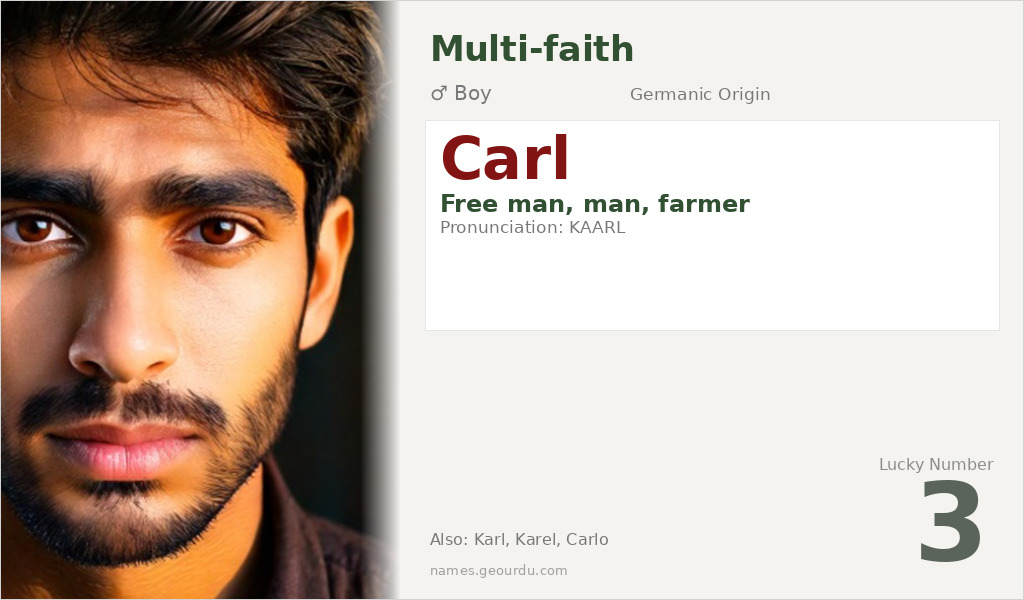
| 📛 Name | Carl |
| 💎 Meaning | Free man, man, farmer |
| 👤 Gender | Boy |
| 🕌 Religion | Multi-faith |
| 🌍 Origin | Germanic |
| 🗣 Pronunciation | KAARL |
| ✍️ Urdu | کارل |
| ✍️ Arabic | كارل |
| 🔢 Numerology | 3 |
| ✨ Spellings | Karl, Karel, Carlo, Carlos, Charles |
Origin & Cultural Significance
Carl has its origins in ancient Germanic languages, specifically from the Proto-Germanic word *karlaz meaning ‘free man’. The name became prominent through Viking expansion and was borne by several Scandinavian rulers, including Karl (Charlemagne) who united much of Western Europe. It spread throughout Europe during the Middle Ages, evolving into Charles in French and English, Carlo in Italian, and Carlos in Spanish. Despite its pagan Germanic origins, the name became popular in Christian Europe after Charlemagne’s reign, demonstrating how names can transcend their original cultural and religious contexts.
Personality Traits
Those named Carl often embody the practical, resilient qualities suggested by their name’s meaning of ‘free man’ or ‘farmer’. They tend to be dependable, hardworking individuals who value their independence while maintaining strong community ties. The name’s Germanic heritage suggests characteristics of straightforwardness, perseverance, and a connection to tradition, though individual personalities naturally vary across cultures and personal experiences.
Similar Names
If you like Carl, consider: Karl, Charles, Carlton, Carlisle, Carleton
Famous People Named Carl
- Carl Linnaeus — Swedish botanist who formalized binomial nomenclature
- Carl Jung — Swiss psychiatrist and psychoanalyst who founded analytical psychology
Frequently Asked Questions About Carl
What does Carl mean?
Carl means 'free man', 'man', or 'farmer' and originates from the Old Norse word 'karl', which evolved through Germanic languages.
Is Carl a boy or girl name?
Carl is traditionally a masculine name, though variations like Carla and Caroline exist for females. In modern usage, it remains predominantly a boy's name across cultures.
What is the origin of Carl?
Carl has Germanic origins, specifically from Old Norse 'karl' meaning 'free man'. It spread through Scandinavian and German influence before becoming popular across Europe.





