
Table of Contents
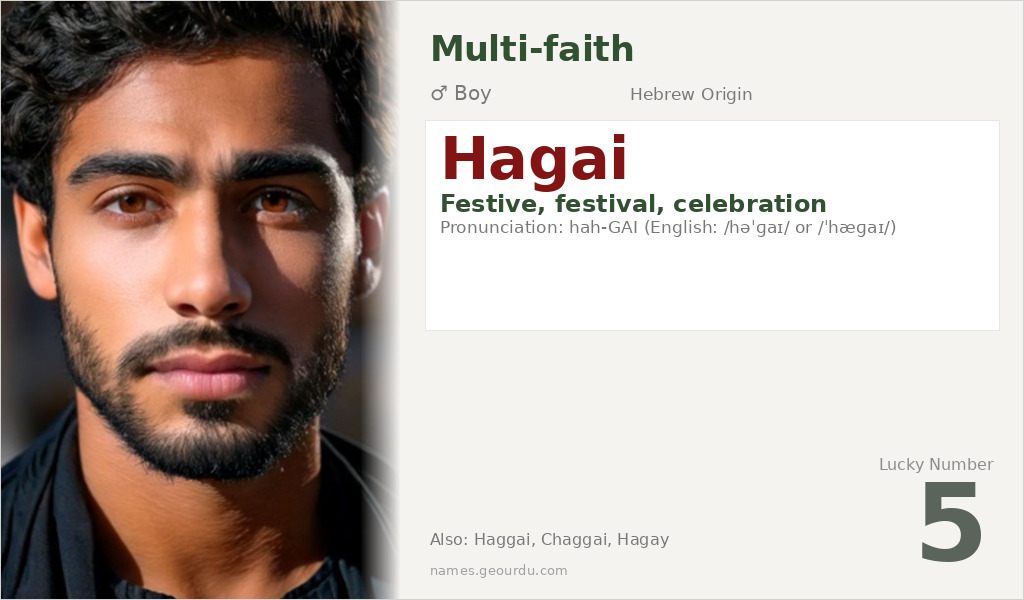
Hagai is a name rich with historical and spiritual significance, tracing its roots back to ancient Hebrew scripture. While simple in sound, it carries the powerful meaning of ‘festive’ or ‘celebration,’ connected to religious observance and joy. This name gained prominence through the Biblical prophet Haggai, who played a crucial role in Jewish history. Today, it remains a meaningful choice for parents seeking a name with deep religious heritage and positive connotations.
Meaning of Hagai
The name Hagai originates from the Hebrew word חַג (chag), meaning ‘festival’ or ‘feast.’ It is derived from the verb חָגַג (chagag), which means ‘to celebrate,’ ‘to hold a pilgrimage feast,’ or ‘to dance in a circle.’ This root appears throughout the Hebrew Bible in contexts of religious celebration, such as the pilgrimage festivals of Passover, Shavuot, and Sukkot. The name is the shortened form of Haggai, which directly translates to ‘my festival’ or ‘festive one.’ In its Biblical context, it symbolizes not just general celebration but specifically the joy found in religious observance and community gathering. This etymological background makes Hagai a name imbued with historical depth and spiritual resonance.
| 📛 Name | Hagai |
| 💎 Meaning | Festive, festival, celebration |
| 👤 Gender | Boy |
| 🕌 Religion | Multi-faith |
| 🌍 Origin | Hebrew |
| 🗣 Pronunciation | hah-GAI (English: /həˈɡaɪ/ or /ˈhæɡaɪ/) |
| ✍️ Urdu | ہگائی |
| ✍️ Arabic | حَجَّي |
| 🔢 Numerology | 5 |
| ✨ Spellings | Haggai, Chaggai, Hagay |
Origin & Cultural Significance
Hagai has its origins in ancient Hebrew culture and the Jewish religious tradition. It first appears in the Hebrew Bible (Old Testament) as the name of the prophet Haggai, who lived around 520 BCE after the Babylonian exile. His book, the Book of Haggai, records his messages encouraging the Jewish people to rebuild the Temple in Jerusalem. While the name is fundamentally Hebrew and Jewish in origin, it has been adopted by Christians through the inclusion of the Old Testament in the Christian Bible. It is used in various cultures, particularly among Jewish communities and those with Biblical naming traditions. The name’s usage reflects its scriptural significance rather than regional tribal origins, distinguishing it from names from Pashto, Balochi, or other regional languages.
Personality Traits
Drawing from its meaning ‘festive,’ individuals named Hagai are often associated with joy, optimism, and a communal spirit. They may be natural leaders who inspire others, much like the prophet who motivated a community to rebuild. Their personality might include a strong sense of tradition, resilience in challenges, and an ability to bring people together in celebration. While names don’t determine personality, the historical and linguistic associations of Hagai suggest qualities of encouragement, faith, and joyous determination.
Similar Names
If you like Hagai, consider: Haggai, Hanan, Hosea, Habakkuk, Hezekiah
Famous People Named Hagai
- Haggai (Biblical Prophet) — One of the twelve minor prophets in the Hebrew Bible/Old Testament who lived in the 6th century BCE and urged the rebuilding of the Second Temple in Jerusalem.
- Hagai Shaham — Israeli violinist known for his interpretations of classical and Jewish music.
Frequently Asked Questions About Hagai
What does Hagai mean?
Hagai means 'festive,' 'celebration,' or 'my festival' in Hebrew, derived from the root word for religious feast or pilgrimage.
Is Hagai a boy or girl name?
Hagai is traditionally a boy's name, as it originates from the male Biblical prophet Haggai. It is rarely, if ever, used for girls.
What is the origin of Hagai?
Hagai originates from Hebrew, specifically from the Hebrew Bible where it is the name of a prophet. It is a Jewish name with adoption in Christian contexts due to shared scripture.





