
Table of Contents
Ewald is a distinguished Germanic name with deep historical roots and a meaningful etymology that reflects values of justice and leadership. Primarily used for boys, this name carries centuries of tradition through its association with early Christian missionaries and its continued use in German-speaking regions. With its strong, resonant sound and noble meaning, Ewald offers a classic choice with substantial cultural heritage.
Meaning of Ewald
The name Ewald derives from Old High German elements that combine to create a powerful meaning. The first component ‘ewa’ (also appearing as ‘ēwa’ or ‘ēo’) signifies ‘law, custom, ordinance, or right’—referring to both legal statutes and traditional practices. The second element ‘wald’ means ‘ruler, power, might, or authority’. Thus, Ewald literally translates to ‘ruler of law’ or ‘powerful law’, suggesting someone who governs with justice or embodies legal authority. This compound structure is characteristic of many traditional Germanic names, where meaningful elements were combined to create names with aspirational qualities. The name’s components appear in various other Germanic names: ‘wald’ is found in names like Oswald (‘divine power’) and Gerald (‘spear ruler’), while law-related elements appear in names like Eward.
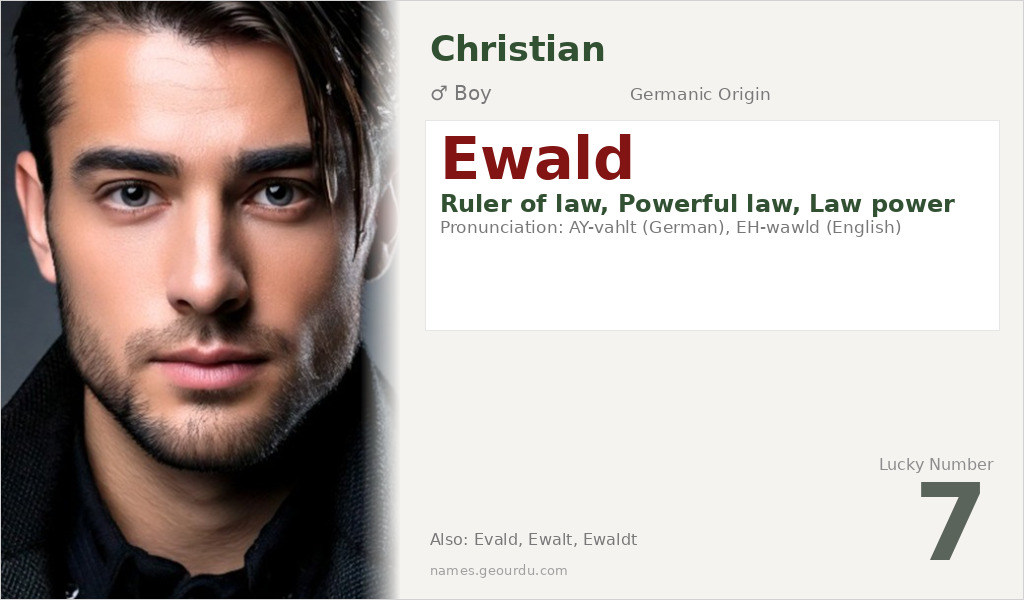
| 📛 Name | Ewald |
| 💎 Meaning | Ruler of law, Powerful law, Law power |
| 👤 Gender | Boy |
| 🕌 Religion | Christian |
| 🌍 Origin | Germanic |
| 🗣 Pronunciation | AY-vahlt (German), EH-wawld (English) |
| ✍️ Urdu | ایوالڈ |
| ✍️ Arabic | إيفالد |
| 🔢 Numerology | 7 |
| ✨ Spellings | Evald, Ewalt, Ewaldt, Ewold |
Origin & Cultural Significance
Ewald originated among Germanic tribes during the early medieval period, specifically within Old High German naming traditions. The name gained significant Christian prominence through two 7th-century Saxon missionary brothers known as Ewald the Black and Ewald the Fair, who were martyred in Westphalia while attempting to convert the pagan Saxons. Their veneration as saints in both Catholic and Orthodox traditions helped establish Ewald as a Christian name throughout German-speaking regions. While most common in Germany, Austria, and Switzerland, the name also spread to Scandinavian countries and, through immigration, to English-speaking nations. Unlike many Germanic names that fell out of use, Ewald has maintained steady, though modest, usage due to its saintly associations and classical sound.
Personality Traits
The meaning ‘ruler of law’ suggests someone with a strong sense of justice, principle, and order. People named Ewald are often perceived as reliable, structured individuals who value tradition and fairness. They may exhibit leadership qualities combined with analytical thinking, approaching challenges with methodical consideration. While potentially reserved, they typically demonstrate steadfastness in their convictions and commitments.
Similar Names
If you like Ewald, consider: Egon, Edgar, Eberhard, Waldemar, Harald
Famous People Named Ewald
- Ewald the Black and Ewald the Fair — 7th-century Saxon missionary saints martyred in Westphalia, venerated in Catholic and Orthodox traditions
- Ewald von Kleist — German field marshal during World War II
- Ewald Hering — 19th-century German physiologist known for color vision theory
- Ewald Lienen — German football manager and former player
Frequently Asked Questions About Ewald
What does Ewald mean?
Ewald means 'ruler of law' or 'powerful law', derived from Old High German elements 'ewa' (law) and 'wald' (ruler, power).
Is Ewald a boy or girl name?
Ewald is exclusively a masculine name with centuries of usage as a boy's name in Germanic cultures and Christian tradition.
What is the origin of Ewald?
Ewald originates from Old High German, specifically from Germanic naming traditions. It gained prominence through two 7th-century Saxon missionary saints and has been used primarily in German-speaking regions.





