Table of Contents
Ewald is a distinguished Germanic name with deep historical roots and a powerful meaning that has endured for centuries. Derived from Old High German elements meaning ‘law’ and ‘ruler’, this name carries connotations of justice, authority, and tradition. Particularly significant in Christian history through two 7th-century missionary saints, Ewald represents a bridge between ancient Germanic culture and Christian tradition. Today, it remains a classic choice with strong character and historical resonance.
Meaning of Ewald
The name Ewald originates from Old High German, combining two meaningful elements: ‘ewa’ (also spelled ‘ēwa’) meaning ‘law, custom, right, or ordinance’ and ‘wald’ meaning ‘ruler, power, might, or authority’. This creates the compound meaning ‘ruler of law’, ‘powerful law’, or ‘law power’. The name reflects the values of early Germanic societies where law and custom were central to social organization. Linguistically, it belongs to a category of Germanic names ending in ‘-wald’ (like Reinwald, Gerwald) that denote rulership or power. The name’s components are well-documented in historical Germanic languages and appear in various medieval texts and records.
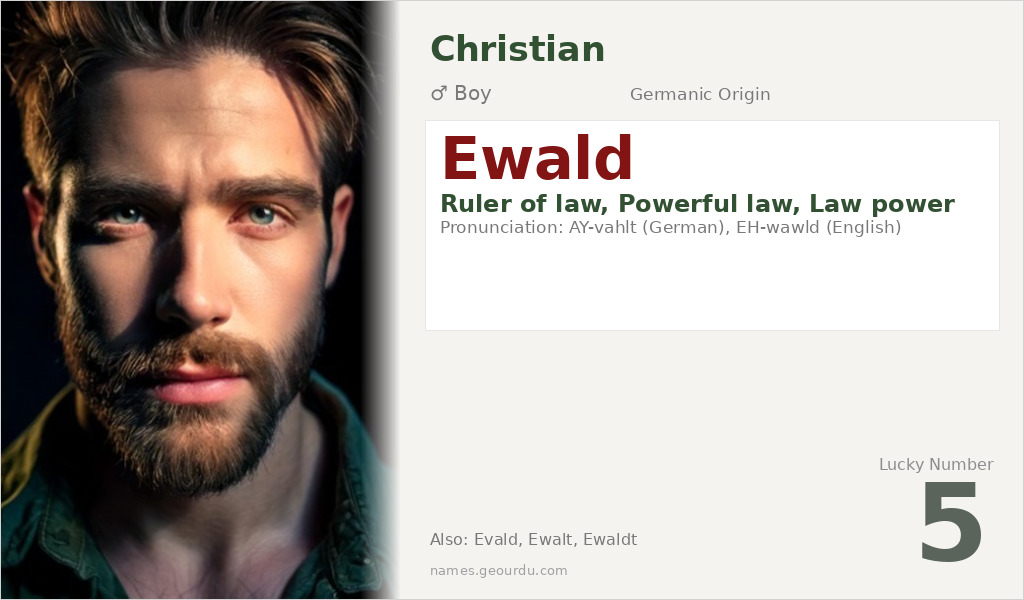
| 📛 Name | Ewald |
| 💎 Meaning | Ruler of law, Powerful law, Law power |
| 👤 Gender | Boy |
| 🕌 Religion | Christian |
| 🌍 Origin | Germanic |
| 🗣 Pronunciation | AY-vahlt (German), EH-wawld (English) |
| ✍️ Urdu | ایوالڈ |
| ✍️ Arabic | إيفالد |
| 🔢 Numerology | 5 |
| ✨ Spellings | Evald, Ewalt, Ewaldt, Ewold |
Origin & Cultural Significance
Ewald has its origins in the Germanic tribes of early medieval Europe, specifically among the Saxons. The name gained significant Christian importance through two 7th-century missionary saints known as Ewald the Black and Ewald the Fair (or Ewald the White), who were Saxon priests martyred in Westphalia while attempting to convert the pagan Saxons. Their veneration helped spread the name throughout German-speaking regions during the Christianization period. While primarily associated with German culture, the name also appears in Scandinavian countries (particularly as Evald) due to historical Germanic influences. Unlike many names that have spread globally with various cultural adaptations, Ewald has remained most closely tied to its Germanic Christian origins.
Personality Traits
Those bearing the name Ewald are often associated with qualities of leadership, integrity, and strength of character. The name’s meaning suggests someone who values justice, order, and principled decision-making. Historically, the association with missionary saints adds connotations of dedication, faith, and courage in adversity. In modern contexts, Ewald might be perceived as traditional, reliable, and somewhat formal—a name that carries weight and history rather than fleeting trends.
Similar Names
If you like Ewald, consider: Eberhard, Eckhard, Gerwald, Reinwald, Siegwald
Famous People Named Ewald
- Ewald the Black and Ewald the Fair — 7th-century Saxon missionary saints martyred in Westphalia, venerated in Catholicism
- Ewald von Kleist — German field marshal during World War II
- Ewald Hering — German physiologist known for color vision theory (Hering's opponent process theory)
Frequently Asked Questions About Ewald
What does Ewald mean?
Ewald means 'ruler of law' or 'powerful law', derived from Old High German elements 'ewa' (law) and 'wald' (ruler, power).
Is Ewald a boy or girl name?
Ewald is exclusively a masculine name with historical usage as a boy's name throughout its Germanic and Christian history.
What is the origin of Ewald?
Ewald originates from Old High German (Germanic language family) and is particularly associated with Saxon culture and Christian saints from 7th-century Germany.