
Table of Contents
Lucifer is one of the most linguistically beautiful yet culturally complex names in history. Meaning ‘light-bearer’ or ‘morning star’ in Latin, this name carries centuries of mythological, astronomical, and religious significance. While its literal meaning speaks of illumination and dawn, its association with the fallen angel in Christian tradition makes it one of the most controversial names in Western culture.
Meaning of Lucifer
The name Lucifer derives from the Latin word ‘lucifer’, which is a compound of ‘lux’ (meaning ‘light’) and ‘ferre’ (meaning ‘to bear’ or ‘to carry’). This creates the literal translation ‘light-bearer’. In classical Roman usage, Lucifer was the name for the planet Venus when it appeared as the morning star, heralding the dawn. The Latin term was used in the Vulgate Bible to translate the Hebrew word ‘helel’ (הֵילֵל) from Isaiah 14:12, which means ‘shining one’ or ‘bright one’. This Hebrew term itself may relate to the Canaanite myth of the morning star god Helel, who attempted to ascend above other deities.
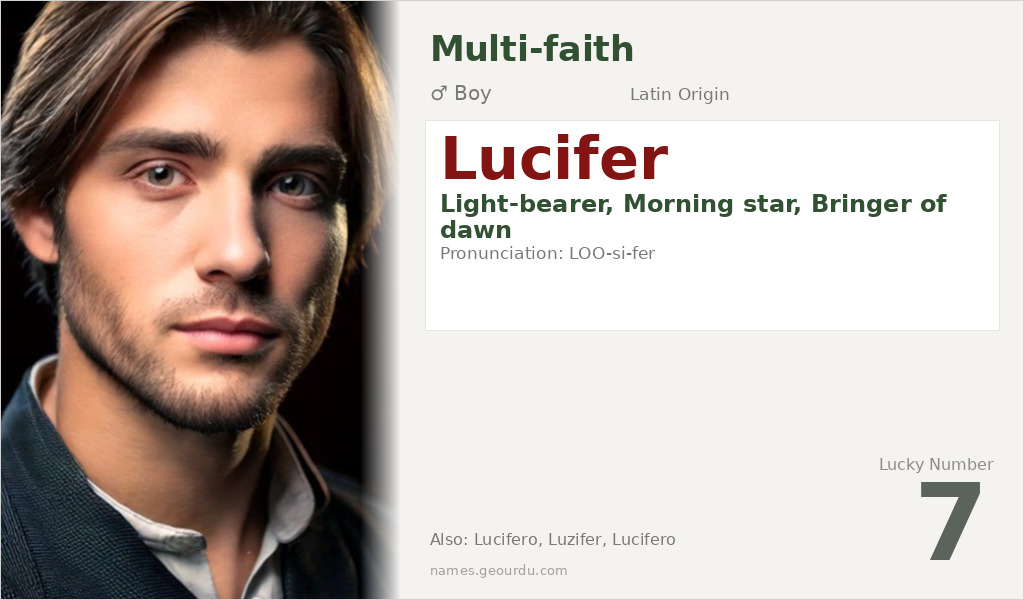
| 📛 Name | Lucifer |
| 💎 Meaning | Light-bearer, Morning star, Bringer of dawn |
| 👤 Gender | Boy |
| 🕌 Religion | Multi-faith |
| 🌍 Origin | Latin |
| 🗣 Pronunciation | LOO-si-fer |
| ✍️ Urdu | لوسیفر |
| ✍️ Arabic | لوسيفر |
| 🔢 Numerology | 7 |
| ✨ Spellings | Lucifero, Luzifer, Lucifero |
Origin & Cultural Significance
Lucifer has its roots in ancient Roman astronomy and mythology, where it referred to the planet Venus as the morning star. The name entered Christian tradition through Saint Jerome’s 4th-century Latin Vulgate translation of the Bible, where ‘Lucifer’ appeared in Isaiah 14:12. Over centuries, Christian theologians interpreted this passage as referring to Satan’s fall from heaven, transforming Lucifer from a poetic term for the morning star into a name for the devil. Despite this association, several early Christian bishops were named Lucifer, most notably Lucifer of Cagliari, a 4th-century saint who opposed Arianism. The name remains extremely rare as a given name in Christian-majority cultures due to its theological associations.
Personality Traits
The name Lucifer carries paradoxical personality associations. On one hand, its literal meaning suggests qualities of illumination, enlightenment, and guidance—traits of a bringer of light. On the other hand, its cultural baggage associates it with rebellion, pride, and fallen status. This duality might appeal to those who value names with depth and historical complexity, though it requires significant consideration of social implications. The name could attract parents seeking something truly distinctive with profound mythological roots.
Similar Names
If you like Lucifer, consider: Lucian, Lucius, Lucas, Lux, Phosphorus
Famous People Named Lucifer
- Lucifer of Cagliari — 4th century bishop and saint
- Lucifer Calaritanus — 4th century bishop known for his opposition to Arianism
Frequently Asked Questions About Lucifer
What does Lucifer mean?
Lucifer means 'light-bearer' or 'morning star' in Latin, from 'lux' (light) and 'ferre' (to bear).
Is Lucifer a boy or girl name?
Lucifer is historically a masculine name, though its extreme rarity as a given name means it has no established gender usage in modern naming practices.
What is the origin of Lucifer?
Lucifer originates from Latin, where it was the astronomical term for the planet Venus as the morning star, later adopted into Christian theology through biblical translation.





