Table of Contents
Ole is a classic Scandinavian name with deep historical roots in Norse culture. Derived from Old Norse elements meaning ‘ancestor’ and ‘descendant’, this name carries a sense of heritage and continuity. Popular throughout Norway, Denmark, and Sweden, Ole has maintained its appeal across generations while spreading to other regions through migration. Its straightforward sound and meaningful origin make it a timeless choice for parents seeking a name with cultural depth.
Meaning of Ole
The name Ole originates from the Old Norse name ‘Óláfr’ or ‘Óleifr’, which combines two elements: ‘anu’ meaning ‘ancestor’ and ‘leifr’ meaning ‘heir’, ‘descendant’, or ‘relic’. This creates the complete meaning of ‘ancestor’s descendant’ or ‘ancestor’s relic’. The name evolved through various forms including Olaf, Olav, and Ola before settling on Ole in modern Scandinavian usage. Linguistically, it belongs to the Germanic language family and shares roots with other Norse names. The name’s preservation of ancestral connection reflects the importance of lineage in Viking and medieval Scandinavian societies.
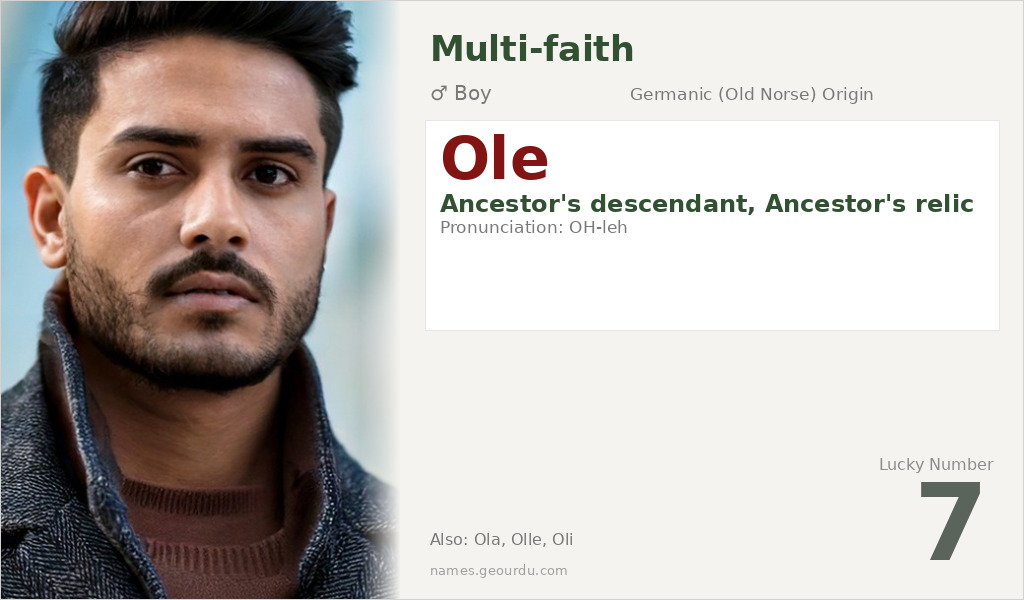
| 📛 Name | Ole |
| 💎 Meaning | Ancestor's descendant, Ancestor's relic |
| 👤 Gender | Boy |
| 🕌 Religion | Multi-faith |
| 🌍 Origin | Germanic (Old Norse) |
| 🗣 Pronunciation | OH-leh |
| ✍️ Urdu | اولے |
| ✍️ Arabic | أولي |
| 🔢 Numerology | 7 |
| ✨ Spellings | Ola, Olle, Oli, Olaf, Oluf |
Origin & Cultural Significance
Ole has its origins in medieval Scandinavia, particularly among Norse-speaking populations. The name gained prominence through historical figures like King Olaf II of Norway (Saint Olaf), who played a significant role in Norway’s Christianization. While the name predates Christianity in Scandinavia, it became associated with Christian saints and royalty during the Middle Ages. Today, it remains most common in Norway, Denmark, Sweden, and among Scandinavian diaspora communities worldwide. The name’s spread reflects both Viking expansion and later Scandinavian emigration patterns.
Personality Traits
Those named Ole often exhibit traits associated with their Norse heritage—practicality, resilience, and a connection to tradition. They tend to be dependable individuals who value stability and family connections. Many display a quiet confidence and methodical approach to challenges, reflecting the name’s historical association with leadership and heritage preservation.
Similar Names
If you like Ole, consider: Olaf, Oliver, Olav, Olin, Oleg
Famous People Named Ole
- Ole Gunnar Solskjær — Norwegian football manager and former player, known for playing for Manchester United
- Ole Edvart Rølvaag — Norwegian-American novelist known for 'Giants in the Earth'
Frequently Asked Questions About Ole
What does Ole mean?
Ole means 'ancestor's descendant' or 'ancestor's relic', derived from Old Norse elements 'anu' (ancestor) and 'leifr' (heir, descendant).
Is Ole a boy or girl name?
Ole is traditionally and almost exclusively a masculine name in Scandinavian cultures where it originates.
What is the origin of Ole?
Ole originates from Old Norse (Germanic language family) and is most strongly associated with Scandinavian countries, particularly Norway, Denmark, and Sweden.