
Table of Contents
Martel is a powerful masculine name with deep historical roots and a meaning that evokes strength and resilience. Derived from the Old French word for ‘hammer’, this name carries the legacy of one of Europe’s most significant military leaders. While often associated with Christian contexts due to historical figures, Martel transcends religious boundaries as a name symbolizing determination and capability. Its straightforward pronunciation and strong connotations make it a distinctive choice with centuries of heritage.
Meaning of Martel
The name Martel has a clear and well-documented meaning: ‘hammer’ or ‘hammer-wielder’. This originates from the Old French ‘martel’, which itself derives from the Late Latin ‘martellus’ meaning ‘hammer’. The Latin term is a diminutive of ‘martulus’, related to the classical Latin ‘marcus’ (hammer). Historically, the name gained prominence through Charles Martel (‘Charles the Hammer’), the Frankish leader who stopped the Umayyad advance into Western Europe at the Battle of Tours in 732 CE. This etymological chain demonstrates how the name evolved from a descriptive occupational term into a proper name symbolizing strength and martial prowess. Unlike many names that have ambiguous or multiple interpretations, Martel maintains this singular, powerful meaning across linguistic transitions.
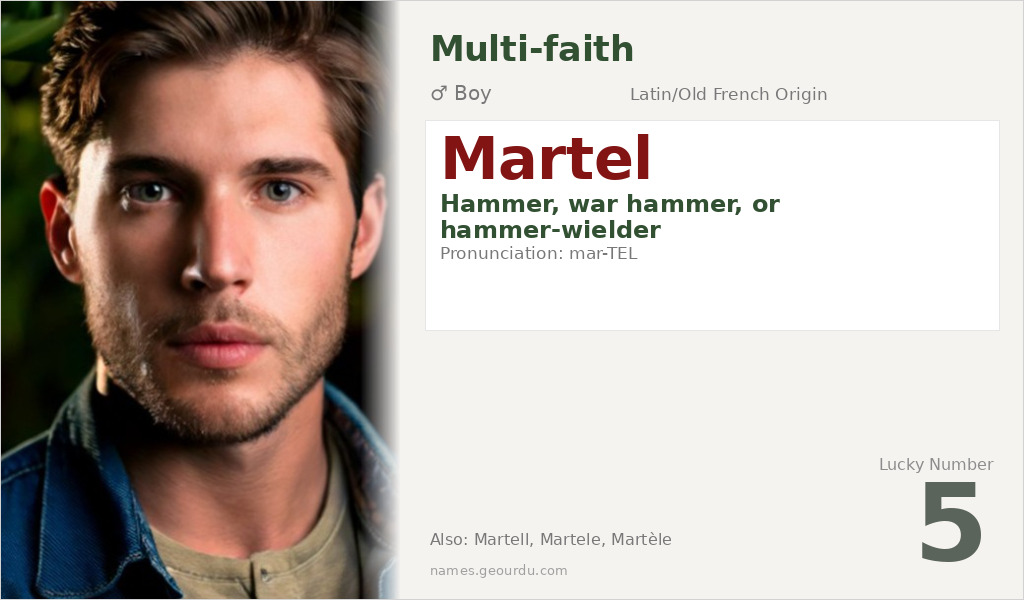
| 📛 Name | Martel |
| 💎 Meaning | Hammer, war hammer, or hammer-wielder |
| 👤 Gender | Boy |
| 🕌 Religion | Multi-faith |
| 🌍 Origin | Latin/Old French |
| 🗣 Pronunciation | mar-TEL |
| ✍️ Urdu | مارٹیل |
| ✍️ Arabic | مارتل |
| 🔢 Numerology | 5 |
| ✨ Spellings | Martell, Martele, Martèle |
Origin & Cultural Significance
Martel originates from Latin through Old French, emerging as a surname before becoming a given name. Its most famous historical bearer, Charles Martel, established the name’s association with military strength and leadership in 8th-century Francia. While the name appears in Christian European contexts due to this history, it is not inherently religious and has been used across various cultural settings. The name spread through Frankish and later French influence, with variations appearing in different European languages. Today, Martel functions as both a surname and given name in multiple countries, particularly in French-speaking regions and among those appreciating its historical significance. Its adoption reflects appreciation for names with clear meanings and historical weight rather than religious exclusivity.
Personality Traits
The name Martel suggests personality traits aligned with its meaning of ‘hammer’—strength, resilience, and the ability to shape outcomes through determined effort. Those named Martel are often perceived as practical problem-solvers who approach challenges directly rather than avoiding them. The historical association with Charles Martel adds connotations of leadership, strategic thinking, and the capacity to protect what matters. While names don’t determine personality, the strong, unambiguous meaning of Martel may influence how bearers and others perceive these qualities.
Similar Names
If you like Martel, consider: Marcel, Martin, Martino, Martyn, Martialis
Famous People Named Martel
- Charles Martel (c. 688-741) — Frankish military leader and grandfather of Charlemagne, known as 'The Hammer' for his victory at the Battle of Tours
- Martel (band) — American Christian rock band formed in 2001
Frequently Asked Questions About Martel
What does Martel mean?
Martel means 'hammer' or 'hammer-wielder', derived from Old French and Latin roots. The name gained historical significance through Charles Martel ('Charles the Hammer'), the 8th-century Frankish military leader.
Is Martel a boy or girl name?
Martel is traditionally and almost exclusively a masculine name. Its historical bearers and linguistic formation as a descriptor of strength and warfare align it with male naming conventions across cultures where it appears.
What is the origin of Martel?
Martel originates from Old French 'martel' (hammer), which comes from Late Latin 'martellus'. The name became prominent through Charles Martel in 8th-century Francia and has since been used as both a surname and given name in various European contexts.





