
Table of Contents
Abraham is one of history’s most significant names, carrying profound religious and cultural weight across multiple traditions. As the name of the biblical patriarch revered in Judaism, Christianity, and Islam, it represents faith, covenant, and lineage. This timeless name continues to be popular worldwide, connecting modern bearers to ancient spiritual heritage while maintaining its powerful meaning of ‘father of many nations.’
Meaning of Abraham
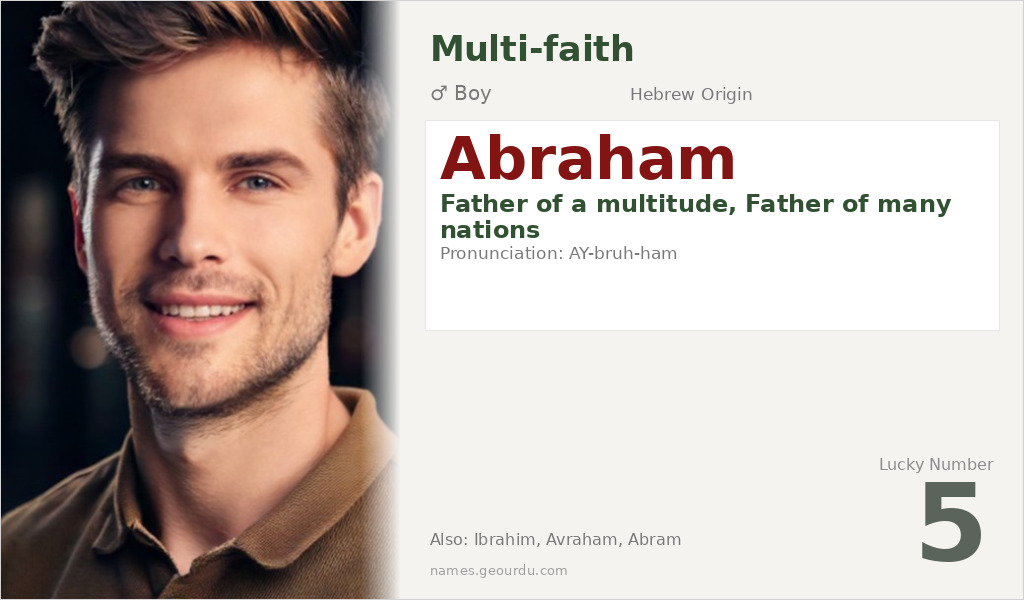
The name Abraham derives from the Hebrew אַבְרָהָם (Avraham), a compound of ‘av’ (father) and ‘raham’ (multitude), literally meaning ‘father of a multitude’ or ‘father of many nations.’ This etymology is explicitly explained in the Hebrew Bible (Genesis 17:5) when God changes Abram’s name to Abraham as part of establishing His covenant. The name’s meaning reflects the divine promise that Abraham would become the ancestor of numerous descendants. Linguistically, the Hebrew root ר-ה-ם (r-h-m) relates to abundance and multiplicity, while ‘av’ is a common Semitic element for father. This precise meaning has been preserved through millennia in Jewish, Christian, and Islamic traditions.
| 📛 Name | Abraham |
| 💎 Meaning | Father of a multitude, Father of many nations |
| 👤 Gender | Boy |
| 🕌 Religion | Multi-faith |
| 🌍 Origin | Hebrew |
| 🗣 Pronunciation | AY-bruh-ham |
| ✍️ Urdu | ابراہیم |
| ✍️ Arabic | إبراهيم |
| 🔢 Numerology | 5 |
| ✨ Spellings | Ibrahim, Avraham, Abram, Ebrahim, Ibraheem |
Origin & Cultural Significance
Abraham originates from ancient Hebrew culture as the name of the first patriarch in the Abrahamic religions. The name appears in the Torah as the founder of the covenant between God and the Jewish people, in the Christian Bible as a figure of faith mentioned prominently by Paul in the New Testament, and in the Quran as Prophet Ibrahim, one of the most important prophets in Islam. The Arabic form Ibrahim (إبراهيم) became widely used across the Muslim world, while European languages adopted variations like Abraham through Greek (Αβραάμ) and Latin translations. Despite its Hebrew origins, the name has been fully integrated into Islamic naming traditions due to Ibrahim’s central role in Islamic scripture and theology.
Personality Traits
Those named Abraham often embody characteristics associated with their namesake: faithfulness, leadership, and resilience. They tend to be principled individuals who value tradition while sometimes pioneering new paths. The name’s historical weight can inspire a sense of purpose and connection to something larger than oneself. Many Abrahams demonstrate strong family values and moral conviction, reflecting the patriarchal associations of their name’s meaning.
Similar Names
If you like Abraham, consider: Ibrahim, Abram, Isaac, Jacob, Joseph
Famous People Named Abraham
- Abraham Lincoln — 16th President of the United States who led the nation through the Civil War and abolished slavery
- Abraham (Biblical Patriarch) — Central figure in Judaism, Christianity, and Islam, considered the father of the Abrahamic faiths
Frequently Asked Questions About Abraham
What does Abraham mean?
Abraham means 'father of a multitude' or 'father of many nations' in Hebrew, from the elements 'av' (father) and 'raham' (multitude).
Is Abraham a boy or girl name?
Abraham is exclusively a masculine name across all cultural contexts where it is used, from its biblical origins to modern usage worldwide.
What is the origin of Abraham?
Abraham originates from ancient Hebrew as the name of the biblical patriarch, with the name appearing in the Torah, Bible, and Quran, making it significant in Judaism, Christianity, and Islam.





