Table of Contents
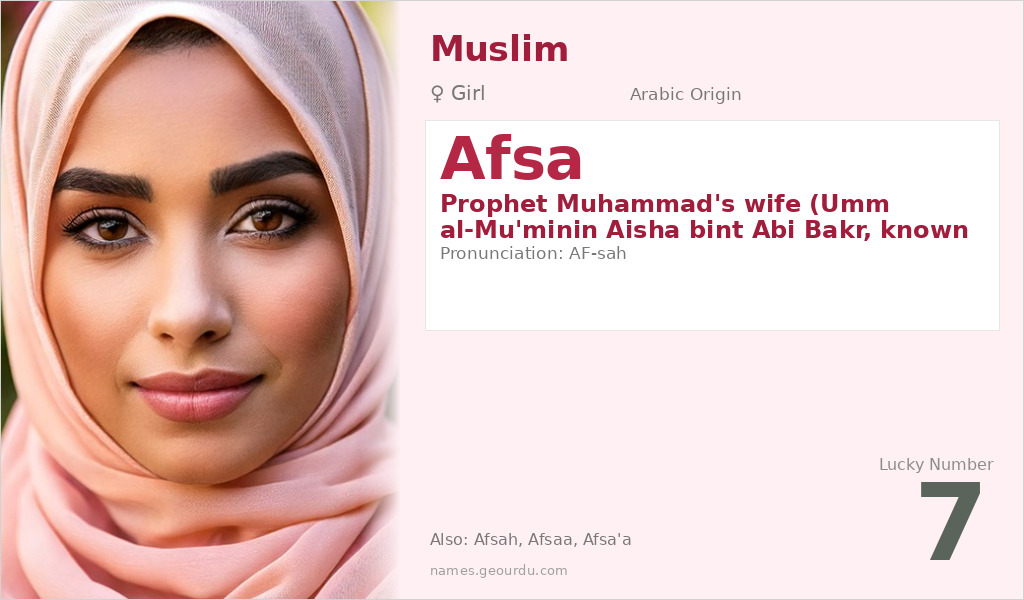
Afsa is a beautiful and meaningful name deeply rooted in Islamic heritage, primarily used for girls in Muslim communities worldwide. Derived from Arabic, it serves as a tribute to Aisha bint Abi Bakr, one of Prophet Muhammad’s wives and a revered figure in Islamic history. This name embodies qualities of wisdom, faith, and resilience, making it a popular choice among parents seeking a name with religious significance. In this guide, we explore the origins, meaning, and cultural context of Afsa.
Meaning of Afsa
The name Afsa originates from the Arabic language, where it is closely associated with Aisha (عائشة), the daughter of Abu Bakr and wife of Prophet Muhammad. Etymologically, it stems from the root ‘afs’ (أفس), which conveys notions of abundance and multiplication. In Islamic tradition, Aisha is often honored with the title ‘al-Siddiqa’ (the truthful) and is remembered for her extensive contributions to Hadith literature. Afsa functions as a diminutive or affectionate form of Aisha, particularly in South Asian cultures like Pakistan and India, where it has evolved into an independent given name. The name symbolizes piety, knowledge, and maternal strength, reflecting Aisha’s role as a teacher and leader in early Islam.
| 📛 Name | Afsa |
| 💎 Meaning | Prophet Muhammad's wife (Umm al-Mu'minin Aisha bint Abi Bakr, known as Aisha al-Siddiqa) |
| 👤 Gender | Girl |
| 🕌 Religion | Muslim |
| 🌍 Origin | Arabic |
| 🗣 Pronunciation | AF-sah |
| ✍️ Urdu | افسا |
| ✍️ Arabic | أفسا |
| 🔢 Numerology | 7 |
| ✨ Spellings | Afsah, Afsaa, Afsa'a |
Origin & Cultural Significance
Afsa has its origins in 7th-century Arabia, emerging from the Islamic tradition centered around the life of Prophet Muhammad. It gained prominence as a reference to Aisha bint Abi Bakr, who played a crucial role in the dissemination of Islamic teachings after the Prophet’s death. Over centuries, the name spread across the Muslim world through trade, migration, and cultural exchange, especially in regions like South Asia, where Arabic names were adapted into local languages such as Urdu and Persian. Today, Afsa is predominantly used in countries like Pakistan, India, Bangladesh, and among diaspora communities, often chosen for its religious resonance and historical depth. It remains a testament to the enduring legacy of early Muslim women in Islamic history.
Personality Traits
Those named Afsa are often seen as insightful and devout, with a natural inclination toward learning and spiritual growth. Inspired by the historical figure Aisha, they may display strong communicative skills and a nurturing demeanor, making them effective in roles that involve teaching or community leadership. Their personality is frequently characterized by a blend of traditional values and modern adaptability, allowing them to navigate diverse social settings with grace and confidence.
Similar Names
If you like Afsa, consider: Aisha, Asma, Fatima, Khadija, Zainab
Famous People Named Afsa
- Afsa Ahmed — Pakistani television actress known for roles in Urdu dramas
- Afsa Butt — Social media influencer and content creator from Pakistan
Frequently Asked Questions About Afsa
What does Afsa mean?
Afsa is an Arabic name meaning 'Prophet Muhammad's wife Aisha,' derived from the root 'afs' indicating abundance. It is a diminutive form honoring Aisha bint Abi Bakr, a key figure in Islamic history.
Is Afsa a boy or girl name?
Afsa is exclusively a girl name in all cultural contexts where it is used, particularly within Muslim communities, as it refers to a female historical figure.
What is the origin of Afsa?
Afsa originates from Arabic, specifically from early Islamic tradition in Arabia, and is associated with Aisha, the wife of Prophet Muhammad. It has since been adopted in various Muslim cultures, especially in South Asia.