Table of Contents
Asma is a beautiful Arabic name with deep historical roots and profound meaning. Carrying connotations of elevation and nobility, this name has been cherished for centuries across the Muslim world and beyond. From early Islamic history to modern times, Asma represents dignity, strength, and high status. Let’s explore the rich linguistic and cultural heritage of this timeless name.
Meaning of Asma
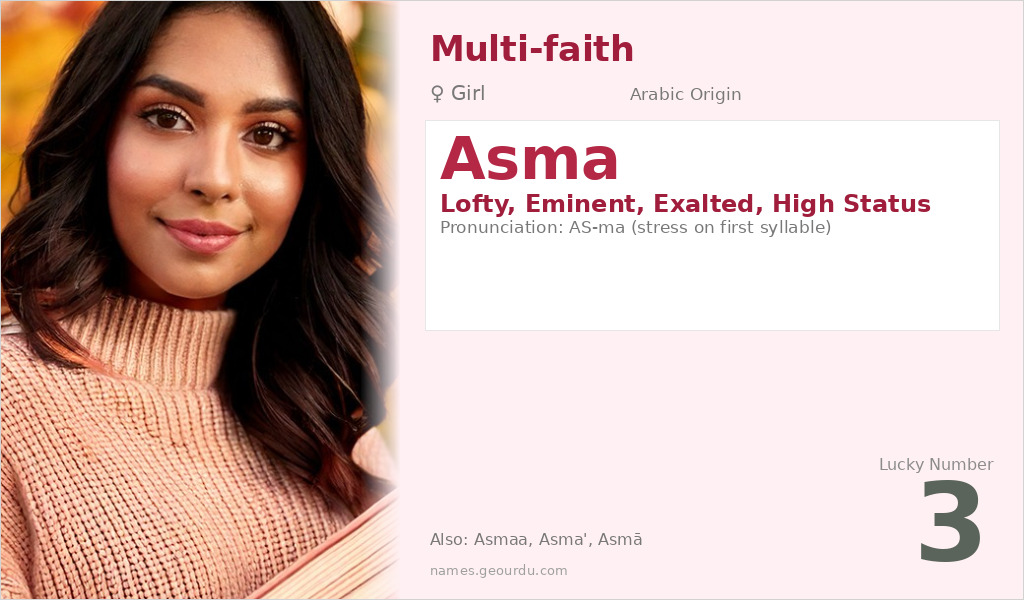
The name Asma originates from the Arabic root ‘s-m-w’ (س-م-و), which relates to height, elevation, and loftiness. As the feminine form of ‘A’la’ meaning ‘highest,’ Asma specifically denotes someone or something that is eminent, exalted, or of high status. In classical Arabic usage, the term describes both physical height and metaphorical elevation in rank or character. The name gained particular prominence through Asma bint Abu Bakr, whose noble qualities embodied the meaning of her name. Linguistically, it represents one of the most positive attributes in Arabic naming traditions, emphasizing dignity and excellence.
| 📛 Name | Asma |
| 💎 Meaning | Lofty, Eminent, Exalted, High Status |
| 👤 Gender | Girl |
| 🕌 Religion | Multi-faith |
| 🌍 Origin | Arabic |
| 🗣 Pronunciation | AS-ma (stress on first syllable) |
| ✍️ Urdu | اسماء |
| ✍️ Arabic | أسماء |
| 🔢 Numerology | 3 |
| ✨ Spellings | Asmaa, Asma', Asmā, Asmah |
Origin & Cultural Significance
Asma has its origins in pre-Islamic Arabic culture but gained significant prominence during early Islam. The most famous historical bearer, Asma bint Abu Bakr (c. 595-692 CE), was the daughter of the first caliph and played crucial roles in Islamic history, including assisting Prophet Muhammad during the Hijrah. Her legacy cemented the name’s popularity across the Muslim world. While primarily used in Arabic-speaking regions, the name spread through Islamic expansion to Persian, Turkish, Urdu, and other Muslim cultures. Today, it remains popular across the Middle East, South Asia, and among Muslim communities worldwide, maintaining its classical elegance while adapting to modern contexts.
Personality Traits
Those named Asma often carry themselves with natural grace and authority that reflects their name’s meaning of ‘lofty’ or ‘exalted.’ They tend to be principled individuals with strong moral compasses and leadership capabilities. While ambitious and goal-oriented, they typically combine their drive with compassion and dignity. The historical association with Asma bint Abu Bakr—known for her courage, loyalty, and resilience—has created cultural expectations of strength and nobility for bearers of this name.
Similar Names
If you like Asma, consider: Aaliyah, Samira, Sumaya, Alia, Rafia
Famous People Named Asma
- Asma bint Abu Bakr — Early Muslim figure, daughter of first caliph, known as 'Dhat al-Nitaqayn' (She of the Two Belts) for her role in the Hijrah
- Asma al-Assad — First Lady of Syria
- Asma Jahangir — Pakistani human rights lawyer and social activist
- Asma Lamnawar — Moroccan singer
- Asma Barlas — Pakistani-American scholar of Islam and politics
Frequently Asked Questions About Asma
What does Asma mean?
Asma means 'lofty,' 'eminent,' 'exalted,' or 'high status' in Arabic, derived from the root word meaning height or elevation.
Is Asma a boy or girl name?
Asma is exclusively a feminine name in Arabic and Islamic naming traditions, being the feminine form of 'A'la' (highest).
What is the origin of Asma?
Asma originates from classical Arabic language and culture, with its most famous early bearer being Asma bint Abu Bakr in 7th century Arabia during the early Islamic period.