
Table of Contents
Airawat is a powerful and ancient name with deep roots in Hindu mythology and Sanskrit tradition. Meaning ‘the celestial white elephant of Indra,’ this name carries connotations of strength, purity, and divine protection. Often chosen for boys in Hindu families, Airawat connects the bearer to one of the most revered mythological creatures in Indian culture. Its rich history and symbolic meaning make it a distinctive choice with profound cultural resonance.
Meaning of Airawat
The name Airawat derives from Sanskrit, where it is properly spelled Airavata. It combines ‘aira’ (ocean/water) and ‘vata’ (born), literally meaning ‘ocean-born’ or ‘born from the waters.’ This refers directly to the mythological origin story where Airawat emerged during the churning of the cosmic ocean (Samudra Manthan). In Hindu scriptures like the Puranas and epics, Airawat is described as a magnificent white elephant with four tusks and sometimes seven trunks, who became the vahana (divine vehicle) of Indra, the king of the gods. The name thus embodies themes of creation, purity, and celestial power, with the white elephant symbolizing rain clouds and fertility in some interpretations.
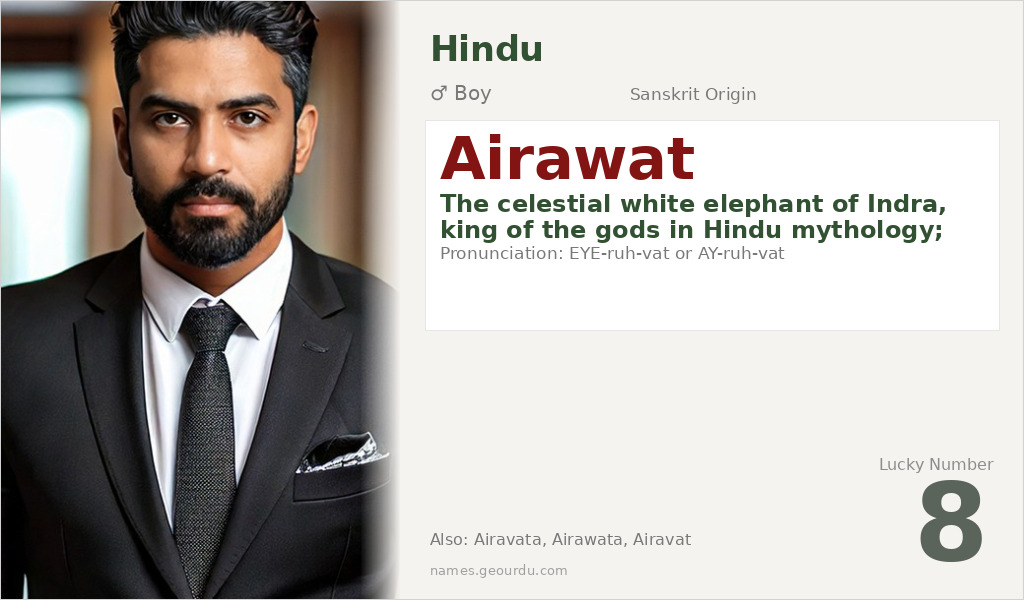
| 📛 Name | Airawat |
| 💎 Meaning | The celestial white elephant of Indra, king of the gods in Hindu mythology; also means 'born from the ocean' or 'ocean-born' |
| 👤 Gender | Boy |
| 🕌 Religion | Hindu |
| 🌍 Origin | Sanskrit |
| 🗣 Pronunciation | EYE-ruh-vat or AY-ruh-vat |
| ✍️ Urdu | ایراوت |
| ✍️ Arabic | أيرافاتا |
| 🔢 Numerology | 8 |
| ✨ Spellings | Airavata, Airawata, Airavat, Erawat, Eravata |
Origin & Cultural Significance
Airawat originates from ancient Sanskrit texts and Hindu mythology, dating back thousands of years to Vedic and Puranic literature. It is primarily used within Hindu communities across India, Nepal, and the diaspora, particularly among those who value mythological and traditional names. The name appears in sacred texts like the Mahabharata and various Puranas, where Airawat plays a significant role in cosmological narratives. While predominantly a Hindu name, its usage has occasionally crossed into other Indian cultural contexts due to the shared mythological heritage. The name remains relatively rare but carries substantial cultural weight when chosen.
Personality Traits
Those named Airawat are often associated with qualities of strength, dignity, and protective nature, mirroring the mythological elephant’s role as a divine guardian. They may exhibit calm authority, reliability, and a deep sense of loyalty to family and community. The name suggests a person who approaches challenges with steady determination and brings stability to their surroundings, much like the steadfast elephant of legend.
Similar Names
If you like Airawat, consider: Indra, Gajendra, Hasti, Varuna, Kuvera
Famous People Named Airawat
- Airavata — Mythological white elephant in Hindu scriptures, vehicle of Indra
- Airavata (band) — Indian classical fusion music group named after the mythological elephant
Frequently Asked Questions About Airawat
What does Airawat mean?
Airawat means 'the celestial white elephant of Indra' in Sanskrit, specifically referring to the mythological elephant born from the churning of the cosmic ocean. It also means 'ocean-born' or 'born from the waters.'
Is Airawat a boy or girl name?
Airawat is exclusively a boy's name in Hindu naming tradition, associated with masculine mythological figures and used for male children.
What is the origin of Airawat?
Airawat originates from Sanskrit and Hindu mythology, with its first recorded usage in ancient Indian texts like the Puranas and epics. It is deeply rooted in Hindu cultural and religious traditions.





