
Table of Contents
Alston is a distinguished masculine name with deep roots in English history and topography. Originally a surname derived from place names in England, it has evolved into a meaningful given name carrying connotations of nobility and natural strength. With its Old English origins, Alston offers a connection to ancient linguistic traditions while maintaining contemporary appeal for parents seeking a name with historical depth and solid character.
Meaning of Alston
The name Alston has two primary interpretations from Old English etymology. The most widely accepted meaning combines ‘Æðel’ (meaning noble, aristocratic) with ‘stān’ (meaning stone), resulting in ‘noble stone’. An alternative interpretation combines ‘Ælf’ (meaning elf, supernatural being) with ‘stān’, giving ‘elf stone’. Both interpretations reflect the name’s origin as a locational surname describing geographical features. The ‘-ston’ element is particularly common in English place names, indicating rocky or stony terrain. As a given name, Alston carries these elemental meanings forward, suggesting qualities of strength, permanence, and either noble character or mystical connection depending on the root interpretation.
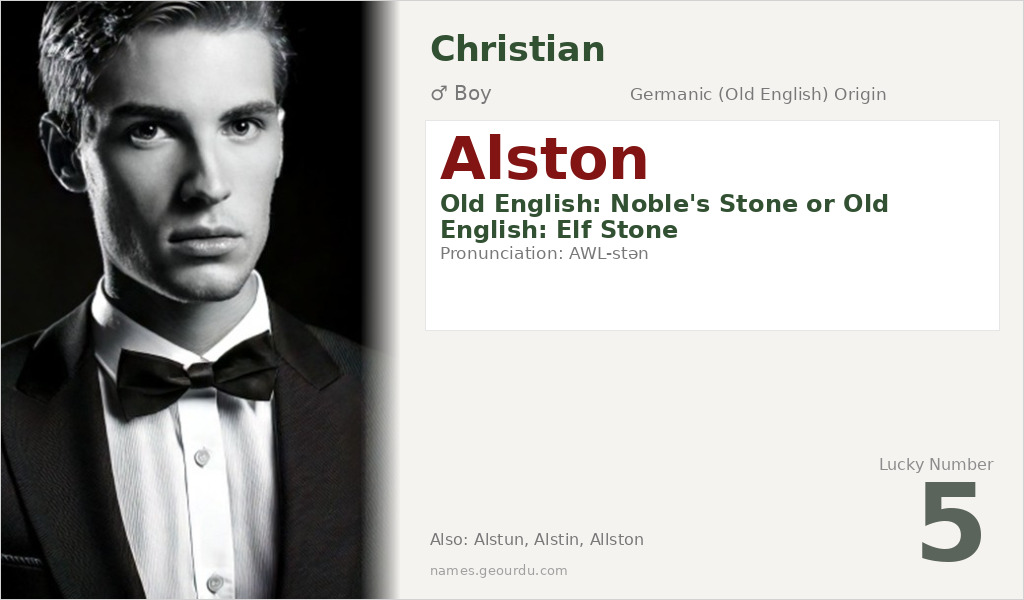
| 📛 Name | Alston |
| 💎 Meaning | Old English: Noble's Stone or Old English: Elf Stone |
| 👤 Gender | Boy |
| 🕌 Religion | Christian |
| 🌍 Origin | Germanic (Old English) |
| 🗣 Pronunciation | AWL-stən |
| ✍️ Urdu | السٹن |
| ✍️ Arabic | ألستون |
| 🔢 Numerology | 5 |
| ✨ Spellings | Alstun, Alstin, Allston |
Origin & Cultural Significance
Alston originated as a toponymic surname in medieval England, derived from places named Alston in Cumbria and Devon. The Cumbrian Alston was recorded in the 12th century as ‘Aldeneston’, meaning ‘Ælfsige’s settlement’, showing the name’s evolution over time. During the Middle Ages, such locational surnames became hereditary and eventually transitioned into given names, particularly in English-speaking Christian communities. The name spread through British colonization and migration, maintaining its strongest presence in England, Scotland, and former British colonies. While primarily associated with Christian communities due to its European origins, Alston has no specific religious connotations beyond this cultural context.
Personality Traits
Those named Alston are often associated with the steadfast qualities suggested by the ‘stone’ element of their name. They tend to be reliable, practical individuals who approach life with determination and consistency. The ‘noble’ or ‘elf’ prefix adds either an air of dignified character or imaginative spirit to their personality. This combination typically results in people who are both grounded in reality and capable of visionary thinking when circumstances require it.
Similar Names
If you like Alston, consider: Alton, Alvin, Alfred, Alistair, Alden
Famous People Named Alston
- Alston Housego — British diplomat and colonial administrator in India
- Alston Scott Householder — American mathematician known for Householder transformation
Frequently Asked Questions About Alston
What does Alston mean?
Alston means 'Noble Stone' or alternatively 'Elf Stone' in Old English, derived from the elements 'Æðel' (noble) or 'Ælf' (elf) combined with 'stān' (stone).
Is Alston a boy or girl name?
Alston is traditionally and predominantly a masculine name, though as with many surnames-turned-given-names, it could theoretically be used for any gender. Historically and culturally, it has been used almost exclusively for boys.
What is the origin of Alston?
Alston originates from Old English as a locational surname derived from places in England named Alston, particularly in Cumbria. It evolved from describing geographical features to becoming a hereditary surname and eventually a given name.





