
Table of Contents
Anantha is a profound Sanskrit name that carries the beautiful meaning of ‘endless’ or ‘eternal’. Rooted in ancient Hindu philosophy and mythology, this name has been cherished for centuries across Indian communities. While often associated with spiritual concepts of infinity and cosmic continuity, Anantha remains a meaningful choice for parents seeking a name with deep philosophical resonance. Its unisex nature makes it versatile for both boys and girls in Hindu naming traditions.
Meaning of Anantha
Anantha derives directly from the Sanskrit word ‘ananta’ (अनन्त), which combines the negative prefix ‘an-‘ (meaning ‘not’ or ‘without’) with ‘anta’ (meaning ‘end’ or ‘boundary’). This creates the literal meaning of ‘endless’, ‘eternal’, ‘infinite’, or ‘without end’. The term appears extensively in Hindu scriptures, most notably in reference to Ananta Shesha, the thousand-headed cosmic serpent who supports the universe and serves as the divine bed for Lord Vishnu. In philosophical contexts, ‘ananta’ represents the boundless nature of consciousness, time, and existence. The name’s etymology is well-documented in Sanskrit lexicons and religious texts, making its meaning unambiguous and deeply rooted in Indian spiritual tradition.
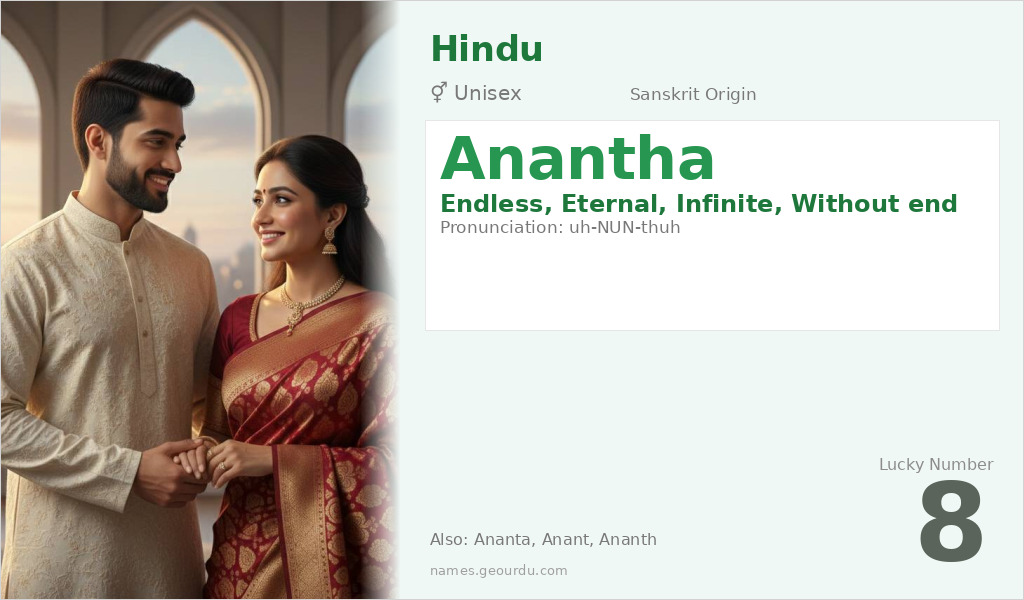
| 📛 Name | Anantha |
| 💎 Meaning | Endless, Eternal, Infinite, Without end |
| 👤 Gender | Unisex |
| 🕌 Religion | Hindu |
| 🌍 Origin | Sanskrit |
| 🗣 Pronunciation | uh-NUN-thuh |
| ✍️ Urdu | اننتھا |
| ✍️ Arabic | أنانثا |
| 🔢 Numerology | 8 |
| ✨ Spellings | Ananta, Anant, Ananth, Anantha |
Origin & Cultural Significance
Anantha originates from Sanskrit, the classical language of ancient India and the primary liturgical language of Hinduism. The name has been used for centuries within Hindu communities across the Indian subcontinent and diaspora. Its most famous mythological association is with Ananta Shesha, the cosmic serpent who represents eternity and supports the universe in Hindu cosmology. While the name appears in various regional forms across India (such as Anant in Hindi, Anantha in Tamil and Telugu), it maintains its core Sanskrit meaning. The name’s usage extends beyond personal names to philosophical concepts, with ‘ananta’ appearing in discussions of infinity in Hindu, Buddhist, and Jain traditions.
Personality Traits
Those named Anantha often embody qualities suggested by their name’s meaning—they tend to be patient, philosophical, and spiritually inclined individuals. The concept of ‘endlessness’ in their name frequently manifests as remarkable perseverance and the ability to maintain perspective during challenges. Many Ananthas demonstrate a natural curiosity about life’s bigger questions and exhibit a calm, steady demeanor that others find reassuring. While personality traits vary by individual, the name’s association with cosmic continuity and infinite potential often influences how bearers are perceived within their cultural contexts.
Similar Names
If you like Anantha, consider: Anant, Akshaya, Amara, Aviral, Nitya
Famous People Named Anantha
- Anantha Padmanabhan — Indian astrophysicist and cosmologist known for his work on dark energy and structure formation in the universe
- Anantha N. Rajan — Indian film director and screenwriter in Tamil cinema
Frequently Asked Questions About Anantha
What does Anantha mean?
Anantha means 'endless', 'eternal', 'infinite', or 'without end'. It comes from the Sanskrit word 'ananta', combining 'an-' (without) and 'anta' (end).
Is Anantha a boy or girl name?
Anantha is traditionally a unisex name in Hindu culture, used for both boys and girls. While it appears for both genders, in some regions it may be more common for one gender than the other.
What is the origin of Anantha?
Anantha originates from Sanskrit, the classical language of ancient India. It has deep roots in Hindu mythology and philosophy, most famously associated with Ananta Shesha, the cosmic serpent who supports the universe.