
Table of Contents
Antim is a distinctive boy’s name with deep roots in Sanskrit and Hindu culture, meaning ‘final’, ‘last’, or ‘ultimate’. It evokes a sense of completion and philosophical depth, often chosen for its spiritual connotations. This name has gained modern recognition through notable athletes and remains a meaningful choice for parents seeking a name with traditional resonance. Explore the rich etymology and cultural context of Antim in this detailed guide.
Meaning of Antim
Antim originates from the Sanskrit word ‘antima’, derived from the root ‘anta’ meaning ‘end’ or ‘boundary’. In Sanskrit linguistics, the suffix ‘-ima’ forms adjectives, giving ‘antima’ the meaning of ‘final’ or ‘ultimate’. This name is well-documented in ancient Hindu texts, such as the Vedas and Upanishads, where it appears in contexts like ‘antim kriya’ (final rites) or ‘antim satya’ (ultimate truth). It carries a profound philosophical weight, often associated with concepts of mortality, spirituality, and the cyclical nature of existence in Hindu thought. Unlike many names, Antim has a clear, unambiguous meaning with no significant variations across Indian languages, maintaining its core sense of ‘last’ in Hindi and other derivatives.
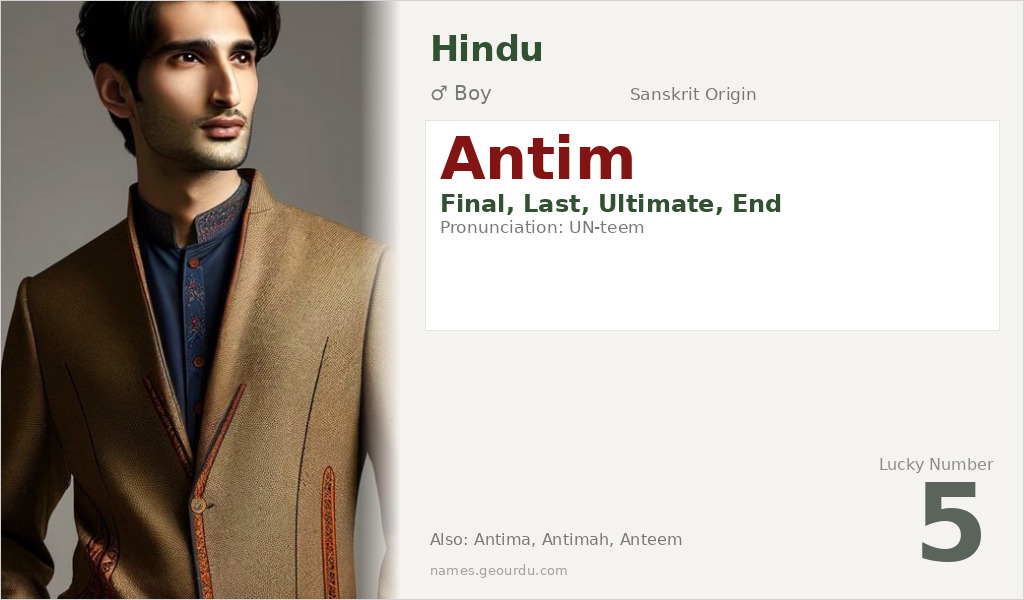
| 📛 Name | Antim |
| 💎 Meaning | Final, Last, Ultimate, End |
| 👤 Gender | Boy |
| 🕌 Religion | Hindu |
| 🌍 Origin | Sanskrit |
| 🗣 Pronunciation | UN-teem |
| ✍️ Urdu | انتیم |
| ✍️ Arabic | أنتيم |
| 🔢 Numerology | 5 |
| ✨ Spellings | Antima, Antimah, Anteem |
Origin & Cultural Significance
Antim has its origins in Sanskrit, the classical language of ancient India, and is primarily used within Hindu communities. It reflects Hindu philosophical themes, such as the concept of ‘antim yatra’ (final journey) referring to death or spiritual liberation. Historically, the name appears in religious and literary contexts, emphasizing endings and transitions. In modern times, it is used across India and the diaspora, often chosen for its spiritual depth rather than regional specificity. While it is not commonly found in other language families like Arabic or Persian, its Sanskrit roots ensure it remains firmly tied to Hindu cultural and religious traditions.
Personality Traits
People named Antim are often perceived as thoughtful and introspective, with a natural curiosity about life’s bigger questions. They may demonstrate resilience and a pragmatic approach, viewing endings as opportunities for growth and renewal. Their name’s meaning can inspire a sense of purpose and finality in their actions, making them determined and focused individuals who value meaningful conclusions in both personal and professional spheres.
Similar Names
If you like Antim, consider: Anant, Akhil, Aditya, Arjun, Vishnu
Famous People Named Antim
- Antim Panghal — Indian freestyle wrestler, 2023 World Championships bronze medalist
- Antim Tyagi — Indian cricketer who played for Delhi in domestic cricket
Frequently Asked Questions About Antim
What does Antim mean?
Antim means 'final', 'last', 'ultimate', or 'end'. It is derived from the Sanskrit word 'antima', with the root 'anta' meaning 'end'.
Is Antim a boy or girl name?
Antim is traditionally a boy's name in Hindu culture, though names can sometimes be used unisexually in modern contexts. Its usage is predominantly male.
What is the origin of Antim?
Antim originates from Sanskrit, an ancient Indian language, and is deeply rooted in Hindu traditions and philosophy.





